

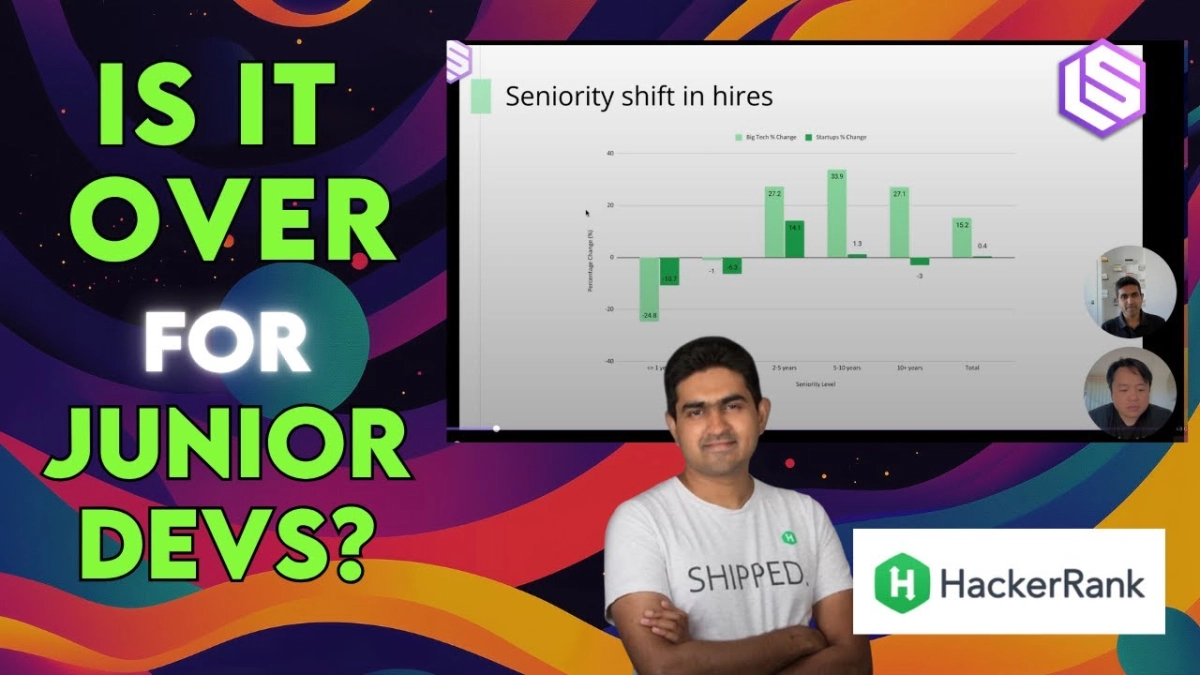
"The more AI becomes powerful, the more valuable human craft and other elements are going to become because people are going to easily determine whether something is done by AI or human." This incisive observation from Vivek Ravisankar, CEO and co-founder of HackerRank, during his recent conversation with Swyx, co-host and founder of smolai, encapsulates a pivotal shift in the rapidly evolving landscape of technical hiring. Their discussion, drawing from HackerRank's extensive data across 2,500+ companies and 28 million developers, offered stark realities and surprising reversals in the hunt for engineering talent in an AI-driven world.
The overall tech job market, according to Indeed's tech job posting index, has largely flattened year-over-year. However, this broad stagnation masks a dramatic surge in AI-specific roles, with the AI jobs index telling a "completely different story" of explosive growth. This dichotomy highlights a reorientation of industry demand, funneling talent towards the frontier of artificial intelligence. Yet, a counter-intuitive trend is emerging in junior hiring, challenging earlier assumptions that AI would displace entry-level coders. Companies are beginning to reverse course, recognizing new graduates as "AI natives" who instinctively integrate tools like Devin and Cursor into their workflows, often more readily than their senior counterparts.
The emergence of AI coding assistants has, however, brought significant integrity challenges to technical assessments. Ravisankar outlined three primary threats: question leaks from platforms like Chegg, the unauthorized use of AI coding tools such as Interview Copilot and Clueless, and outright impersonation during tests. HackerRank has responded with a multi-layered defense, from DMCA takedowns to sophisticated, custom-trained plagiarism models capable of detecting AI-assisted coding patterns with 85-90% precision. Their philosophy is clear: integrity isn't about forbidding AI, but about ensuring candidates adhere to established rules. This pragmatic stance has led them to officially integrate AI assistants into their assessment platform, acknowledging the futility of fighting against ubiquitous unauthorized tools.
The next-gen developer, or "10x developer," according to Ravisankar, is defined by four core attributes: strong fundamentals in software engineering, the ability to leverage AI across the entire Software Development Life Cycle (SDLC), deep knowledge of AI concepts from prompt engineering to fine-tuning, and a keen sense of "good taste" coupled with business acumen for building impactful products. This comprehensive skillset moves beyond rote coding, demanding a strategic understanding of how humans and AI can collaboratively drive innovation. He drew an analogy to aviation: "90% of your flight is flown by AI, but you still need the pilot to know aeronautical engineering."
This evolving skillset is reshaping developer workflows into two dominant modes: the 'agent review' model, where AI agents perform tasks and humans review the output, and the 'copilot assistance' model, where humans actively use AI as a real-time assistant. HackerRank's assessment tools are adapting to mirror these real-world scenarios, moving beyond traditional LeetCode-style problems to repository-based tasks within an IDE environment. This shift aims to evaluate a developer's ability to integrate and manage AI tools effectively, rather than just their raw coding speed.
Related Reading
- Hiring is Selling: Why AI-Driven Sourcing Defines Early Startup Success
- IBM CEO Dispels AI Bubble Fears, Details Strategic Workforce Shift
- OpenAI's Trillion-Dollar Ambition Meets Wall Street Skepticism
A surprising observation is that some of the most AI-forward companies, like Anthropic, are paradoxically "AI-backward" in their hiring processes, explicitly banning AI use in applications. Conversely, traditional services and consulting firms are aggressively pushing for AI-enabled assessments, likely driven by a need to maximize productivity in margin-sensitive businesses. This highlights a nuanced understanding of AI's role: while powerful for augmenting labor, critical human judgment remains paramount in cutting-edge research and development.
This underscores a fundamental truth: as AI tools become more powerful and accessible, the human element—craft, judgment, and the ability to discern quality—becomes increasingly valuable. The ease with which AI can generate content means humans will naturally assign lower value to purely AI-generated output, elevating the importance of human-curated and human-refined work. This emphasis on human discernment extends to the hiring process itself, where the focus shifts from raw output to the critical thinking and strategic application of tools, whether human or artificial.



