

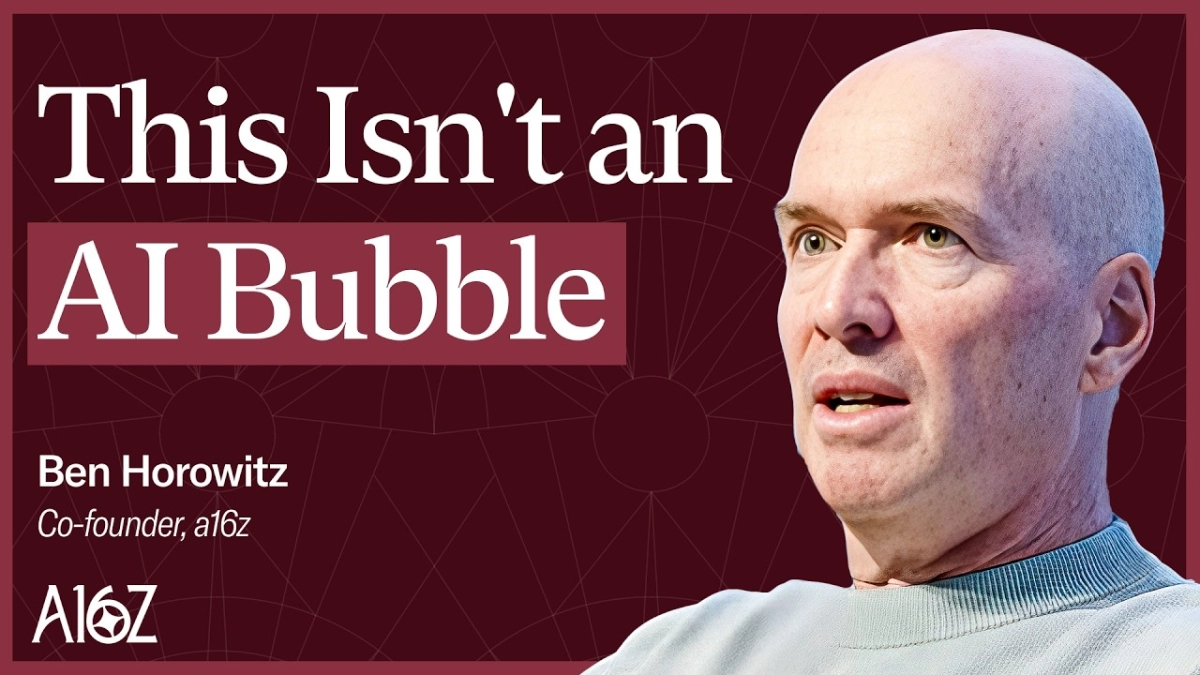
The defining challenge for any organization attempting to harness the exponential change driven by artificial intelligence is scale—not just in capital deployment, but in capability and influence. Ben Horowitz, co-founder and General Partner at Andreessen Horowitz (a16z), believes that the traditional model of venture capital is fundamentally insufficient for the modern entrepreneur building world-changing technology. Horowitz spoke with Jack Altman on the Uncapped podcast about the foundational principles and operational structure that allowed a16z to scale into a multi-billion dollar venture powerhouse, particularly within the context of rapid technological shifts like AI.
A core tenet of the a16z philosophy, established at the firm’s inception, was the recognition that the historical venture capital model was a poor product for the entrepreneur. Traditional VCs were often hands-off, providing little beyond funding and relying primarily on intuition and deal flow rather than deep, operational support. Horowitz argues that founders need a comprehensive support system—a network that provides confidence and advice necessary to navigate the complex journey of scaling a business. "Give me like the network to be confident in the advice I need to run this fucking thing," Horowitz stated, capturing the frustration felt by entrepreneurs dealing with disconnected capital providers. This realization led a16z to build out platform services—teams dedicated to recruiting, go-to-market strategy, policy, and network connections—treating the firm itself as a scalable product designed to maximize founder success.
Central to the firm’s success is the unique, decades-long partnership between Horowitz and Marc Andreessen. Horowitz describes their relationship using a musical analogy: Andreessen is Michael Jackson, the singular talent and visionary idea generator, while Horowitz sees himself as Quincy Jones, the producer and executor who maximizes that talent. Their dynamic is one of complementary opposites; Andreessen generates ideas and pushes boundaries, while Horowitz provides the decisive structure and editing necessary to execute those visions. "He’s a star of talents that nobody else has," Horowitz says of Andreessen, acknowledging the asymmetric distribution of genius that defines their investment thesis.
This complementary structure extends directly to the firm’s operating model, contrasting sharply with VC firms that maintain a lean, partner-centric structure. Horowitz argues that the sheer breadth of the modern technology market—where software is truly "eating the world"—demands scale. The belief that only a handful of deals matter every year is outdated. In a world where technology is transforming every major industry, hundreds of billion-dollar opportunities emerge annually. To address this market effectively, a firm must be large enough to handle the volume and diversity of deals, necessitating the expansion of the general partner base and support staff.
The internal structure of the firm, particularly in managing the investment partners, requires careful attention to avoid the internal conflicts that often plague multi-partner firms. Horowitz emphasizes that while venture capital attracts highly intelligent, often disagreeable people—who make the best investors precisely because they challenge consensus—this trait must be managed institutionally. Horowitz notes that the worst internal conflicts are often the ones that go unaddressed. "They’re all kimchi problems, the deeper you bury them, the hotter they get." This mandates a management approach that minimizes structural conflict, allowing the highly skilled GPs to focus on their domain expertise and deal execution rather than internal politics.
A key philosophical distinction for a16z, particularly relevant to founders, lies in its approach to evaluating talent and potential. Horowitz stresses that the firm focuses intently on the magnitude of a founder’s strengths rather than fixating on their weaknesses. If an entrepreneur demonstrates world-class ability in their core domain—be it technology, engineering, or vision—the firm is willing to overlook deficiencies in areas like accounting or go-to-market strategy, because those weaknesses can be mitigated by the firm's platform services.
This focus on core strength also informs Horowitz’s view on governance, especially board seats. While some contemporary VCs champion a completely hands-off approach, Horowitz argues that taking a board seat is a critical fiduciary protection for the CEO and the company itself, particularly once external investors and employee equity are involved. Running a company without a board once you have outside investors is "the most dangerous fucking idea in the world," Horowitz asserts, explaining that a board provides essential legal protection and perspective that a busy CEO often lacks. The board member's role should be advisory—helping the CEO "think through things"—rather than dictatorial.
The commitment to scale and platform services also directly addresses the changing landscape of marketing and media. The traditional indirect channel of relying on press releases and tech journalists to convey vision has been replaced by direct channels, such as social media and podcasts. a16z recognized this shift early, building a media arm that effectively broadcasts its ideas and brand identity directly to founders and the broader tech ecosystem, establishing thought leadership and generating significant deal flow. Horowitz notes that the very laws of physics governing media have changed, making direct engagement essential.
The structure of Andreessen Horowitz, designed not just for capital allocation but for comprehensive operational support and brand building, is a direct response to the increasing complexity and scale of modern technological disruption. By viewing itself as a company whose primary product is the venture capital experience, a16z engineered a model built to amplify the strengths of exceptional founders operating in an environment defined by rapid, often unpredictable, change.



