

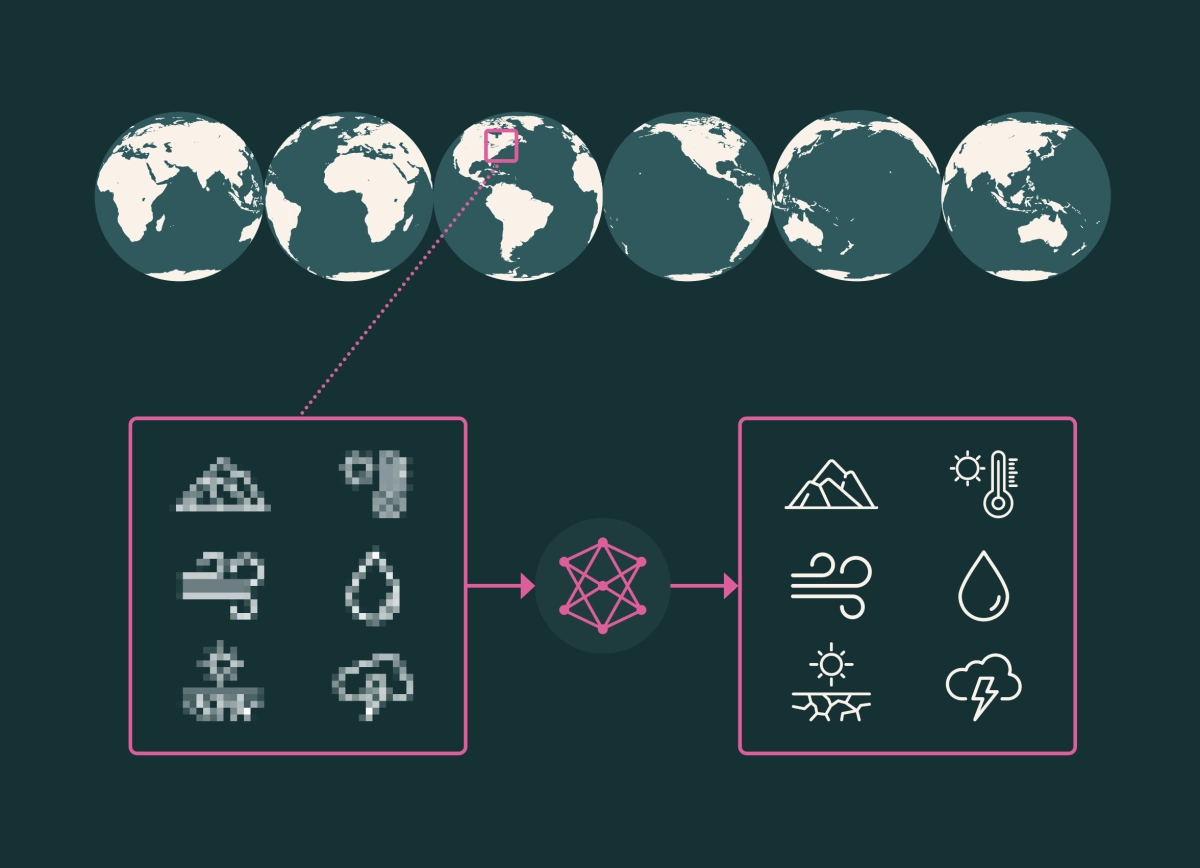
The computational barrier limiting high-resolution climate modeling has finally cracked. Ai2, in collaboration with NOAA GFDL, introduced HiRO-ACE, an AI climate simulation framework that delivers 3-kilometer resolution climate data globally at unprecedented speed. This two-stage system bypasses the massive energy and time costs of traditional storm-resolving models, making localized climate risk assessment truly feasible for the first time.
The core value proposition is efficiency, addressing the fact that traditional 3km simulations consume months and the equivalent of 21 years of average US household electricity for a single decade run. HiRO-ACE achieves a staggering speedup: simulating 1,500 years of 100km climate data in a day, and then downscaling a year of 3km regional data in 45 minutes on a single NVIDIA H100 GPU. This shift fundamentally changes the economics of climate research, moving high-fidelity data from a niche academic luxury to a widely accessible tool. According to the announcement, a researcher could now generate decades of regional 3 km precipitation in a day, a task that previously required months of dedicated supercomputing time.
HiRO-ACE’s success lies in its specialized, tandem architecture designed to maintain fidelity while maximizing speed. The first component, ACE2S, is a stochastic climate model emulator running at a coarse 100km resolution. This stochastic aspect is crucial because it preserves the grid-scale precipitation characteristics necessary for accurate storm generation, avoiding the overly smooth outputs typical of past deterministic AI-based atmospheric models.
The Fidelity of AI Downscaling
The second component, HiRO (High Resolution Output Downscaler), performs the critical 32x downscaling. HiRO takes the coarse 100km precipitation and wind fields from ACE2S and transforms them into detailed 3km structures, accurately capturing features like tropical cyclones, atmospheric rivers, and convective thunderstorms. Crucially, this speed does not sacrifice accuracy; HiRO-ACE maintains low time-mean biases, with relative errors generally less than 10% compared to the original physics-based X-SHiELD simulation it emulates. Furthermore, the entire framework is probabilistic, allowing researchers to generate ensembles to quantify uncertainty at both the large weather scale and the fine storm scale.
This ensemble capability is vital for stakeholders engaged in climate risk assessment. As Josh Hacker, Chief Science Officer at Jupiter Intelligence, noted, this technology allows for the assessment of multiple extreme event types with various durations and spatial extents, bringing capability to the local scale that stakeholders need. The ability to generate realistic storm structures and accurately reproduce the probability of rainfall rates through the 99.99th percentile validates the model’s utility for high-impact applications.