

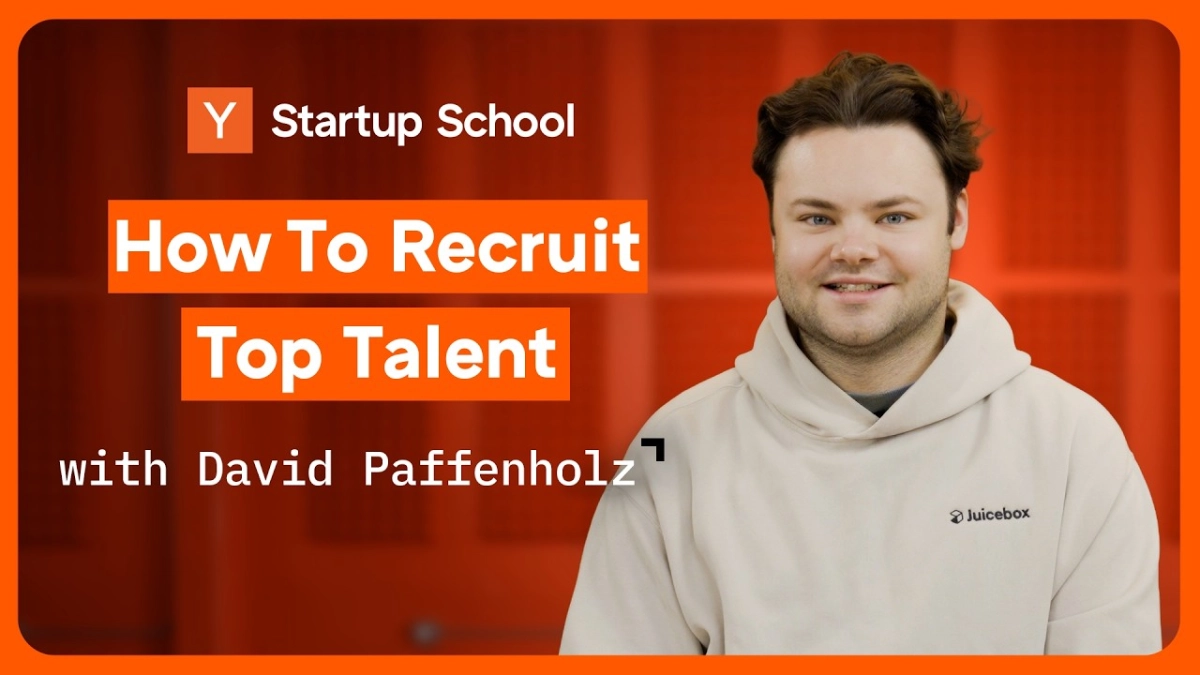
In the rapidly evolving landscape of artificial intelligence, where groundbreaking innovations emerge with dizzying speed, the ability to recruit exceptional talent has become as critical as the technology itself. For early-stage startups, this challenge is particularly acute, demanding a paradigm shift in approach: hiring is no longer just about assessing candidates, but fundamentally about selling your vision. This transformative perspective was at the heart of David Paffenholz's discussion with Harj Taggar at Y Combinator's Startup School, where the Juicebox co-founder and CEO laid out a strategic roadmap for finding, pitching, and closing top engineering and sales talent.

Paffenholz began by stressing the outsized impact of initial hires. "Talent is 10x more important at early stage companies," he asserted, explaining that these foundational team members "define culture, velocity, and the future of the business." The first ten individuals to join, he argued, effectively lay down the cultural blueprint for the next fifty, making their selection a non-negotiable priority.
The talent market is fiercely competitive. Top-tier engineers, for instance, routinely receive hundreds of outreach messages, a deluge that makes it incredibly difficult for an unknown startup to capture attention. This saturation underscores the necessity for a highly differentiated and proactive recruitment strategy.
Candidates, especially those with sought-after skills, possess a range of options: the stability and brand recognition of Big Tech, the predictable upside of Growth-stage companies, or the high-impact, high-risk environment of an early-stage venture. Startups, Paffenholz noted, offer unique draws like "direct impact, faster career growth, and real ownership of the work being done, not just a narrow function." Understanding what truly motivates a candidate — whether it's mission, equity, problem space, or team culture — is the first step in tailoring an effective pitch. This means asking early what they want and consistently checking if their aspirations align with the startup journey.
This competitive landscape necessitates a shift from reactive hiring to proactive sourcing. "The best candidates aren't applying; they're already working somewhere else," Paffenholz stated, advocating for an approach akin to outbound sales. Founders must actively build a "top-of-funnel pipeline" by prospecting, engaging in cold outreach, and meticulously managing the talent funnel through to conversion.
This is precisely where AI-driven platforms like Juicebox come into play. As an AI sourcing platform backed by Sequoia, Juicebox empowers startups to move beyond traditional job boards and leverage "Humans + Agents" for "talent discovery across 800M+ global profiles." Its capabilities provide real-time insights and streamline engagement, allowing founders to identify and connect with ideal candidates with unprecedented precision.
Sourcing strategies, Paffenholz advised, must be tailored to the specific role. For Account Executive (AE) hires, the focus should be on targeting individuals at competitor companies who demonstrate strong quota attainment signals or rapid internal promotions. For Software Engineers (SWEs), the search criteria shift to signals of individual impact, such as significant open-source contributions, experience shipping products from 0 to 1 or 1 to 100, and deep expertise in specific technical areas. Juicebox's interface, with its "PeopleGPT" for initial search and "Autopilot" for assessing specific criteria, allows for this granular, data-driven approach to candidate identification.
Once potential candidates are identified, crafting compelling outreach is critical. Initial emails must be concise and attention-grabbing, highlighting key metrics like impressive Annual Recurring Revenue (ARR) growth or significant funding announcements. Paffenholz suggested leveraging growth stories, mentioning investors like Sequoia, and clearly linking to a job description that emphasizes exciting aspects of the role. Subsequent follow-ups and LinkedIn messages should build on this initial engagement, reiterating value propositions and making it easy for candidates to schedule a call. For technical roles, "engineer-to-engineer outreach," ideally from a technical co-founder or CTO, significantly boosts response rates.
The interview process itself is a continuation of the sales effort. Paffenholz's guiding principle is simple: "Always sell the candidate on the company first." The initial 30-minute call should focus on determining the candidate's interests and motivations, articulating the company's vision, and inspiring excitement. Technical assessments, for SWEs, are then integrated into later rounds, involving practical challenges like building a web app or solving system design problems, designed to gauge problem-solving skills, pace, and product sense. For AEs, mock pitches or demos are crucial.
Related Reading
- Box CEO: AI Agents Redefine Enterprise Productivity
- Google Cloud's Vertex AI Agent Engine Bridges the Production Gap for AI Agents
- Agentic AI: The Concierge Revolution and the Compute Bottleneck
When it comes to closing, speed is the startup's ultimate advantage. Offers must be delivered swiftly to preempt larger companies with slower bureaucratic processes. At this final stage, reinforcing the company's mission and the candidate's potential technical impact is vital. Personal touches, such as direct calls from founders or introductions to the wider team, can also sway a decision.
Ultimately, Paffenholz urged founders to embed sourcing and hiring as a core, ongoing priority. This means dedicating specific time, such as scheduling 100 outreach emails per week, and aiming to speak with at least 10 candidates weekly. Crucially, "every founder should be involved in hiring," actively participating in phone calls and coffee chats. By embracing this sales-centric, disciplined approach, founders can build formidable teams, transforming talent acquisition from a daunting task into a powerful engine for growth and innovation.


