

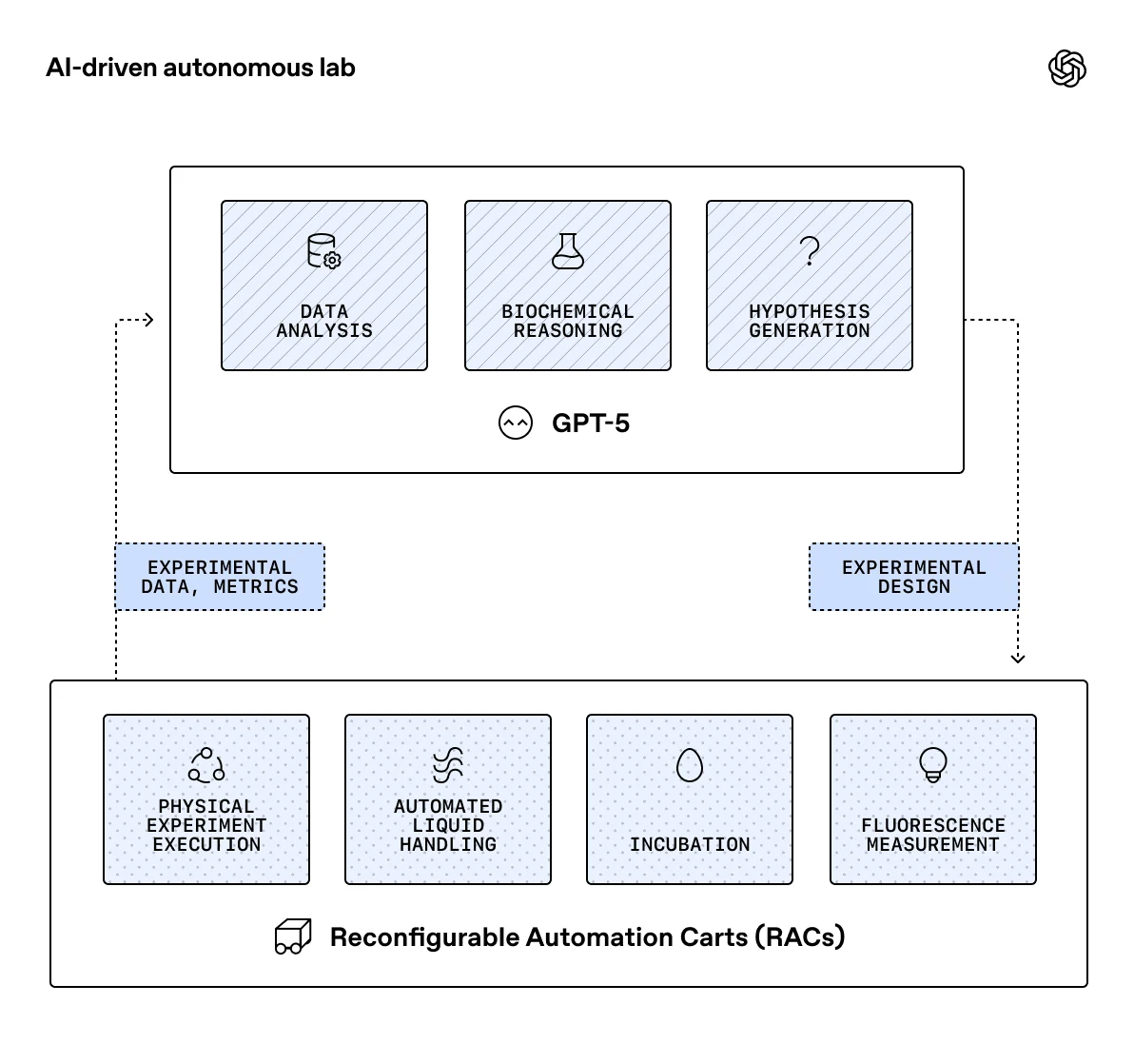
AI is no longer confined to digital realms. In a significant leap for biology, GPT-5 has been directly linked to an automated laboratory, demonstrating a 40% reduction in the cost of producing proteins through cell-free synthesis. This collaboration with Ginkgo Bioworks showcases how frontier AI models can now drive physical experimentation at scale.
AI Powers Wet Lab Revolution
Unlike fields where ideas can be tested computationally, biological progress traditionally relies on time-consuming and expensive lab work. Autonomous labs, however, are changing this paradigm. By connecting advanced AI models like GPT-5 to robotic systems, researchers can now propose experiments, execute them, analyze results, and iterate autonomously, drastically reducing experimental bottlenecks.
Building on prior work that showed GPT-5 could optimize lab protocols, this new research focuses on a critical biological process: cell-free protein synthesis (CFPS). This method allows for protein production without living cells, making it ideal for rapid prototyping and testing.
Optimizing Protein Production
The partnership involved linking GPT-5 to Ginkgo's cloud laboratory, a remotely operated, automated wet lab. Over six rounds of closed-loop experimentation, the system tested over 36,000 unique CFPS reaction compositions. GPT-5, given access to computational tools and relevant scientific literature, rapidly established a new cost-efficiency benchmark.
The system achieved a 40% reduction in overall protein production cost and a 57% decrease in reagent costs. Crucially, it also identified novel reaction compositions that proved more robust under the conditions typical of automated labs.
The Value of Cell-Free Synthesis
CFPS is a cornerstone of modern biotechnology, underpinning many medicines, diagnostics, and industrial enzymes. Faster and cheaper protein production via CFPS accelerates scientific discovery and streamlines the path from research to real-world applications, from pharmaceuticals to detergents.
However, optimizing CFPS is notoriously complex and expensive. The process requires a delicate balance of DNA templates, cellular machinery extracted into a lysate, and numerous biochemical components. While machine learning has been applied previously to reduce costs, the manual nature of experimentation has led to incremental progress.
An Autonomous Lab in Action
The core of this breakthrough lies in the closed-loop system. GPT-5 designed experimental batches, which were then executed by robots in Ginkgo's cloud laboratory. The resulting data was fed back to GPT-5, which used it to refine its next set of experimental designs. This cycle was repeated six times.
Programmatic validation ensured that AI-designed experiments were physically executable, preventing theoretical designs that couldn't be realized in the automated workflow. Across the entire process, more than 36,000 reactions were performed, enabling patterns to emerge from the biological noise.
After just three rounds of experimentation and two months, GPT-5 established a new state-of-the-art, achieving the 40% cost reduction compared to previous benchmarks in 384-well plate formats.
Key Learnings from AI-Driven Optimization
The improvements stemmed from identifying synergistic combinations of ingredients and understanding the practical constraints of high-throughput automation. GPT-5 discovered low-cost compositions that human researchers had overlooked, highlighting the vastness of the potential experimental space.
The system also adapted to the realities of plate-based experiments, where factors like oxygenation and mixing differ from traditional bench-top setups. GPT-5 proposed reaction conditions optimized for these high-throughput constraints, often outperforming prior methods.
Specific components like buffering agents, energy regeneration elements, and polyamines, though seemingly minor, had a significant impact on cost and yield. The cost structure itself dictated strategy; with lysate and DNA being major expenses, maximizing protein output per unit of input became the most effective approach.
Future Directions and Limitations
While successful for sfGFP and a specific CFPS system, the researchers acknowledge that generalization to other proteins and systems requires further validation. Factors like oxygenation and reaction geometry can influence yields and may need deeper investigation.
Human oversight remains necessary for complex protocol adjustments and reagent handling, indicating that fully autonomous biological discovery is still evolving. The team plans to apply this autonomous lab approach to other biological workflows where rapid iteration is key.
The research also touches on biosecurity implications, emphasizing the need for robust frameworks to manage potential risks associated with AI's increasing capabilities in biological research.


