
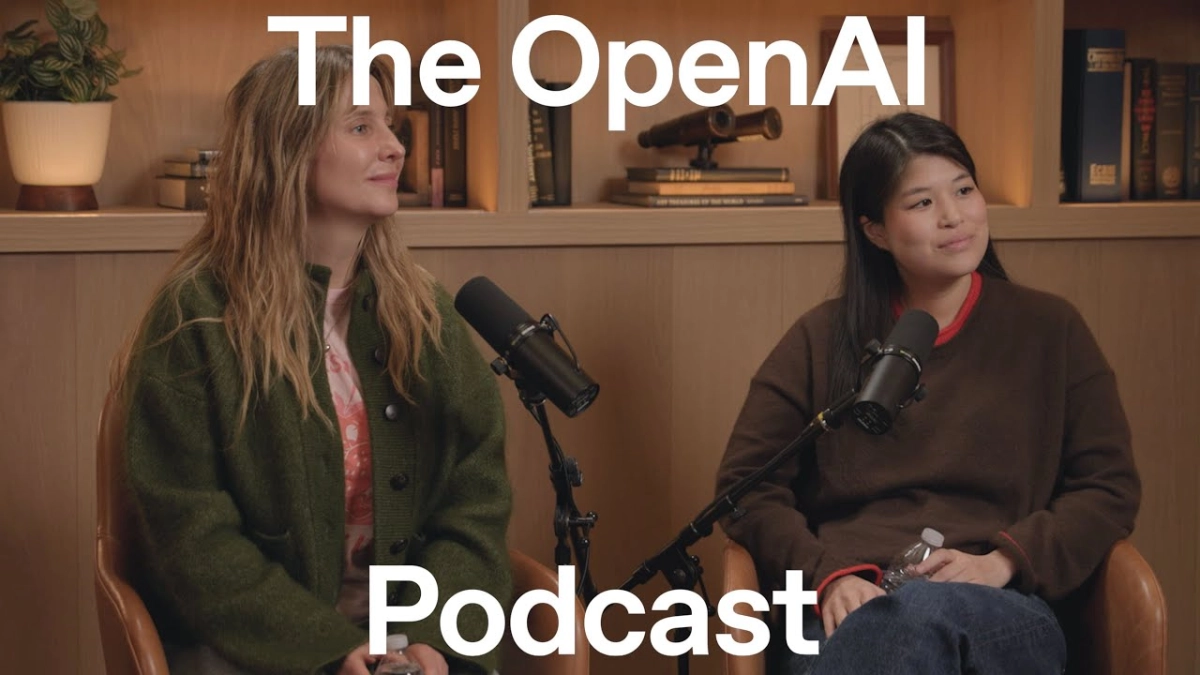
"Part of the art here is figuring out how to pull out these quirks in the model that can come across as personality without breaking steerability." This insight from Laurentia Romaniuk, a product manager at OpenAI, encapsulates the nuanced challenge at the heart of the latest advancements in AI. Romaniuk, alongside researcher Christina Kim, recently sat down with host Adrian Maen on the OpenAI Podcast to discuss GPT-5.1, delving into the intricate balance of building models that excel in both cognitive ability and emotional intelligence, all while offering users unprecedented control over their AI interactions. Their conversation illuminated the complex interplay of technical innovation and human-centric design in shaping the future of conversational AI.
The primary objective for GPT-5.1 was to address crucial user feedback from its predecessor, GPT-5, and to fundamentally enhance the model's reasoning capabilities. Kim highlighted a significant technological leap, stating that "for the first time ever, all of the models in chat are reasoning models." This means that even the baseline model now possesses a deeper capacity for logical thought and problem-solving, allowing it to "think" through complex queries and refine its responses before delivery. This inherent intelligence across all tiers represents a foundational improvement, leading to a smarter, more capable AI experience for every user.
A key driver behind GPT-5.1's development was the community's response to GPT-5. Romaniuk candidly shared, "With the ChatGPT 5 launch, one of the things we heard was that the model felt like it had weaker intuition and that it was less warm." Users perceived a certain coldness or a lack of understanding in the model's interactions, often feeling as though it forgot crucial context from earlier in the conversation. This feedback underscored the need for advancements beyond mere factual accuracy, pushing OpenAI to infuse more emotional intelligence into the system.

To combat this perceived lack of warmth and intuition, OpenAI engineers focused on enhancing the model's memory and context retention. The goal was to ensure the model could consistently hold onto user-provided information across a longer conversational window, preventing it from appearing forgetful or detached. This seemingly subtle adjustment has profound implications for user experience, fostering a more continuous and empathetic interaction.
However, "personality" in an AI model extends far beyond just memory. Romaniuk clarified, "Personality, though, for most of our users, I think is something much larger. And it's the whole experience of the model." This holistic view encompasses not only the innate behavioral quirks of the model but also how users can actively steer its responses. The aim is to empower users with greater flexibility, allowing them to guide the model's style and tone to better suit their individual preferences and the specific context of their interaction. This steerability, whether through custom instructions or new style and trait features, is paramount to achieving a truly personalized AI experience.
The development of model behavior is a continuous balancing act, a blend of rigorous science and intuitive art. OpenAI's approach involves a constant feedback loop, utilizing "user signals research" to understand how people interact with and perceive the models. This iterative process allows researchers and product managers to make subtle tweaks, ensuring that while the model gains capabilities and flexibility, it also maintains safety and avoids unintended harmful outputs. The challenge lies in "pulling out these quirks in the model that can come across as personality without breaking steerability," a delicate dance between enabling creative expression and maintaining control.
The current iteration of ChatGPT is not a singular entity but a sophisticated "system of models," as Kim described. Different models specialize in different tasks, from quick conversational responses to complex reasoning and tool utilization. The auto-switcher feature intelligently directs user queries to the most appropriate model, often seamlessly in the background. For users, understanding this underlying complexity is less important than experiencing a fluid, effective interaction, which necessitates a user interface designed to intuitively bridge these disparate capabilities.
Related Reading
- OpenAI's Future Hinges on Enterprise Adoption and Sustained Funding
- AI's Maturation: From Model Supremacy to Infrastructure Dominance
- Nvidia CEO Jensen Huang Declares AI a Foundational Platform Shift Beyond Chatbots
Looking ahead, the focus remains on pushing the boundaries of customization and intelligence. The goal is a future where models can infer user intent and context with even greater accuracy, tailoring responses to individual expertise and preferences without explicit prompting. This involves continuously refining how models handle subjective domains, express uncertainty, and engage in open-ended conversations. The ongoing evolution of AI, particularly in areas like memory and proactive information retrieval, promises a deeply personalized and adaptive user experience.
Ultimately, the journey of shaping model behavior is about achieving a harmonious blend of advanced technical capabilities and profound human understanding. It’s an ongoing process of learning, iterating, and adapting, driven by a commitment to making AI not just smarter, but also more intuitive, steerable, and ultimately, more human-centric in its interactions.