

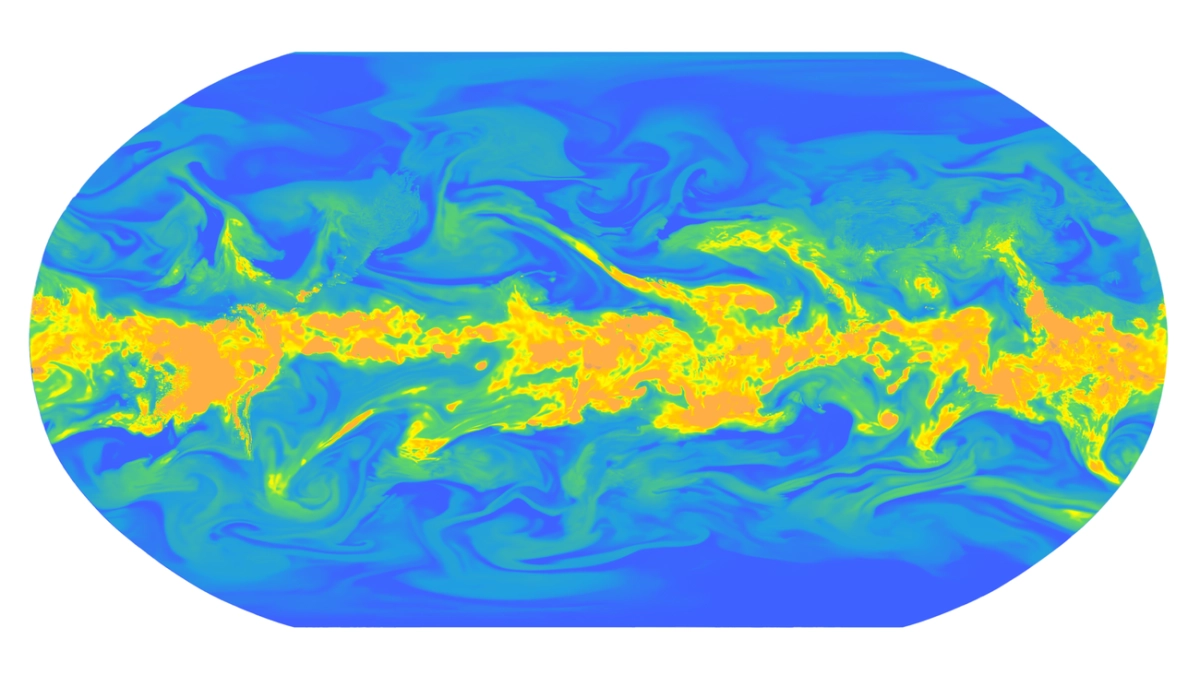
Google has launched WeatherNext 2, a significant upgrade to its weather forecasting AI that promises to reshape how we predict and react to atmospheric conditions. The new model delivers faster, higher-resolution, and more accurate global predictions by generating hundreds of possible outcomes instead of just one. According to the announcement, this marks a major step in translating advanced AI research into practical, high-impact tools for consumers and enterprises alike.
The core innovation behind WeatherNext 2 is a new approach called a Functional Generative Network (FGN). This system injects 'noise' directly into the model's architecture, allowing it to create a wide range of physically realistic scenarios from a single starting point. This method is a dramatic departure from traditional, physics-based supercomputer models that are computationally expensive. WeatherNext 2 can generate its hundreds of predictions in less than a minute on a single TPU, a task that would take hours on conventional systems.
This new weather forecasting AI is uniquely trained on individual weather elements like temperature or wind speed, which Google calls 'marginals'. From this focused training, the model learns to skillfully predict complex, interconnected systems, or 'joints'. This capability is crucial for real-world applications, such as identifying the full scope of a heatwave region or forecasting the total power output across an entire wind farm, which depend on how countless variables interact.
From Lab to Live Applications
This is not just a research paper; Google is aggressively integrating this technology across its ecosystem. WeatherNext 2 is already powering forecasts in Search, Gemini, and Pixel devices, with an integration into Google Maps planned for the coming weeks. More importantly for the industry, the forecast data is now available in Google's Earth Engine and BigQuery. The company is also launching an early access program on its Vertex AI platform, allowing businesses to build custom models for their specific needs.
The shift to probabilistic weather forecasting AI, as demonstrated by WeatherNext 2, is a genuine game-changer. It moves the world from asking "What will the weather be?" to "What are the possible weather scenarios?". This ability to model uncertainty and prepare for worst-case outcomes is invaluable for industries like logistics, energy, and agriculture. It fundamentally changes how businesses and governments can manage climate-related risk in an increasingly volatile world.