

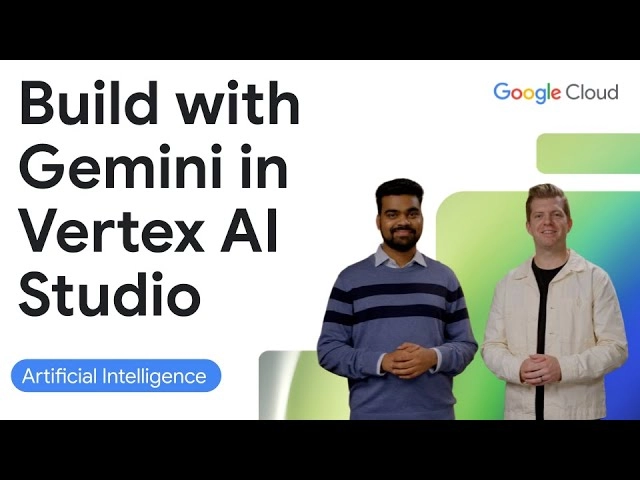
Google Product Managers Shubham Saboo and Colby Hawker recently showcased a groundbreaking demonstration of how Vertex AI Studio, powered by Gemini, can dramatically reduce the friction and time involved in building production-grade AI applications. Their bold claim, delivered early in their presentation, challenged conventional development timelines: "Today, we want to show you how to build a production grade financial analyst agent. It's powered by Gemini, using Vertex AI Studio." This assertion immediately set a high bar, especially when Saboo retorted, "Production grade in 10 minutes don't usually go in the same sentence." Yet, the subsequent demonstration meticulously broke down how Google is addressing the pervasive developer friction in AI.

The core of their presentation revolved around creating a financial analyst assistant capable of ingesting a PDF earnings report, extracting key financial metrics, and converting them into a structured JSON output, which could then be visualized as a Sankey diagram. This use case perfectly encapsulates a common enterprise need, where raw, unstructured data must be transformed into actionable insights. The speakers addressed the typical hurdles developers face: "getting started with AI sounds like a day of setup, fighting with dependencies, and trying to get a budget for this major project." Google's solution aims to dismantle these barriers, starting with an "Express Mode" that requires no Google Cloud account or credit card, allowing developers to begin prototyping immediately.
A significant innovation highlighted was the "vibe coding" feature, particularly the use of slash commands for prompt optimization. Initially, a simple prompt to extract revenue, cost of goods sold, and operating expenses yielded a list that was not easily parseable. This is a familiar frustration for developers, often leading to a tedious "trial and error" loop. Colby Hawker articulated this pain point directly: "You shouldn't have to guess. Vertex AI Studio can now help you optimize this prompt." By simply typing "/prompt refine," an integrated AI agent transformed the initial vague instruction into a much more detailed and effective prompt, complete with a persona for the agent, explicit instructions, and an example JSON output format. This is not just a refinement; it's a paradigm shift. Shubham Saboo underscored this, noting, "They are not guessing anymore. They are collaborating with an AI to build a prompt." This collaborative approach with an intelligent agent drastically shortens the iterative process of prompt engineering, moving it from an art form to a more guided, efficient science.
Related Reading
- Khosla's Bet on World Models: General Intuition's Vision for AI's Next Frontier
- Google-Replit Deal Ignites AI Coding Democratization
- Claude.ai: Amplifying Human-AI Collaboration Through Intelligent Context and Customization
Once the optimized JSON output was achieved, the path to a functional application became remarkably straightforward. The platform offers one-click API key generation for immediate deployment. For those needing to visualize the extracted data, the "/build" command referenced the refined prompt and instantly generated a web application featuring a Sankey diagram, demonstrating the flow of financial metrics. This seamless transition from data extraction to visualization within the studio itself significantly accelerates the development cycle.
Beyond rapid prototyping, Vertex AI Studio also addresses the demands of production environments and team collaboration. The platform facilitates the transition from Express Mode to a full Google Cloud project, retaining all previously saved work. This enables enterprise-grade features such as version history, allowing developers to track changes, test new ideas, and revert to previous iterations with ease. Furthermore, the concept of "agents" allows for the chaining of multiple steps and the integration of various tools, like Google Search, database lookups, or custom APIs for real-time data fetching. "All the work we just did, it's reusable," Hawker emphasized, showcasing how refined prompts can become tools within more sophisticated, multi-step agents. For product managers or marketing teams without direct access to GCP accounts, the platform offers read-only sharing links, fostering transparency and collaboration without compromising security or requiring complex IAM permissions. This comprehensive approach ensures that AI applications can evolve from simple prototypes to complex, secure, and scalable solutions within a single, integrated environment.
