

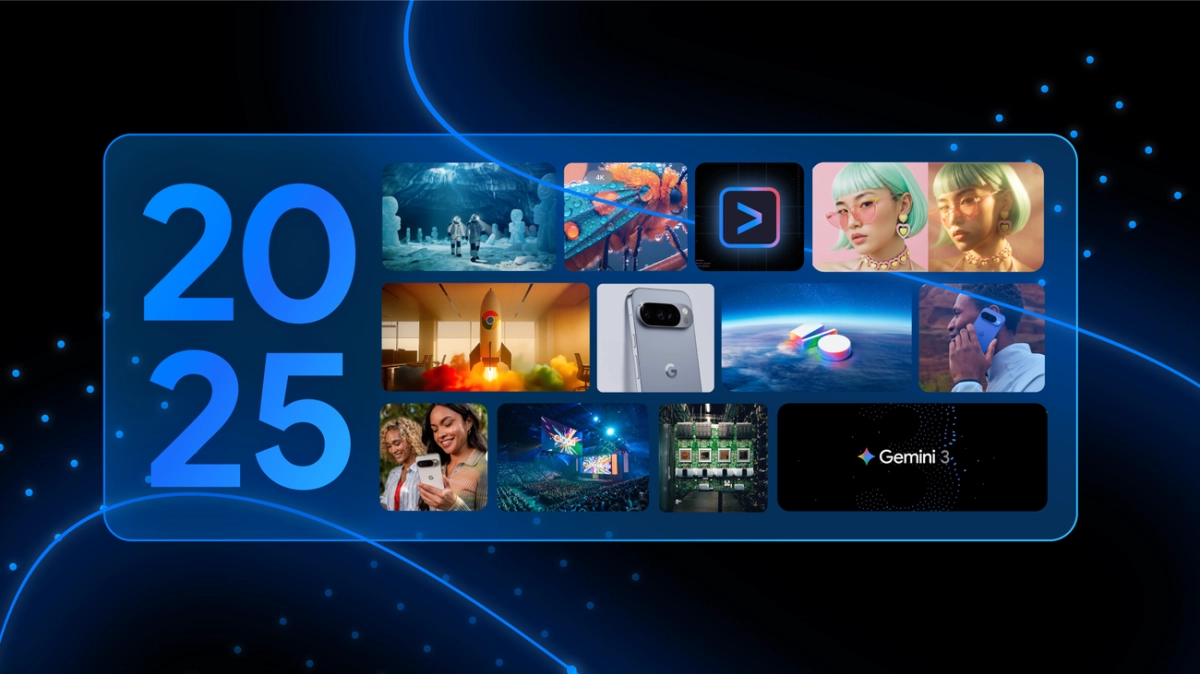
Google's 2025 narrative was unequivocally dominated by artificial intelligence, marking a profound strategic pivot that reshaped its core offerings and user interactions. The company's relentless cadence of AI announcements, culminating in the Year in Search 2025 report, illustrates a comprehensive, top-down effort to embed generative AI across its entire ecosystem. According to the announcement, this aggressive deployment signals a new era where AI is not merely an auxiliary feature, but the foundational layer for all product development and the primary interface for digital engagement, fundamentally altering user expectations and industry benchmarks.
The sheer volume and rapid iteration of Gemini updates throughout 2025 underscore its central role as Google's unifying AI agent, a strategic move to consolidate its AI efforts. From Gemini 2.0 Flash in January, pushing capabilities to Android and Google TV, to the powerful Gemini 3 in November and Gemini 3 Flash in December, Google systematically scaled its flagship model, pushing frontier intelligence into everyday tools. This pervasive integration into core services like NotebookLM, Whisk, and even Google Maps navigation demonstrates an ambition to make Gemini the ubiquitous intelligence layer for every Google product and user touchpoint. The strategic implication is clear: Google is constructing a cohesive AI operating system, where Gemini acts as the orchestrating brain, fundamentally altering how users interact with their digital world and setting a new standard for intelligent assistance. This consistent advancement also serves to future-proof Google's offerings against emerging competitive threats, ensuring its AI capabilities remain at the forefront of the industry.
Perhaps the most significant shift for users and the industry came with the debut of AI Mode in Search in March, evolving into Search Live by June and officially launching in September. This move transcends traditional keyword-based information retrieval, transforming Search into an interactive, conversational intelligence engine capable of real-time exploration and complex query resolution, a direct challenge to conventional search paradigms. Features like "Shop with AI Mode" and the ability to "use AI to buy and try clothes on yourself virtually" highlight a direct monetization pathway and a deeper integration into transactional user journeys, fundamentally disrupting established e-commerce models. The Year in Search 2025 will undoubtedly reflect a user base increasingly reliant on these AI-powered interfaces, signaling a permanent redefinition of what "searching" truly means and how information is consumed and acted upon. This evolution positions Google Search not just as an answer engine, but as a proactive digital assistant, anticipating needs and facilitating complex tasks.
Google's AI Ecosystem: From Silicon to Solutions
Google's commitment to an AI-first future extended deeply into its hardware and broader ecosystem, ensuring AI capabilities were not confined to software but deeply integrated at the device level. The Pixel 10 phones, launched in August, were touted as "powerful and proactive," indicating a tight coupling of on-device AI with user experience, enabling more personalized and efficient interactions. Similarly, new Google Home devices in October were explicitly "built for Gemini," signifying a strategic move to embed advanced conversational AI directly into the smart home hub. Android 16, with its continuous updates throughout the year, became a robust platform for AI-driven features, from smarter writing and real-time help to enhanced sharing and remixing emojis. This hardware-software synergy is critical for Google, allowing it to control the full stack and deliver optimized, privacy-conscious AI experiences directly to the user, thereby creating a formidable competitive moat and reinforcing user loyalty within its ecosystem.
Beyond consumer-facing features, Google significantly advanced its underlying AI infrastructure and developer tools, fostering a robust ecosystem for innovation across the tech landscape. The introduction of Gemma 3, a highly capable model runnable on a single GPU or TPU, alongside the Ironwood TPU for inference, showcased Google's commitment to democratizing advanced AI development and making powerful models accessible. Specialized models like Veo 2/3 for video generation, Flow for AI filmmaking, and Nano Banana for viral image editing provided powerful new creative tools, empowering content creators and developers alike. The Gemini CLI, offering an open-source AI agent, further solidified Google's position as a key enabler for the next generation of AI-powered applications. This dual focus on both foundational models and practical application tools positions Google not just as a provider of AI services, but as a crucial architect for the future of AI development, influencing industry standards and accelerating innovation.