

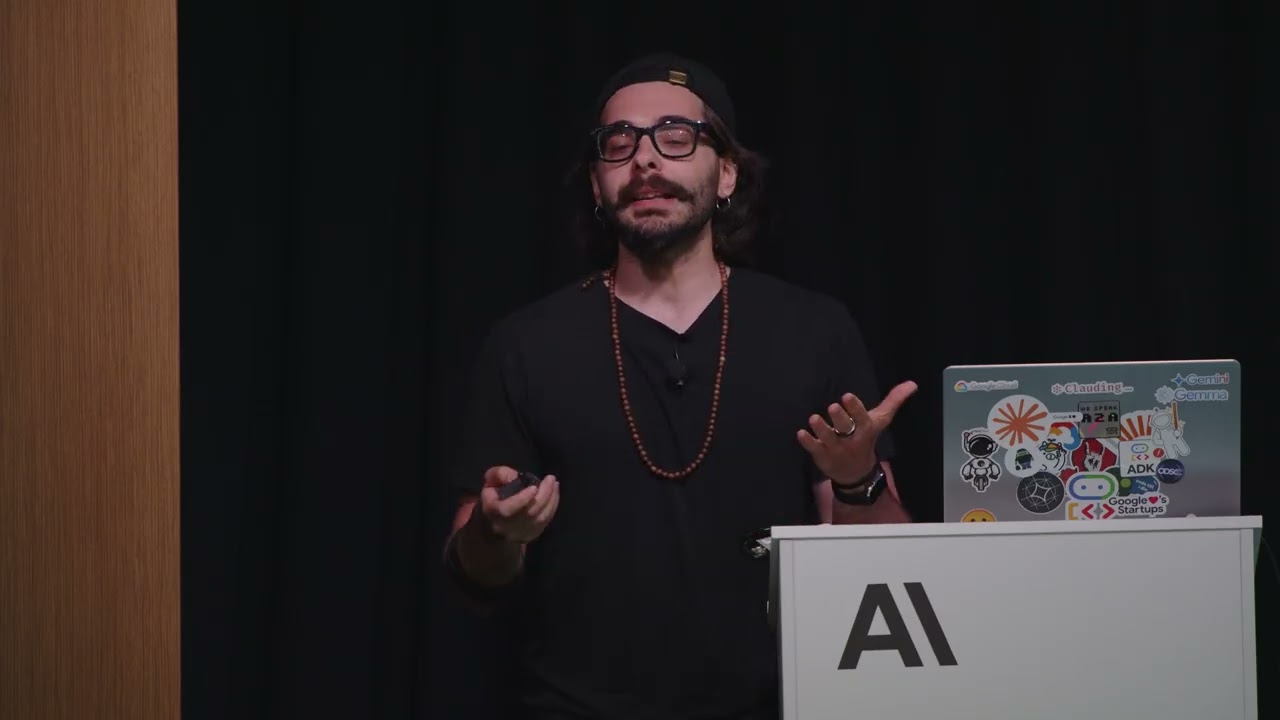
Google Cloud is tackling the chaotic and complex process of productionizing AI agents with a new, unified framework. At Anthropic's Code w/ Claude event, Ivan Nardini, a Developer Relations Engineer for Google Cloud, outlined the critical hurdles developers face when moving sophisticated AI agents from prototype to production and introduced Google’s comprehensive solution: the agentic stack on Vertex AI. The core challenge, Nardini explained, is that while building agents is powerful, the path to deployment is fraught with friction.
Nardini spoke at the San Francisco event about the three primary obstacles hindering the operationalization of AI agents. He identified a "fragmented landscape" of competing frameworks, the difficulty of integrating disparate systems, and a significant "lack of ops and governance" required for reliable scaling and monitoring. After successfully building a prototype, developers are often left to manually solve the immense challenges of deployment, observability, and management. This friction stifles iteration and makes governing an ecosystem of agents nearly impossible.
Google’s answer is a four-tiered agentic stack designed to standardize and streamline the entire agent lifecycle. It begins with the Agent Development Kit (ADK), an "open-source, code-first toolkit for building, evaluating, and deploying AI agents." Layered on top are two open protocols: the Model Context Protocol (MCP), which standardizes how applications provide context to LLMs, and the Agent2Agent (A2A) protocol, which enables seamless communication between agents, even those built on different frameworks. These protocols create a common language for a world of otherwise siloed agentic systems.
The capstone of this architecture is the Vertex AI Agent Engine, a managed platform that abstracts away the most difficult operational tasks. By handling auto-scaling, infrastructure management, and providing built-in observability through Cloud Logging, Monitoring, and Tracing, the Agent Engine allows developers to focus on building agent logic rather than managing infrastructure. Nardini emphasized that without such a platform, "it's so hard to manage them in production because you need to take care of all the operation around the agents and the relative governance." The platform effectively provides the operational backbone that has been missing from the agent development ecosystem.
Moving from a prototype to a production-ready system is the primary bottleneck for agentic AI. Google's agentic stack is designed to address this operational gap directly.