

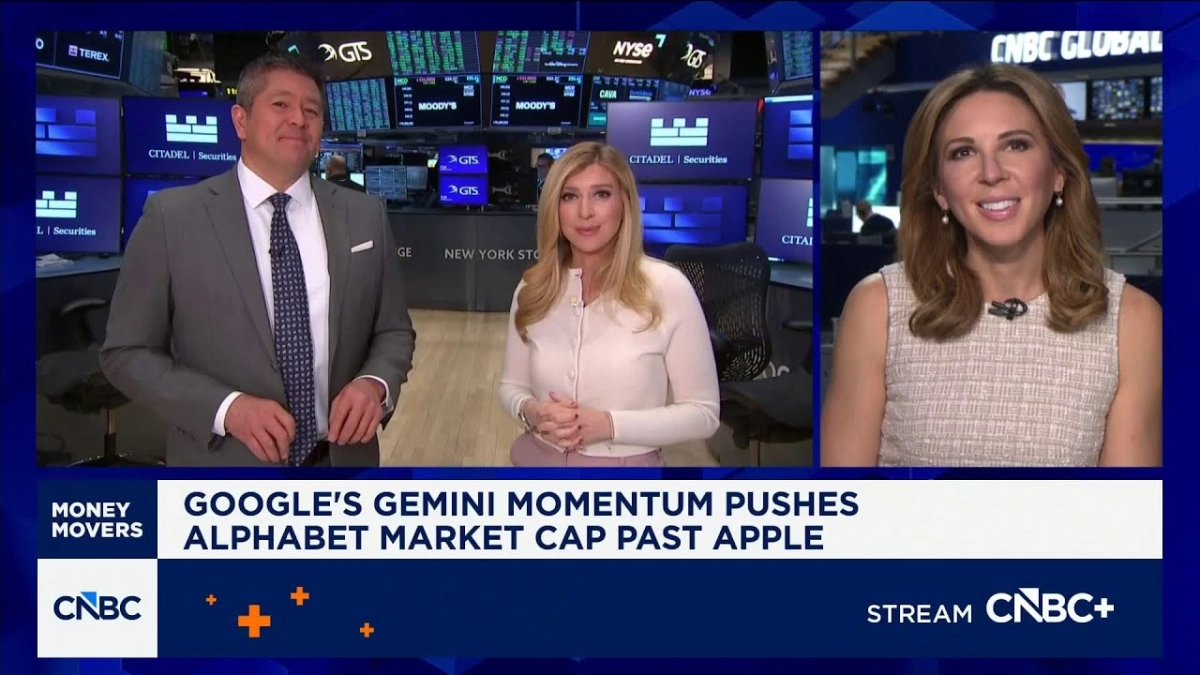
Alphabet’s strategy in the generative AI wars is now defined by a massive, aggressive data grab, betting that user inertia will fuel its dominance in the consumer ecosystem. This high-stakes move—rolling out powerful Gemini features across Gmail that access users' entire email histories by default—has immediately translated into market momentum, pushing Alphabet’s valuation past Apple’s for the first time since 2019. The sheer scale of this deployment, touching over three billion Gmail users globally, establishes a profound competitive chasm based on proprietary data access that rivals like OpenAI cannot easily bridge.
The details of this tectonic shift were outlined by CNBC’s MacKenzie Sigalos in a report on the product rollout, where she spoke with the network’s anchors regarding the profound implications for privacy and competition. The new suite of Gemini-powered tools includes "AI Overviews" for enhanced search and summary, "Proofread" for style and grammar refinement, and an "AI Inbox" that prioritizes and streamlines views. The key operational detail, however, lies in the default activation for U.S. users, necessitating a manual opt-out process buried deep within settings.
This default setting is Google’s ultimate strategic weapon. By making the AI features immediately available and active, Google leverages user passivity to acquire the most valuable training resource possible: years of contextually rich, personal, conversational data. As Sigalos noted, this involves “digging through years of Gmail threads in order to train Gemini to write like you and draft messages in your voice.” This personalized data acts as a powerful barrier to entry, allowing Gemini to offer an immediately bespoke experience that generic, publicly trained models cannot replicate without similar access.
Google is keenly aware of the privacy and regulatory implications of this default data access. The company is careful to delineate that personal emails are not being used to train the general, underlying AI models that everyone else uses. Instead, a Google product lead described the process as "real-time processing in what he called a unique, isolated environment to create this bespoke experience just for you." This linguistic maneuvering attempts to distinguish between model training (which is globally scrutinized) and personalized feature enhancement (which is often accepted as a convenience trade-off).
The geographic distinction in the rollout underscores the regulatory tightrope Google is walking. In major markets like Japan and Europe, users are required to manually toggle the feature on. This stark contrast reveals Google's calculated risk assessment, prioritizing rapid data assimilation in the less restrictive U.S. market while adhering to stricter opt-in requirements mandated by regulations like the GDPR abroad. The fact that the process is on by default for US users is a clear competitive signal. It is the playbook now in consumer AI: ship features, flip them on, and let users opt out.
The competitive landscape is already reflecting the effectiveness of Google’s aggressive deployment. While OpenAI’s ChatGPT has commanded significant attention, recent web data shows signs of waning momentum. Sigalos cited data indicating that while ChatGPT saw declining sequential total visits for two consecutive months, Gemini usage jumped by nearly 30% immediately following the Gemini 3 rollout. This direct inverse correlation suggests Google is successfully leveraging its massive distribution footprint to convert existing users into AI consumers, drawing attention—and usage—away from its primary rival.
The market has rewarded this decisive push. Wall Street analysts are buying into the "Golden Age of Gemini," with Google shares experiencing substantial gains and analysts upgrading the stock. Alphabet’s market cap surpassing Apple is a tangible metric reflecting investor confidence in the monetization potential and competitive strength derived from integrating Gemini across the entire Google consumer ecosystem, from Gmail and Drive to Chat and Meet. Google’s advantage lies not just in its foundational models, but in the seamless, default integration of those models into services used by billions daily, creating a data feedback loop that few companies in the world can match.



