

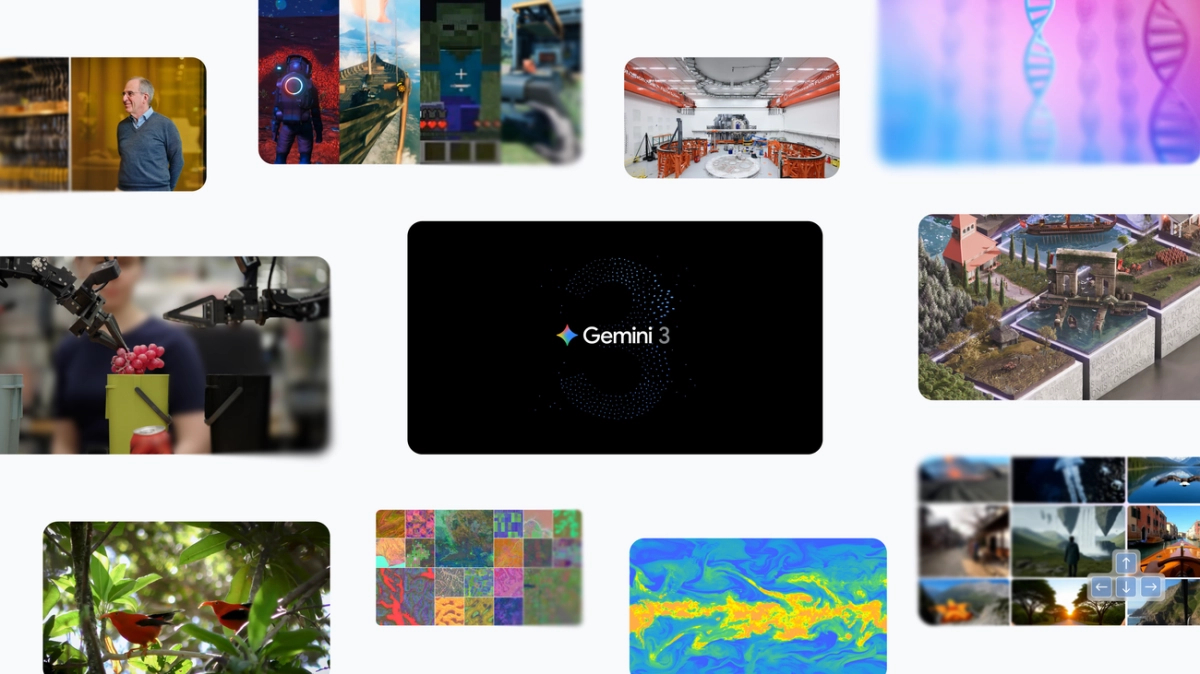
Google's "year in review" for 2025 reveals a pivotal shift in artificial intelligence, highlighted by the November launch of Gemini 3 and its December counterpart, Gemini 3 Flash. These models represent a significant leap beyond previous iterations, pushing AI from a mere tool to a truly collaborative utility. The advancements underscore Google's aggressive pursuit of more capable, multimodal, and efficient AI systems, fundamentally reshaping how we interact with technology and how technology interacts with the world.
The core of Gemini 3's impact lies in its unprecedented reasoning and multimodal understanding. According to the announcement, Gemini 3 Pro, Google's most powerful model to date, not only topped the LMArena Leaderboard but also achieved breakthrough scores on challenging benchmarks like Humanity’s Last Exam and GPQA Diamond. These tests are designed to assess an AI's ability to truly think and reason like humans, indicating a sophisticated capacity to process and synthesize information across various modalities, moving closer to genuine comprehension. Furthermore, its gold-medal standard performance in international mathematics and coding contests, powered by its Deep Think capabilities, signals a new era for AI in complex problem-solving, pushing the boundaries of what automated systems can achieve in abstract domains.
The introduction of Gemini 3 Flash is arguably the most disruptive aspect of this release, signaling a critical inflection point for AI accessibility. It delivers Gemini 3 Pro-grade reasoning with significantly improved latency, efficiency, and cost, a combination previously unattainable at this scale. This strategic move means that the "next generation's Flash model is better than the previous generation's Pro model," effectively democratizing access to frontier AI capabilities. This efficiency breakthrough will accelerate the integration of advanced AI into a wider array of applications, making sophisticated AI more accessible and economically viable for developers and businesses seeking to deploy high-performance models at scale.
Agentic AI Takes Center Stage
Beyond raw performance, Gemini 3 marks a profound evolution towards agentic AI, where models don't just assist but actively collaborate and act autonomously. Google Antigravity, alongside Gemini 3's enhanced coding prowess, ushers in a new paradigm for software development, moving from simple code completion to intelligent, autonomous partners capable of complex project collaboration. This agentic shift extends into robotics with foundational Gemini Robotics models, Gemini Robotics 1.5, and the introduction of Genie 3 as a new frontier for general-purpose world models, bringing AI agents into both the physical and virtual worlds. The implications for automation, scientific research, and complex system management are immense, suggesting a future where AI systems take on more proactive and integrated roles in our daily lives and industries.
The ripple effect of Gemini 3 is evident across Google's extensive product ecosystem, transforming user experiences at a fundamental level. From the Pixel 10's deeply integrated AI-enabled features and an updated AI Mode in Search, to advanced capabilities within the Gemini app and NotebookLM's Deep Research, the new models are making Google's offerings more intuitive, powerful, and personalized. Creative industries also stand to benefit immensely, with generative media models like Veo 3.1, Imagen 4, and Nano Banana Pro offering unprecedented capabilities for video, image, and audio generation and editing. This widespread integration solidifies AI's role as a foundational layer for future product innovation, enabling users to achieve more with less effort.