

Google DeepMind's AI clinician aims to aid doctors

Google DeepMind is developing an AI co-clinician to assist doctors, improve patient care, and address healthcare worker shortages, exploring multimodal interactions.

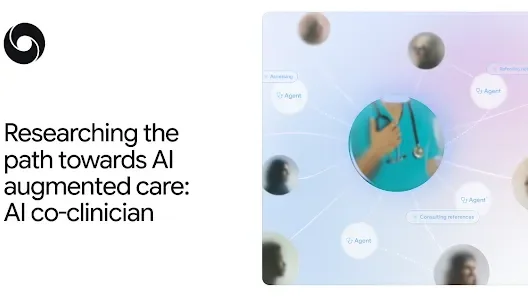
Abstract representation of AI interacting with medical data.
Conceptual image representing AI's role in future healthcare.· Deepmind

Google DeepMind is launching a research initiative focused on developing an AI co-clinician, aiming to enhance healthcare delivery by augmenting doctors' capabilities. The project, detailed on Deepmind, addresses a global shortage of clinical experts.

The AI co-clinician is envisioned as a collaborative team member, interacting with patients under direct clinical oversight. This approach seeks to extend clinicians' reach while maintaining their ultimate judgment and control.

Augmenting Clinician Expertise

The research prioritizes AI systems that are trustworthy and factually grounded, crucial for clinician adoption. In blind evaluations comparing AI responses to leading evidence synthesis tools, physicians consistently preferred the AI co-clinician's output.

Using the "NOHARM" framework, the system was tested for errors of commission and omission. In 98 primary care queries, it recorded zero critical errors in 97 cases, outperforming two widely used AI systems.

The AI also showed significant progress in complex medication knowledge and reasoning, particularly when answering open-ended questions. It surpassed other frontier AI systems on the OpenFDA RxQA benchmark, a challenging test of medical knowledge.

Exploring Multimodal Patient Interaction

Beyond clinician support, DeepMind is investigating the AI's role in patient-facing scenarios. Recognizing that medicine involves more than text, the team is exploring real-time multimodal capabilities using audio and video.

Leveraging advancements from Gemini and Project Astra, the AI co-clinician is being tested in simulated telemedical calls. The goal is to support diagnosis and management, with expert supervision.

In simulations involving synthetic clinical scenarios, the AI demonstrated the ability to guide patients through physical examinations. It successfully corrected inhaler techniques and assisted in identifying injuries.

While expert physicians outperformed the AI overall, particularly in identifying critical "red flags," the AI co-clinician performed comparably to or better than primary care physicians in 68 out of 140 assessed consultation skills.

Engineering Trust and Safety

Clinical-grade AI requires robust safeguards. The AI co-clinician employs a dual-agent architecture with a "Planner" to monitor and ensure the "Talker" agent remains within safe clinical boundaries.

The system also prioritizes clinical-grade evidence, performing verification and citation checking for retrieved information.

© 2026 StartupHub.ai. All rights reserved. Do not enter, scrape, copy, reproduce, or republish this article in whole or in part. Use as input to AI training, fine-tuning, retrieval-augmented generation, or any machine-learning system is prohibited without written license. Substantially-similar derivative works will be pursued to the fullest extent of applicable copyright, database, and computer-misuse laws. See our terms.