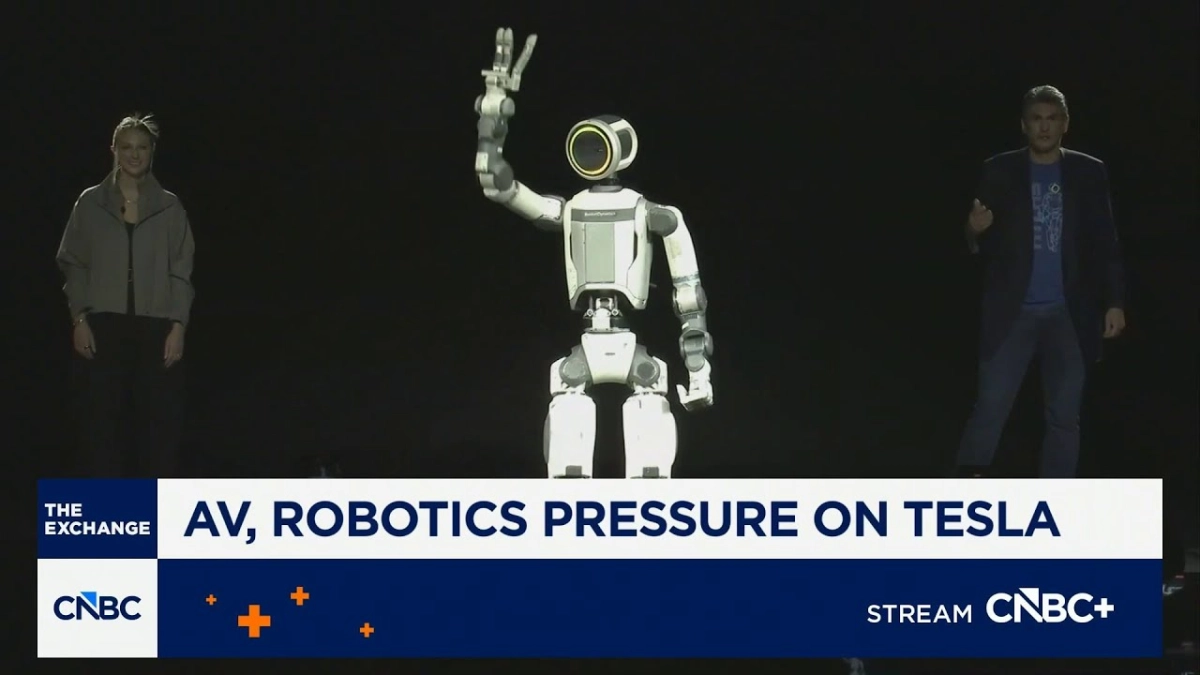
"Autonomy is no longer Tesla's story alone." This observation, delivered by CNBC’s Deirdre Bosa during a segment on the escalating competition in autonomous vehicles (AV) and robotics, encapsulates the central narrative emerging from the latest industry developments. The news of Google DeepMind partnering with Boston Dynamics to inject advanced AI into humanoid robots, coupled with Nvidia’s aggressive moves in self-driving software, suggests that the market premium once exclusively enjoyed by Tesla is rapidly eroding under the weight of formidable tech rivals.
Bosa, reporting from San Francisco on CNBC’s The Exchange, detailed how the confluence of major AI and robotics announcements is directly challenging the valuation thesis that has long supported Tesla’s astronomical market capitalization. The core proposition—that Tesla’s full-stack ownership of data and software provided an insurmountable competitive moat—is now facing threats from highly specialized and well-funded competitors aiming to dominate specific layers of the autonomy stack.

The robotics sector delivered a sharp demonstration of this competitive escalation. Boston Dynamics unveiled its next-generation Atlas robot at CES, showcasing dexterity and capabilities that move beyond the limitations of purely human-form design. This presentation was notable not just for the technology, but for the company's deliberate restraint in managing expectations, contrasting sharply with the habitual hype surrounding similar projects.
Executives from Boston Dynamics were careful to avoid the hyperbole that has often surrounded humanoid robot announcements, stating clearly that the demonstration was tele-operated. They quickly shifted focus to the machine’s functional superiority, emphasizing "fully rotational joints, built to operate in heat, cold, rain."
The strategic partnership between Google DeepMind and Boston Dynamics is perhaps the most critical development. DeepMind, leveraging its expertise in large-scale AI models, is providing the intelligence necessary for Boston Dynamics' sophisticated hardware to execute complex, real-world tasks. This union combines arguably the world's leading AI research powerhouse with the world's most advanced robotics engineering firm, creating a horizontal challenge to Tesla’s vertically integrated approach to robotics, specifically its Optimus project. The focus is clearly on robust utility and environmental resilience, a pragmatic engineering path distinct from simply mimicking the human form.
Simultaneously, the autonomous vehicle race is seeing parallel fragmentation. Nvidia announced Alpamyayo, an open reasoning Visual Language Model (VLM) framework designed for autonomous vehicles, aimed at creating reusable software modules compatible across various automotive systems. This software-first approach is designed to run across multiple manufacturers, directly challenging the notion that a single company must own the entire hardware and software stack to succeed in AV.
Bosa highlighted the tension inherent in this market structure: Nvidia's push for open, reusable architecture "is a direct challenge to the core Musk dogma that owning the data and the full stack creates an insurmountable edge." If Nvidia successfully provides the intelligence layer for global automakers—including established players like Mercedes, which was featured in the demonstration—it validates a model where data aggregation and full vertical control are not the only paths to dominance. The market could fracture into specialized hardware providers (like Boston Dynamics) and generalized AI providers (like DeepMind and Nvidia), leaving Tesla exposed in its isolated full-stack silo.
While this competition applies pressure on Tesla’s valuation, it also validates the underlying technological thesis that autonomy is the future of transportation and labor. Elon Musk, ever the provocateur, responded to the Nvidia news on X, acknowledging the threat while maintaining composure: "I'm not losing any sleep about this. And I genuinely hope they succeed." However, the financial markets reacted immediately, with Tesla shares dropping sharply on the day of the news, reflecting investor recognition that the competitive field has become significantly crowded and sophisticated. The rapid advancements from DeepMind, Boston Dynamics, and Nvidia confirm that the era of autonomy is imminent, but it is unlikely to be a monopoly.