

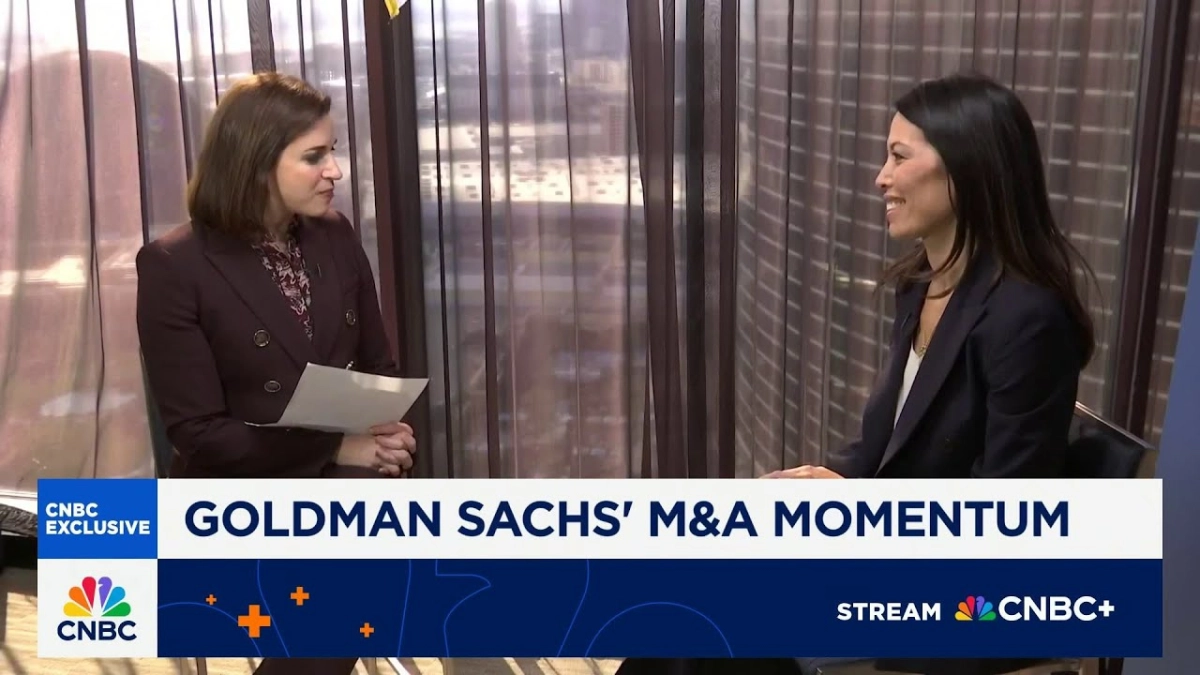
"AI will be absolutely transformative and value-creating across industries over time," asserted Kim Posnett, Goldman Sachs' Global Co-Head of Investment Banking, encapsulating the pervasive optimism surrounding artificial intelligence, even as market participants grapple with the specter of a potential bubble. Posnett recently spoke with Leslie Picker on CNBC's "The Exchange," offering a comprehensive perspective on the state of the AI trade, the significant debt issuance by hyperscalers, and the broader M&A and IPO landscape influenced by this burgeoning technology.
Confidence in the enduring impact of artificial intelligence permeates the financial sector, yet the question of whether the current surge in AI-related valuations signals an impending bubble remains a topic of intense debate. Posnett directly addressed this "multi-trillion dollar question," drawing parallels to the internet sector's revolutionary impact but emphasizing AI's "much greater scale, it's much faster, and there's much, much broader applicability across consumer and enterprise." This fundamental difference suggests that while the hype is real, the underlying technological shift is even more profound than previous eras of innovation.
Goldman Sachs' own equity research provides a historical lens, examining 51 periods of major technological innovation over 175 years, from 1825 to 2000. Their findings reveal that 75% of these periods ultimately led to equity price bubbles. However, their current analysis indicates that the market has not yet reached a similar bubble state for AI. Posnett, while acknowledging the research, offered a more cautious personal assessment: "I think it's still too early to tell." This nuanced view highlights the difficulty in definitively classifying market conditions during periods of rapid, foundational change.
The journey for AI, according to Posnett, will undoubtedly be one of long-term growth. "I do think that the path will be up and to the right over time. I just don't think it'll be a straight line." This perspective underscores the inherent volatility and speculative elements that accompany groundbreaking technologies. There will be "ups" and "downs," "winners" and "losers," as capital is allocated at an unprecedented pace. The challenge for investors and market participants lies in discerning which companies possess sustainable models and which are merely riding the wave of enthusiasm. The ultimate distribution of value across the complex AI ecosystem remains an open question, with time being the sole arbiter.
A significant point of discussion revolved around the substantial debt issuance by hyperscalers, raising concerns about potential overextension. Posnett clarified that the majority of this capital raising is indeed driven by these large, established players. Debt investors are actively seeking greater exposure to these entities, viewing them as robust vehicles for long-term growth. This is not a case of reckless borrowing. "The hyperscalers are huge, diversified businesses with enormous amounts of EBITDA and cash flow and balance sheet capacity. They're at the very high quality end of the investment grade market." Even after these substantial capital raises, these companies maintain "very healthy credit metrics" and possess additional debt capacity, suggesting a solid financial footing rather than speculative leveraging. The slight widening of credit spreads observed is attributed to debt investors recalibrating to the increased aggregate debt volume, rather than signaling distress.
Another potential red flag raised by the interviewer was the "circularity" of deals, where model companies, infrastructure providers, and hyperscalers engage in a web of strategic partnerships and investments. This interconnectedness, some argue, could amplify risk in the event of a market correction, echoing concerns from past tech booms. Posnett acknowledged the dual nature of this trend, stating, "Some would argue that these are very strategic partnerships and strategic investments in an AI ecosystem that is merited because of the size of the opportunity. Others would argue that the interconnectedness creates elevated risk, especially in the event of a correction. And I think probably both are true." This balanced perspective suggests that while collaboration is essential for innovation and market expansion, it also introduces systemic dependencies that warrant close monitoring.
Beyond the immediate dynamics of AI, Posnett pointed to a confluence of broader macroeconomic factors contributing to current market confidence and activity. A "pro-growth US administration," a "constructive regulatory environment," and a "continuing Fed easing cycle"—with potential rate cuts on the horizon—are all creating a favorable backdrop. Coupled with equity markets near all-time highs and robust public market valuations, these elements collectively foster a climate of elevated CEO confidence. This renewed optimism, she concluded, is directly fueling the observed uptick in M&A and IPO activity across various sectors, with AI serving as a powerful, overarching growth catalyst. The current market environment, therefore, is not solely defined by AI's promise, but by a complex interplay of technological disruption and supportive economic conditions.



