

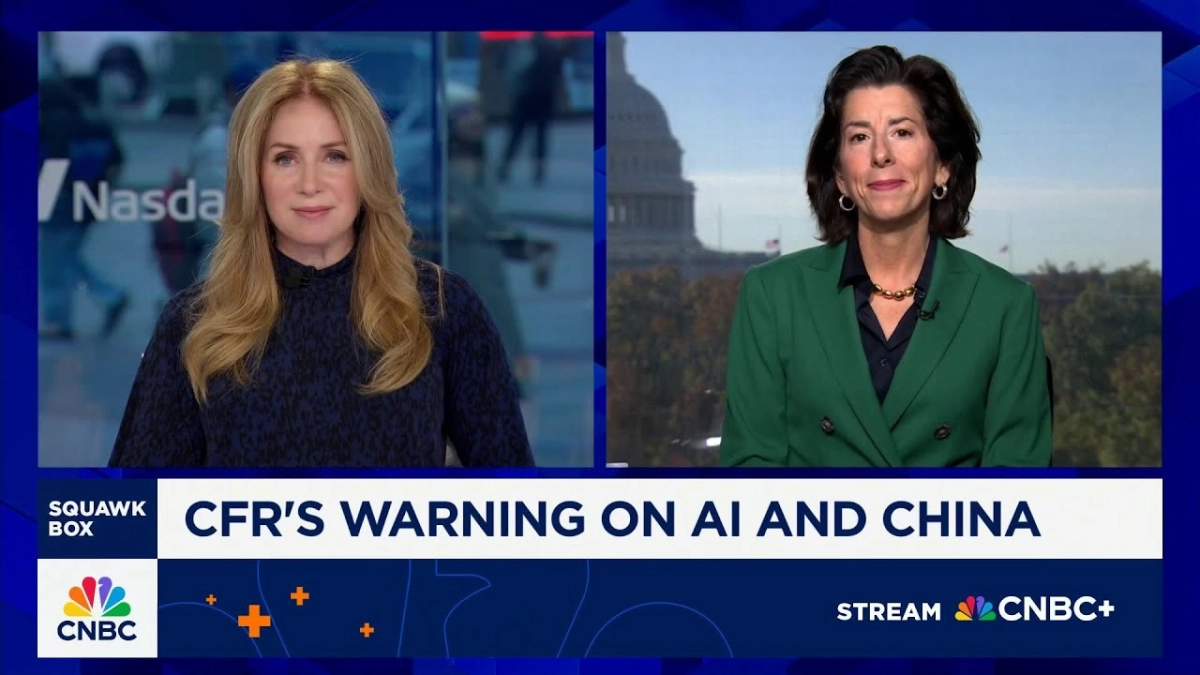
"In order to win and outcompete China, the U.S. needs to lead in AI, quantum, and biotech." This declaration from former Commerce Secretary Gina Raimondo, speaking with CNBC's "Squawk Box," sets a clear strategic imperative for the United States. Her participation in a discussion about a new bipartisan report from the Council on Foreign Relations on economic security and strategic competition in emerging technologies highlights the critical juncture at which the nation finds itself. The report underscores that the technological race with China is not merely about economic advantage, but fundamental national security.
Raimondo emphasized the urgency of the situation, noting that while bipartisan agreement is rare these days, the report's findings on economic security and competition in emerging technologies resonated across the political spectrum. This consensus is crucial, as the United States faces significant challenges in maintaining its technological edge, particularly against China's aggressive advancements. The report, which Raimondo co-chaired, identifies AI, quantum computing, and biotechnology as the key battlegrounds where this competition is being waged.
A core insight from Raimondo's commentary is the direct link between technological leadership and national security. She stated, "We really need to lead in AI, quantum, and biotechnology. That means everything from staying ahead, you know, out-innovating faster than China, but also securing our supply chains." This dual focus on innovation and supply chain resilience is paramount. The pandemic exposed vulnerabilities in global supply chains, and the report aims to address how the U.S. can bolster its domestic capacity in critical technology sectors to mitigate risks and ensure national security.
The discussion also touched upon the effectiveness of current trade policies, particularly tariffs. Raimondo acknowledged that while tariffs can be a tool, they are not a panacea. She indicated that the effectiveness of such measures is often debated, and that a broader strategy is required. This implies a need for more nuanced approaches that foster domestic innovation and strengthen alliances, rather than relying solely on punitive measures.
A significant concern raised was the extent of China's investment and focus on these critical technologies. Raimondo highlighted that "China is obsessively focused. The PRC has increased its investment in biotech by 400x in the past 10 years." This staggering figure underscores the scale of China's commitment and the potential for them to gain a decisive advantage if the U.S. does not respond with commensurate urgency and investment. The report’s findings suggest that the U.S. must not only invest but also ensure that its innovations and supply chains are secure and not overly reliant on adversarial nations.
The conversation also delved into the specific vulnerabilities within these sectors. Raimondo pointed out, "We are dangerously dependent on China for things like rare earth minerals, for things like lithium, other metals, and for things like penicillin and other pharmaceuticals." This dependence creates strategic vulnerabilities that China could potentially exploit. The report advocates for a comprehensive strategy that addresses these dependencies by fostering domestic production and diversifying supply chains, ideally through collaboration with allies.
Raimondo stressed that the approach to competition should not solely be about restricting China, but more importantly, about bolstering the U.S. ecosystem. "We have to invest more in the U.S., we recommend setting up a system of biotech hubs around the country, but also rely on our allies," she articulated. This collaborative approach, combined with strategic domestic investment, is seen as the most effective path to maintaining American leadership. The report emphasizes leveraging the strengths of the U.S. system, including its deep capital markets and innovative spirit.
When questioned about whether the U.S. is falling behind, Raimondo offered a nuanced perspective. She acknowledged concerns, particularly regarding China's rapid advancements, but maintained an optimistic outlook on the U.S. capacity to compete. "We can win. Let me state that. We can win. We are the best country in the world," she asserted. However, she immediately followed this with a call to action: "But we have to lean in. We have to accelerate. We have to have much more secure supply chains than we do today in all three areas." This highlights that while the U.S. has inherent strengths, proactive and strategic action is indispensable.
Related Reading
- AMD's Strategic AI Gamble: Lisa Su on a Trillion-Dollar Opportunity
- Anthropic announces $50B nationwide AI infrastructure buildout
- AMD CEO Lisa Su: AI Investment is "The Right Gamble" in a Trillion-Dollar Market
The strategy proposed by Raimondo and the CFR report centers on leveraging the U.S.'s inherent advantages. "The U.S. has the deepest capital markets, the best innovation flywheel, risk-taking culture, fantastic colleges and universities," she noted. The key is to harness these strengths effectively. This involves not only government investment but also incentivizing private sector investment to build out domestic capabilities in critical areas like manufacturing and research. The report's focus on incentivizing private sector investment is a recognition that government alone cannot achieve these goals; it must partner with and encourage industry.
Ultimately, the message from Gina Raimondo is one of urgency and strategic focus. The U.S. must actively cultivate leadership in AI, quantum, and biotech, not just to secure economic prosperity, but to safeguard national security. This requires a multifaceted approach that combines innovation, supply chain resilience, international cooperation, and a commitment to leveraging the nation's unique strengths. The report serves as a roadmap, but its recommendations demand swift and decisive action to ensure America remains at the forefront of technological advancement.

