

Pondering the profundity of ChatGPT has become commonplace, even among the non-tech folk. ChatGPT, OpenAI's revolutionary text-generating AI chatbot, has taken the world by storm for its capacity to write essays, generate code, and complete a multitude of tasks given only short text prompts, with responses superior to that of a human expert. It’s been hailed as the most successful consumer app ever, and it has ushered in a new era of tech, the likes of which we haven’t experienced since perhaps the internet becoming widely accessible.
As consumers first benefited from the goldrush of ChatGPT powered apps, startups and corporations are coming out of the woodwork to capitalize on this trend with native integrations. Due to this emerging trend, analysts forecast that the Generative AI market will grow at a CAGR of 58% over the next five years. By 2030, the technology is expected to contribute $15 trillion to the global economy.
While there's an evident slowdown in the global venture capital asset class, Generative AI continues to undergo robust investment activity. Microsoft invested $10 billion investment in OpenAI; Google invested $450 million in Anthropic; Microsoft, Reid Hoffman, Bill Gates, Eric Schmidt and Nvidia invested $1.5 billion in Inflection AI; and Cohere raised $270 million; and Adept raised $350 million. Israel's Generative AI ecosystem shares similar investor enthusiasm, albeit at a smaller scale, attracting a combined $257 million in 2023 (according to StartupHub.ai data).
A number of giant enterprise software companies have recently announced the integration of Generative AI into their solutions. Salesforce released AI Cloud that links its offerings including Einstein, Data Cloud, Tableau, Flow and MuleSoft to multiple LLMs. Accenture has announced a commitment of $3 billion to AI over three years to be able to offer solutions to its clients using the technology and has created a platform to allow clients access to all the main LLMs. Oracle, taking a slightly different approach, partnered with Cohere to create its own AI solution and LLMs and allow clients to create their own LLMs trained on their internal data.
The very latest advancement in the field is Nvidia's recent announcement of the wide-accessibility of its cloud-based AI supercomputing software service, DGX Cloud. Powered by thousands of virtual Nvidia GPUs, which allows organizations to remotely train large, complex LLMs and other Generative AI models without the need to operate a supercomputing data center. Amazon also introduced two language models via its Amazon Web Services, supporting customers in building bots.
In the broader market, there has been a huge discrepancy in performance in 2023 between the S&P 500 representing all sectors and the indices such as the Nasdaq and NYSE Tech Index. This outperformance is due to some of the largest tech stocks such as Microsoft, Alphabet, Apple, Amazon and more recently Nvidia, that are seen as the main beneficiaries of the Generative AI boom and dominate these indices. These stocks are responsible for almost all the gains in the S&P 500 this year but have much higher weightings in the other two indices which is why they have outperformed.
This outperformance by the largest incumbents has been largely due to their offerings in Generative AI. Although there are also many startups in this area, the market seems to be suggesting that the largest companies will be able to create walls around their AI products which will allow them to dominate this market and dramatically increase their earnings.
Nevertheless, companies of all sizes are clamoring to integrate cutting-edge LLMs into their offerings - the main trend underway. Users are able to query ChatGPT and give it context in each prompt. If one wishes to create a model that already understands their company’s internal files, this could be achieved with low-code and no-code tools, using a vector database like Pinecone. Nevertheless, ServiceNow debuted AI Lighthouse, a collaboration with Nvidia and Accenture, to empower enterprises to swiftly build and deploy their custom Generative AI models, offering an accessible pathway for businesses to harness the transformative power of AI without the need for extensive infrastructure or in-house expertise. This really is the first time that inquiries can be answered with exact precision, and cuts the time spent searching from hours and even days to seconds. Will divisions like customer support become obsolete?
Scores of companies have already eagerly embraced the technology, some in lieu of their own IP. With LLM foundational models becoming more accessible and effective, businesses that fail to adapt may find themselves below par.
What is having a more immediate effect is the internal use to improve efficiency in areas such as coding, testing, copywriting, design, customer support, leading to strong gains in productivity. “We expect to see more than a 30% efficiency increase in each company over the coming year” says Gigy Levy Weiss, co-founder and General Partner at NFX, about his portfolio companies.
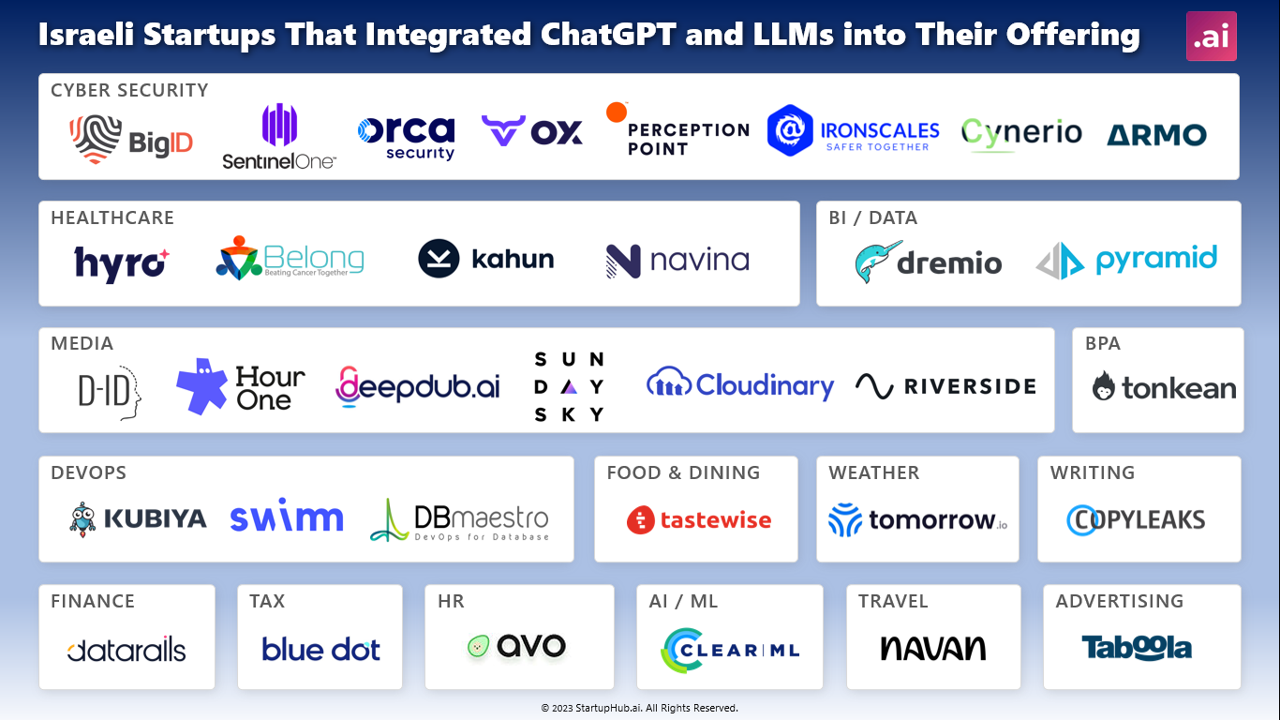
Here are some of the Israeli companies that are integrating outside LLMs into their products according to information received by StartupHub.ai: (Note: this list is not exhaustive).
[elementor-template id="506047"]Dot Compliance has introduced an AI-powered electronic Quality Management System (eQMS) for life sciences, leveraging ChatGPT and proprietary algorithms. The system streamlines quality processes and automates tasks, reducing costs associated with regulatory fines and delays. The technology accelerates product development and market launch while minimizing risks tied to penalties and product recalls.
Taboola (NASDAQ: TBLA) is experimenting with integrating Generative AI, including ChatGPT, into its ad platform to enable advertisers to quickly generate multiple ad variations through text queries. The AI-generated ads will be performance-driven, using data from billions of Taboola's ad engagements. Currently in limited Beta testing, the AI-powered ad creation tool aims to revolutionize the way advertisers create and optimize their ads, and is expected to be available to advertisers later this year.
Generative AI technologies like ChatGPT, BARD, Claude 2 and Meta's recently released LLaMa 2 may reshape the advertising industry by serving ads directly in AI-generated responses. Microsoft's Bing chatbot is already incorporating more ads in its chat experience. It remains uncertain how this will impact ad networks like Taboola and Outbrain in the future. Morgan Stanely recently reported that one fifth of all advertising globally in 2022 was digital, with a potential $780 billion in ad spending still offline. AI, LLMs and Generative AI creation tools could help advertisers better target customers online, leading to improved paid and organic results from search engines, higher engagement in social media and online video, and more sales from ad units.
AppsFlyer launched measurement and Data Clean Room support for ChatGPT and Bard plugins. With this new functionality, AppsFlyer enables brands to measure engagement and lifetime value (LTV) within ChatGPT plugins – and to also see their LTV across multiple channels, side-by-side. For example, they can compare the total revenue of a travel app between mobile and ChatGPT.
Barak Witkowski, Executive Vice President, Product at Appsflyer sees huge potential from adding LLM capabilities: “The new plugins have created a massive opportunity for brands to increase revenue while exploring new customer experiences”. But he also cautions as to how they will actually need to be used: “They have also created yet another siloed platform for brands to measure.”
Podcasting and deep media startups Riverside.fm and D-ID integrated ChatGPT to provide more seamless content creation and content editing capabilities. Riverside.fm leverages ChatGPT to assist podcasters in planning, repurposing, and overcoming creative slumps in their podcast episodes, while D-ID combines their text-to-video streaming technology with ChatGPT to make conversations with AI more accessible through a web app. By harnessing the power of ChatGPT, both companies offer their users the ability to produce professional content more easily, streamlining their production processes and enhancing their overall performance.
Similarly, Tastewise is using ChatGPT to amplify their users’ ability to query recipes and size up the trending foods in one command text. TasteGPT provides real-time product, dish, menu, and marketing campaign recommendations, generating ready-to-share reports and decks, including trends, and ingredient pairings.
Commenting on the technology, Yorai Fainmesser, General Partner and founder of VC Disruptive AI sees this moment as a platform shift. "Within the next 18 months, I believe every company and business will make use of Generative AI technology. I haven’t seen Automatic Speech-Recognition (ASR) catchup like Computer Vision and Natural Language Processing (NLP), but it’s the next step and I do anticipate a platform bringing speech to the mix, in real-time."
Kubiya, the DevOps self-learning, headless internal developer platform announced their integration recently, launching the first AI assistant for engineering platforms and knowledge management, with a ChatGPT-like experience for users. The tool simplifies access to DevOps functions and answers questions from knowledge systems such as Notion and Confluence.
Amit Eyal Govrin, CEO, sees LLMs as a gamechanger for his users. “For the first time humans and machines have found a common language. Specifically this newfound capability helps unlock organizational efficiency through knowledge, communication and context-awareness in ways that have never been seen before - especially for Developer and Operations personas who historically have had a complicated relationship.”
Ultimately, all of them find value in the tool's ability to process and understand natural language, which allows for more efficient and accurate machine-interactions, benefiting both the organizations and their end-users.
But when looking at AI startups, some might suggest that their valuations should be lower as they integrate the foundational models at the expense of their own tech and capital. In other words, their own IP is less valuable, especially if the startup is working on deep NLP tech.
Others disagree. One AI expert says that a company’s own data and datasets are still integral and constitute a moat. It is imperative, now more than ever, for organizations to design, develop and deploy AI responsibly and to ensure data quality and the robustness of training data.
All things considered, Generative AI is expected to grow significantly in the coming years. According to various reports, the global Generative AI market size is anticipated to reach between $110-127 billion by 2030-2031, with a projected CAGR of 32-35.6% from 2022-2023 to 2030.
Booms are always followed by criticism. Some argue the potential negative consequences of Generative AI’s proliferation, upending the multi billion dollar investments made directly into other AI technology to achieve the same result, and the problematic nature of the models that do not attribute where they are getting their information from.


