

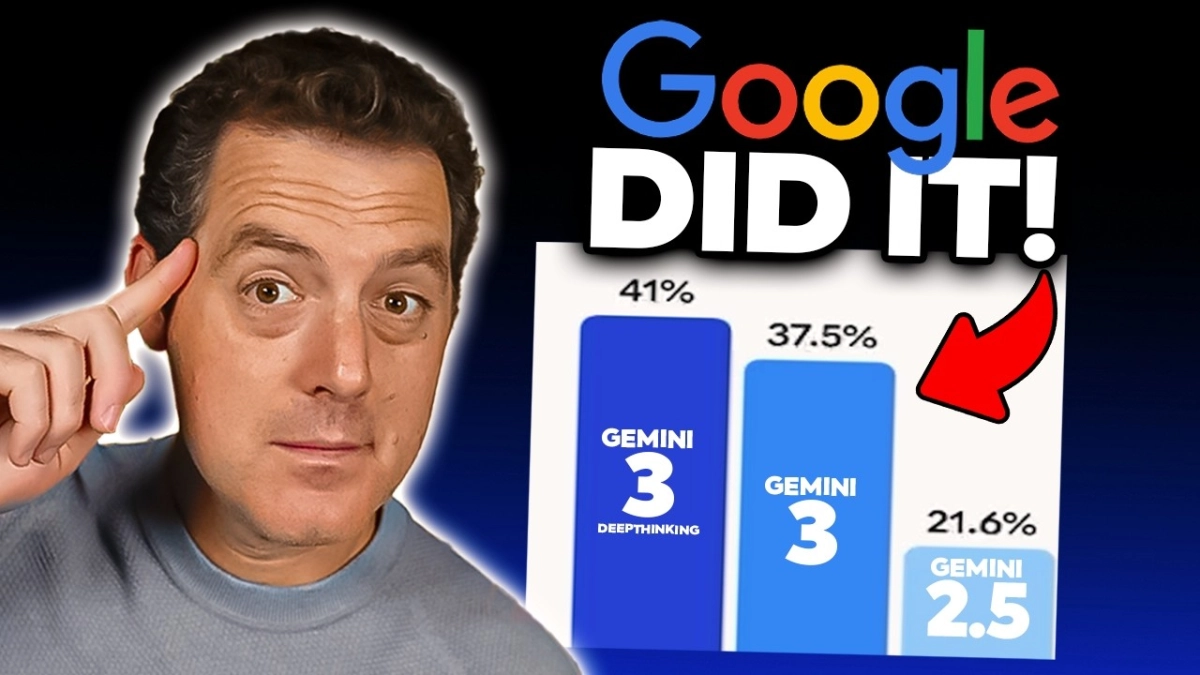
"Gemini 3 is here, and my goodness, it was worth the wait," exclaimed Matthew Berman, a prominent AI commentator, as he unveiled Google's latest iteration of its foundational AI model. Berman’s enthusiastic review highlighted not just the technical prowess of Gemini 3, but also Google's aggressive strategy to embed this advanced intelligence across its vast product ecosystem, signaling a significant shift in the competitive landscape for founders, VCs, and AI professionals. The launch introduces Gemini 3 Pro, a preview of Gemini 3 Deep Think, and a host of integrated applications, all designed to push the boundaries of multimodal reasoning and practical application.
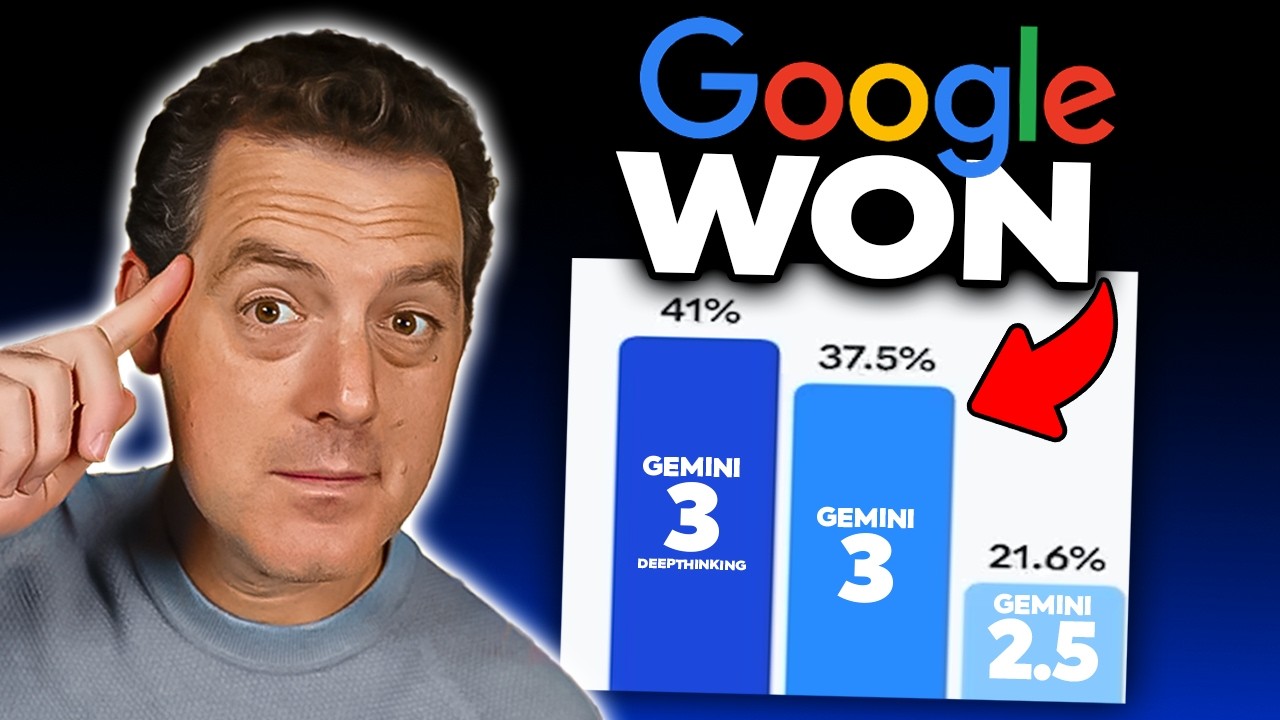
Berman's commentary primarily focused on the remarkable benchmark performance of Gemini 3 Pro, which he presented as decisively outperforming other frontier models like Claude Sonnet 4.5 and GPT-5.1 across a spectrum of challenges. On "Humanity's Last Exam," a test of academic reasoning, Gemini 3 Pro achieved 37.5% without tools and an impressive 45.8% with search and code execution, significantly eclipsing its rivals. Similarly, in visual reasoning (ARC AGI-2) and scientific knowledge (GPQA Diamond), Gemini 3 Pro demonstrated substantial leads, boasting 31.1% and 91.3% respectively, compared to single-digit or low double-digit percentages from competitors. The model even aced the AIME 2025 mathematics benchmark with 100% accuracy when leveraging code execution, underscoring its robust problem-solving capabilities.
A particularly compelling aspect of Gemini 3's launch is the introduction of "Deep Think," a variant designed for enhanced, token-intensive reasoning. This model variant demonstrates even more profound improvements in complex tasks. On the ARC-AGI-1 visual reasoning puzzles, Gemini 3 Deep Think achieved a staggering 45.1%, a nearly ten-fold improvement over its predecessor, Gemini 2.5 Pro, and significantly higher than competitors. This capability to interpret abstract patterns and generalize from minimal examples points towards a genuine leap in abstract intelligence, a crucial step toward Artificial General Intelligence.
Beyond raw benchmarks, Gemini 3 distinguishes itself through its native multimodal architecture, seamlessly processing text, images, audio, video, and code. Berman emphasized the "unique one" among these modalities: video. With an unprecedented 1-million-token context window, Gemini 3 can analyze entire YouTube videos frame-by-frame, understanding visual and auditory cues far beyond mere transcription. This deep video comprehension unlocks capabilities such as automatic chapter marking and granular content analysis, transforming how information can be extracted and utilized from dynamic media.
Google's strategic integration of Gemini 3 into its core products marks a pivotal moment. The rollout of "AI Mode" within Google Search, powered by Gemini 3, promises to revolutionize information retrieval. This mode dynamically generates user interfaces and custom search result pages based on complex queries, providing interactive explanations and visual diagrams rather than static links. "This was written by Gemini 3," Berman noted, referring to a dynamically generated explanation of RNA polymerase, illustrating how search is evolving from passive information delivery to active, personalized learning experiences.