


In a recent video, Garry Tan, President & CEO of Y Combinator, showcased four open-source AI projects that he believes represent the future of human-AI interaction and business automation. The projects, including gstack, Hermes Agent, and Paperclip, offer a glimpse into a future where AI agents are not just tools but integrated components of a company's operational infrastructure. Tan, a seasoned investor and entrepreneur with a deep understanding of the startup ecosystem, highlighted how these projects are pushing the boundaries of what's possible with AI, particularly in the realm of autonomous agents.
Garry Tan's Vision for AI Agents
Tan, who has invested in and seen thousands of startups, including giants like Coinbase, Instacart, and Airbnb, brings a wealth of experience to his analysis of emerging technologies. He frames the current AI landscape as being on the cusp of a significant revolution, driven by the development of sophisticated AI agents. He quotes Andrej Karpathy, who noted that the pace of AI development has shifted dramatically, with individuals now able to accomplish tasks previously requiring large teams.
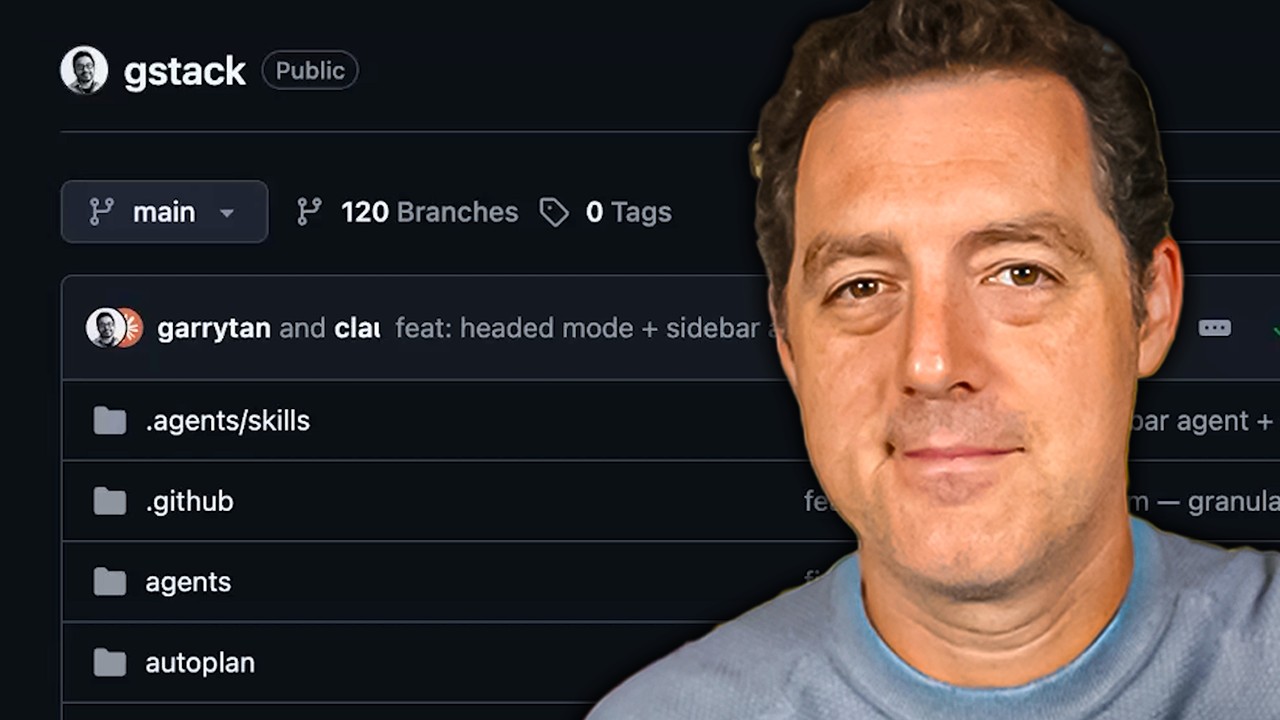
Tan's presentation focuses on projects that embody this shift, specifically highlighting gstack. He describes gstack as a framework for orchestrating AI agents, allowing them to work together on complex tasks. The project, which has rapidly gained traction on GitHub with tens of thousands of stars, is presented as a way to leverage the power of AI agents for a wide range of applications, from web browsing and task automation to more complex workflows like design consultation and code review.
Key AI Agent Projects Explored
gstack: The Orchestration Framework
Gstack, developed by @garrytan, is presented as a foundational tool for building and managing AI agents. Tan emphasizes its open-source nature and its ability to integrate with various AI models and endpoints. The framework offers a suite of pre-built 'skills' that agents can utilize, allowing for modularity and extensibility. The installation process is described as straightforward, with a quickstart guide provided for immediate use. Tan demonstrates how gstack can be used to chain together different skills, enabling agents to perform complex, multi-step tasks autonomously.
Hermes Agent: The Self-Improving AI
Hermes Agent is highlighted as an AI agent built by Nous Research that focuses on a built-in learning loop. Its core functionality involves creating skills from experience, nudging itself to persist knowledge, and searching its own past conversations. The agent is designed to build a deepening model of the user it interacts with, running across sessions and leveraging a GPU cluster or serverless infrastructure. Tan notes its viral growth on GitHub, indicating strong community interest. The agent's ability to self-improve and adapt based on interactions is presented as a key differentiator.