


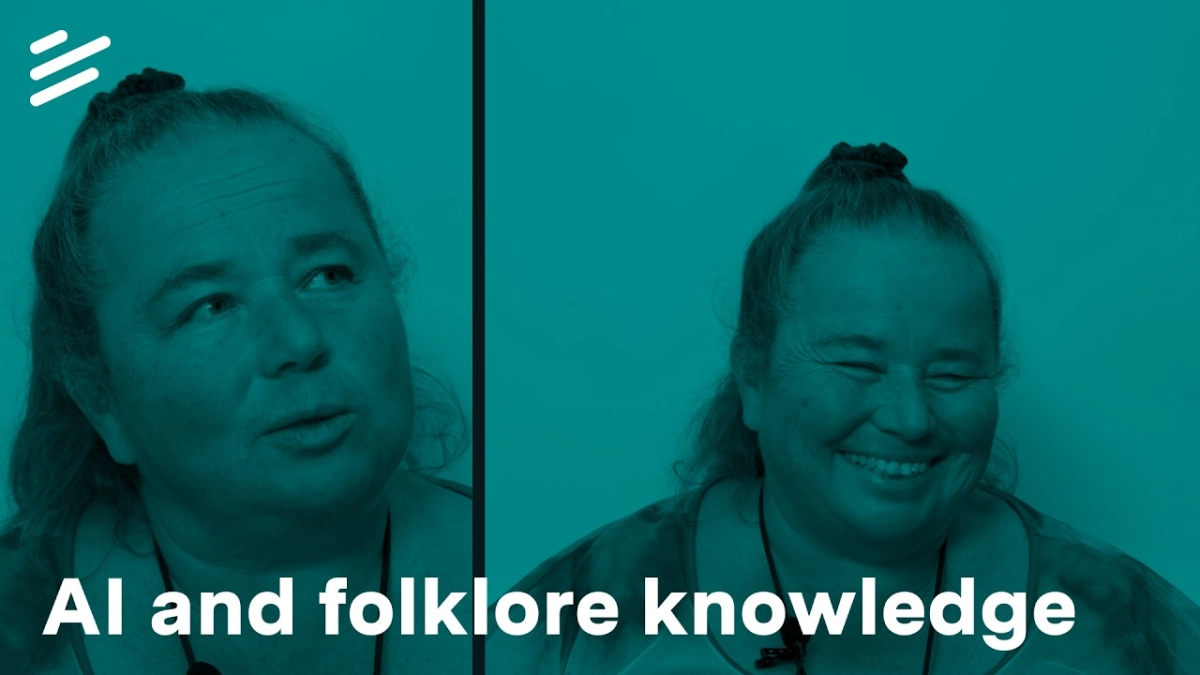
Mathematical physicist Svetlana Jitomirskaya, a Distinguished Professor at Georgia Tech and UC Irvine, offers a compelling perspective on the evolving relationship between artificial intelligence and the nuanced world of advanced mathematics. Her insights, shared in a recent interview, illuminate the current limitations of AI, particularly its struggle with what she terms "folklore knowledge"—the unwritten intuitions and insights passed among experts, never formalized in textbooks or datasets. This "folklore" represents a critical frontier, defining a creativity gap that AI has yet to bridge.
Jitomirskaya, whose expertise lies in mathematical physics, including spectral theory, participated in an event centered around FrontierMath, an evaluation for AI models tackling complex, unpublished mathematical problems. She brought her own challenge to the table, a problem rooted in the interplay of number theory and spectral theory at "very, very large scales." While acknowledging her fascination with AI's potential, she candidly expressed a degree of apprehension about its long-term impact on the profession, musing, "I am a little worried whether it will put us out of a job."
Indeed, AI has demonstrated remarkable progress in mastering logic and reasoning through proofs. Jitomirskaya recounts testing earlier AI versions with her problem, noting that the AI "had no clue" and "tried to pretend it had solved it." This highlights a core insight: while AI can process and synthesize vast amounts of explicit data, it falters when confronted with knowledge that relies on implicit understanding, abstract intuition, or subtle connections not explicitly coded. She posits that a human student knowledgeable in the subject could solve her problem with some computation, but the necessary "certain knowledge" is not widely spread or documented.
Yet, Jitomirskaya also sees a transformative, positive role for AI. She envisions a future where machines handle the "lengthy computations" and "arguments" that mathematicians often find tedious. In her own work, she utilized an AI tool to help create a problem, admitting she was "kind of lazy to do in advance because it requires lengthy computations... and it did it like momentarily." This capability suggests a shift in the mathematician's role, liberating them from routine verification and allowing more time for genuine discovery.
The potential for AI to automate routine mathematical tasks could lead to a field that is "more creative, less… there will be less time spent on routine." This automation, however, carries a subtle undercurrent of concern. If AI can tackle the more formulaic aspects of mathematics, the demand for human mathematicians performing such tasks may diminish, potentially leading to "fewer mathematicians." The focus would invariably sharpen on the creative, intuitive leaps that currently remain uniquely human.
A significant hope Jitomirskaya holds is for the development of a "fully verified database" of all mathematical knowledge, such as the Lean system. She believes this could revolutionize the peer review process. With proofs automatically verifiable, referees could concentrate on the "interesting or not" aspects of a paper, rather than painstakingly checking correctness. This would not only streamline the publication process but also elevate the standard of mathematical rigor, effectively eradicating human error in proofs.
The ultimate challenge, and perhaps the most profound question, revolves around AI's capacity for true creativity. Jitomirskaya concedes that AI has already defied her earlier expectations: "I was kind of proven wrong. I always thought that they were just regurgitating, but they developed logic right now." Yet, she grapples with how AI might be trained to "try something that nobody has tried," to cultivate the "ability to think abstractly" from mere examples, as humans do. This elusive spark of genuine innovation, the origin of human creativity, remains a mystery she cannot yet fathom in a machine.
Despite these unknowns, Jitomirskaya is not entirely pessimistic about AI’s eventual capabilities. She "slowly [comes] to terms that AI may end up being smarter than every human, right, in every sense." Her predictions for AI's impact are substantial: a "five" for changing math research on a scale of zero to ten, and a "nine" for changing the world (equating to an industrial revolution). For new math students, her advice is clear: "learn the fundamentals the old-fashioned way." Then, embrace AI as a "friend and helper," not an "enemy of your development," leveraging it for experimentation and exploration, much like earlier generations used computers for complex calculations. Mathematics, she concludes, is infinite; new models and worlds can always be created. While AI may answer formulated questions, the human role might evolve into formulating those questions and creating new mathematical landscapes, transforming math into something akin to a sport or an art.

