

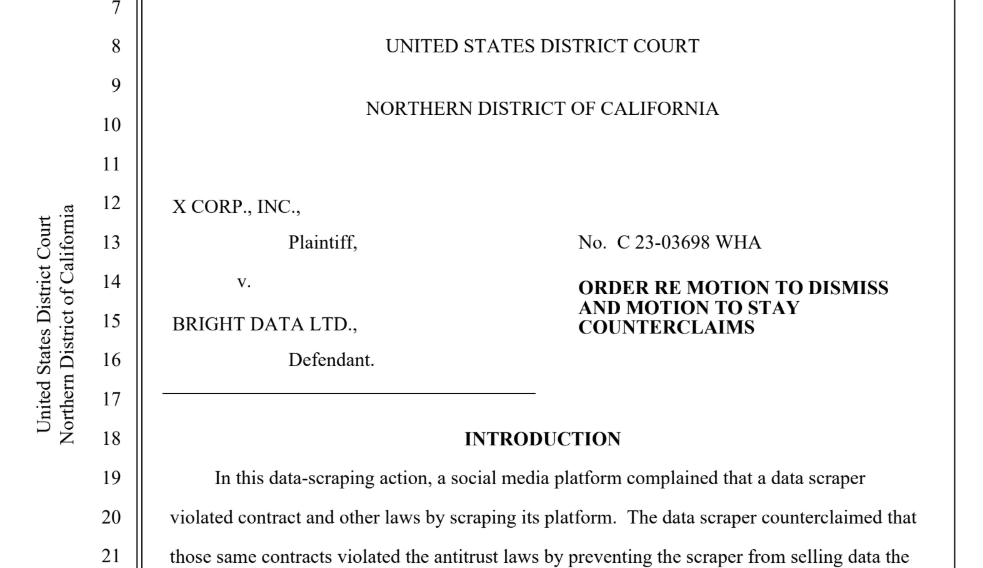
In the latest development of the ongoing legal saga over public web data, a federal court has rejected X Corp.'s (formerly Twitter) attempt to dismiss antitrust counterclaims brought by data collection company Bright Data. This ruling allows Bright Data's significant challenge against X's data practices to proceed.
This decision follows a previous ruling in May 2024, where the same court dismissed X's initial lawsuit against Bright Data. In that instance, X had accused Bright Data of unlawfully scraping data, but the court found X. failed to substantiate its claims. Now, the focus shifts to Bright Data's counterclaims.
The current dispute centers on changes X implemented after acquiring Twitter. Bright Data alleges that X unlawfully altered its Terms of Service to block data scrapers, aiming to monopolize the market for "public-square data", the real-time information shared on platforms like X. This data is increasingly valuable, particularly as X commercializes it through ventures like its AI arm, xAI.
The court found Bright Data's antitrust allegations plausible, noting that X Corp.'s updated terms, which now prohibit crawling and scraping without written consent and impose hefty liquidated damages, could constitute monopolization and an unreasonable restraint of trade under US antitrust law. The ruling highlighted the potential anti-competitive impact of terms preventing X users from dealing with alternative data providers like Bright Data.
"X’s exclusionary conduct effectively locked out competitors and forced customers into restrictive agreements," said Or Lenchner, CEO of Bright Data, reacting to the latest ruling. "These actions were taken while X moved to commercialize the same data through the AI venture, xAI."