


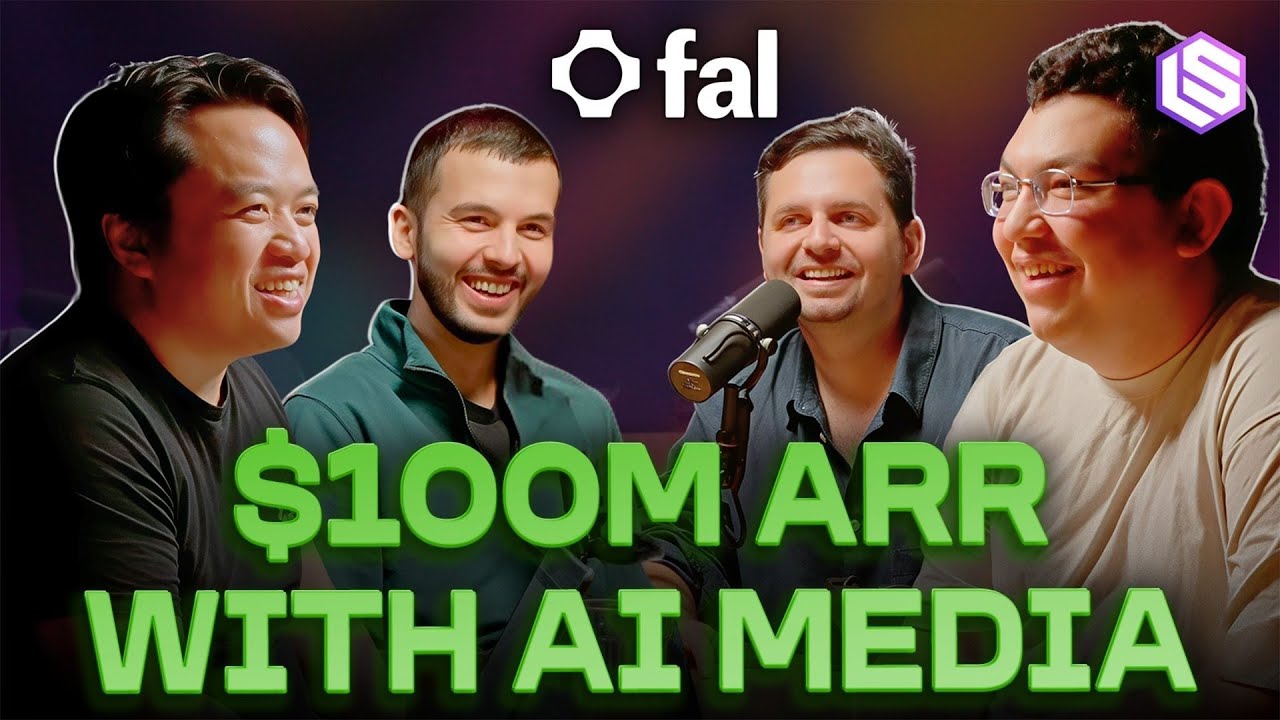
The ascent of Fal.ai, the generative media inference provider that recently secured a $125 million Series C round and crossed $100 million in ARR, offers a compelling narrative of strategic pivots and hyper-optimized execution in the rapidly evolving AI landscape. This success story, unpacked in an interview featuring Fal.ai’s CTO Gorkem Yurtseven and Head of Engineering Batuhan, alongside Alessio Fanelli of Kernel Labs and co-host Swyx, illuminates the critical factors driving innovation and market dominance in the generative AI space. The discussion, hosted by the Latent Space Podcast, delved into Fal.ai’s journey from optimizing Python runtimes to becoming a leading platform for image, video, and audio model inference.
Fal.ai’s journey began with an initial focus on building a feature store and then a Python runtime in the cloud. However, as Gorkem Yurtseven explains, a pivotal moment arrived with the release of Stable Diffusion 1.5. “We noticed like we had the serverless runtime and everyone was running the Stable Diffusion 1.5 by themselves, and we noticed it’s terrible for utilization and they are not optimizing it.” This observation sparked a crucial strategic decision: to shift towards optimizing inference for generative media models and offer it as an API. This pivot was not merely opportunistic; it was a response to a clear market inefficiency and a foundational insight that optimization, particularly for the burgeoning diffusion models, would be a key differentiator.
A core insight from the interview is that differentiation in the generative media space isn't just about raw model performance, but about the underlying infrastructure's efficiency and developer accessibility. Batuhan articulated this succinctly: “We don’t add a model that’s like significantly worse in any aspect compared to other models that we have. We are trying to bring unique models that solve a customer’s needs.” This philosophy ensures that Fal.ai's platform hosts a curated selection of models, each excelling in specific use cases, from logo generation to human face generation, rather than simply offering a vast, undifferentiated catalog. This approach caters directly to product engineers and mobile developers, abstracting away the complexities of GPU deployment and custom kernel development.
The technical prowess underpinning Fal.ai’s success is remarkable. The team’s deep expertise in low-level optimization, including CUDA kernel development and compiler engineering, has allowed them to achieve significant performance gains. Batuhan, a former core developer of the Python language, highlighted the initial state of affairs: “The space was actually so, so much worse than what we have today, where like running basic Stable Diffusion 1.5 was like a UNet with convolutions, and the convolution performance on NVIDIA was like, you’re getting like 30% of the GPU power if you just use raw PyTorch because no one cared about it.” This stark reality presented a massive opportunity. Fal.ai's ability to extract substantially more performance from GPUs (often 10x faster than self-hosted solutions) translates directly into lower costs and faster iteration cycles for their users, fostering engagement and driving adoption.
Another critical insight is the strategic advantage of specializing in generative media rather than competing in the broader, heavily resourced large language model (LLM) inference market. Gorkem explained this crucial decision: “A lot of the inference providers at the time, there were maybe a couple of them, and they all went all in on language models, and we decided, you know, language models, hosting language models is not a good business at the time. We thought, okay, we are going to be competing against OpenAI and Anthropic and all these labs.” This deliberate choice to focus on a "net new market" in generative media, rather than vying for market share with tech giants, allowed Fal.ai to define its own space and build a leadership position. This strategic clarity, combined with their technical edge, has been instrumental in their rapid growth.
The importance of latency in generative media workflows, particularly for video, cannot be overstated. Gorkem shared a telling anecdote: a customer's A/B test revealed that intentionally slowing down inference latency significantly impacted user engagement metrics. "It's almost like page load time. When the page loads slower, you make less money. It's very similar." This direct correlation between speed and user retention underscores why Fal.ai prioritizes sub-second inference times, especially as video models become more sophisticated and interactive. The goal is to provide instantaneous feedback loops for creators, enabling rapid iteration and fostering a seamless creative experience.
Fal.ai’s dedication to staying at the forefront of hardware innovation, including optimizing for Blackwell and other next-generation GPUs, further solidifies its position. While the open-source community rapidly catches up on software optimizations, the continuous evolution of hardware creates a perpetual moving target for peak performance. This necessitates constant, deep-level engineering work, as Batuhan explained: "We are at that point where we should be the ones pushing the boundaries on Blackwell because no one else is doing this work." This proactive approach to hardware optimization ensures Fal.ai maintains its performance leadership, offering clients access to cutting-edge capabilities long before they become widely accessible or easily replicable. The company’s success is a testament to identifying a niche, executing with technical excellence, and consistently staying ahead of the curve in a dynamic technological landscape.

