

“This time it’s different.” So declared Sarah Guo, founder of AI-native venture fund Conviction, at the AI Engineer World's Fair in San Francisco. Guo offered a sharp assessment of the current state of artificial intelligence startups and investment, highlighting key trends and opportunities for builders and investors alike. Her perspective emphasized that the current AI revolution transcends previous technological shifts due to its unprecedented user uptake and the sheer scale of value creation, despite the inherent complexities of AI product and engineering.
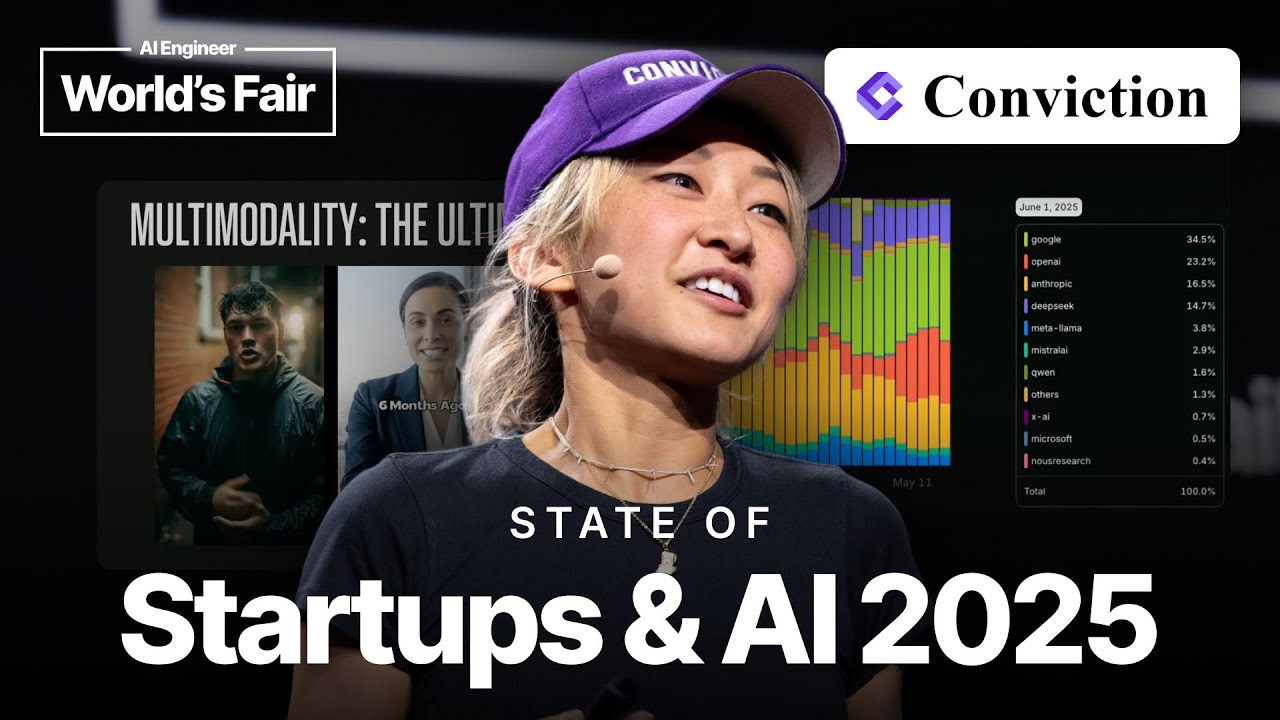
The conversation quickly turned to the burgeoning landscape of AI agents and multimodality. Guo noted a remarkable 50% increase in agentic startups over the past year, many demonstrating real-world utility. She highlighted the rapid advancements in multimodal AI, where capabilities in voice, video, and image generation are progressing at an astonishing pace, leading to companies rocketing past significant annual recurring revenue milestones. Voice, in particular, is poised for early application in business workflows due to its natural communication mode.
The landscape for foundational models is rapidly commoditizing. As Guo succinctly put it, “Last year’s model is a commodity.” This dynamic, evidenced by the diversifying market share beyond early leaders, signifies a crucial shift in where value is captured. It means builders can increasingly rely on a competitive model market to drive down costs and improve accessibility, allowing focus to shift towards application.
Code, according to Guo, stands as "the first killer AI app." Its success stems from several factors: it is structured text, allowing for deterministic validation through automated tests and compilation. Furthermore, code is seen as a crucial stepping stone on the path to Artificial General Intelligence (AGI), attracting significant research investment. Crucially, "engineers know engineers," meaning the early builders of AI-powered coding tools intimately understood their users' workflows, a principle applicable across all industries. This intimate understanding, coupled with meticulous execution, is what truly differentiates successful AI products.
Guo introduced "the thick wrapper recipe" as a guiding principle for product development. This involves collecting and packaging context, presenting it to models, orchestrating various models, thoughtfully presenting outputs to the user, and ultimately enabling seamless workflows. She stressed that "the prompt is a bug, not a feature," advocating for intuitive user experiences that anticipate needs rather than requiring explicit instructions. This emphasis on user-centric design, she argued, is critical for building customer trust and driving adoption.
