

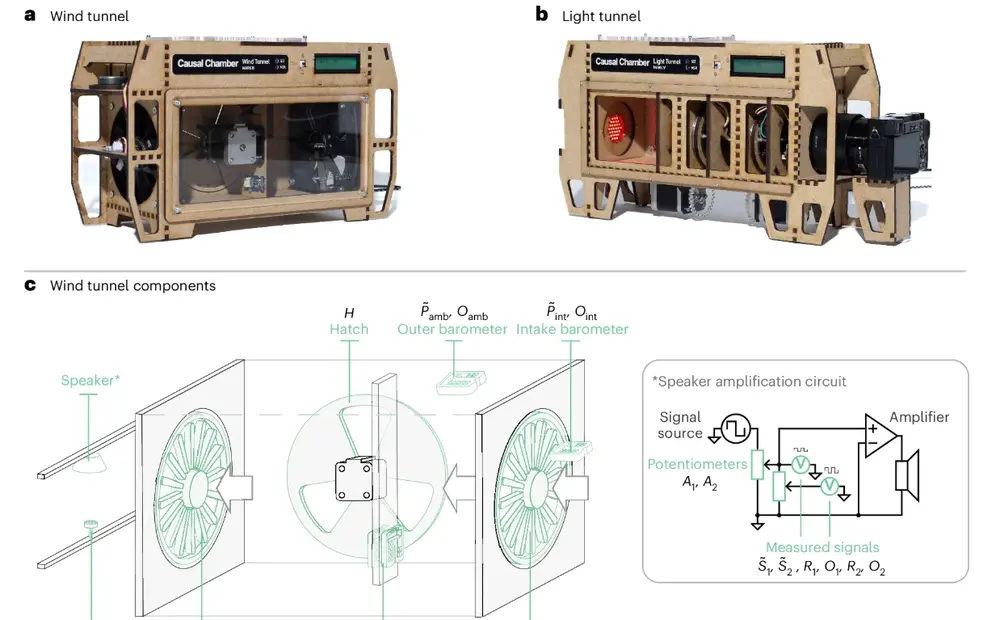
New miniature laboratories developed by mathematician Juan Gamella at ETH Zurich provide controlled environments for rigorously testing artificial intelligence (AI) algorithms, ensuring their reliability before deployment in real-world scenarios.
AI algorithms and models, despite thorough theoretical development, often encounter unexpected issues when applied practically. Traditional testing via computer simulations can lead to performance overestimations, as simulations are approximations of reality. Addressing this, Gamella has created miniature laboratories, or "mini-labs," which provide realistic, measurable data within controlled physical environments. This enables precise evaluation and improvement of AI algorithms early in the development phase.
These mini-labs, referred to as "causal chambers" in Gamella's publication in Nature Machine Intelligence, produce large datasets inexpensively and efficiently from non-trivial, well-understood physical systems. The devices, consisting of a wind tunnel and a light tunnel, are computer-controlled laboratories capable of manipulating and measuring a variety of physical variables. This setup provides valuable real-world data to validate algorithms for tasks including causal inference, out-of-distribution generalization, change point detection, independent component analysis (ICA), and symbolic regression.
Gamella likens these mini-labs to wind tunnels used in aviation, serving as a practical intermediate step between computer simulations and full-scale real-world testing. This approach particularly benefits AI applications involving direct physical interaction, such as robotics, enhancing their real-world reliability.
Initially educated in mathematics, Gamella pursued robotics at ETH Zurich before returning to mathematics and AI research. His mini-labs have already found practical applications in industry, particularly in optical testing environments. While initially attempted in cell biology contexts, cost constraints limited broader biological applications.