

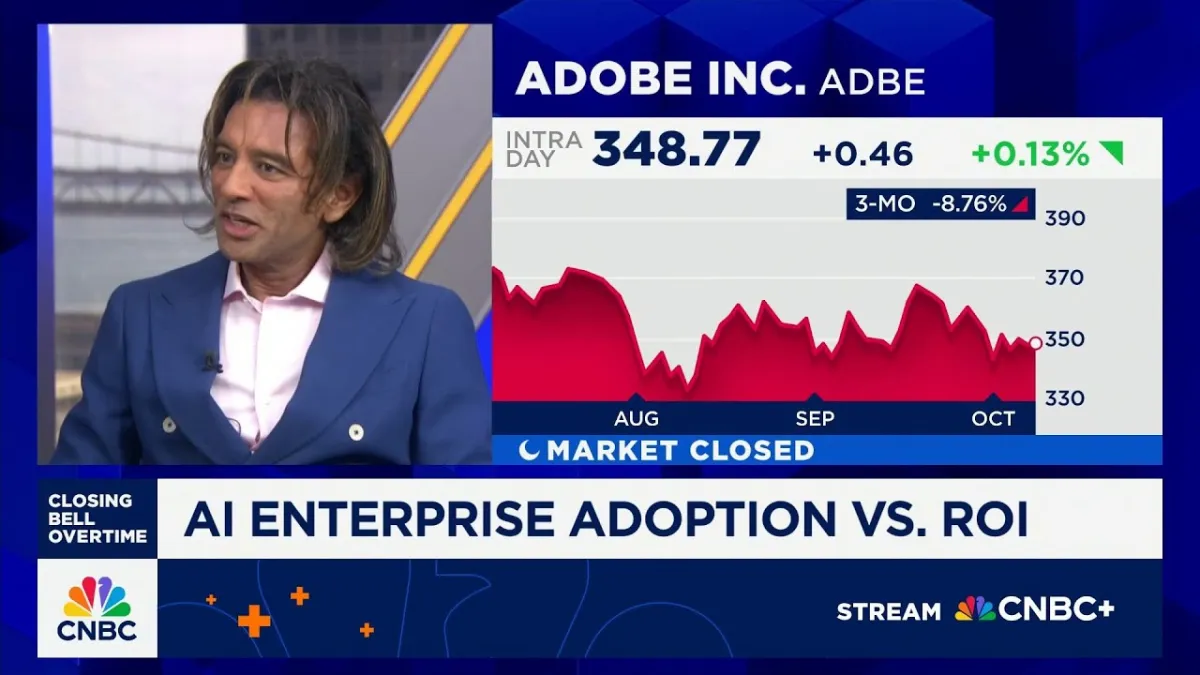
Kash Rangan, Goldman Sachs Senior Software Analyst, recently joined Frank Holland on CNBC's "Closing Bell Overtime" to dissect the current state of AI adoption, particularly distinguishing between consumer and enterprise markets. The conversation illuminated critical nuances concerning where real value is being generated and the challenges that persist in translating AI excitement into tangible, repeatable revenue streams for businesses. While consumer-facing AI has seen rapid uptake, the enterprise landscape presents a more complex picture, marked by internal scaling without equivalent external market impact.
The fundamental question posed by Holland, whether OpenAI is becoming a "single point of failure" for the AI economy, served as a potent springboard. Rangan acknowledged the merit of OpenAI's funding and the massive capital requirements for building foundational models, noting that hyperscalers' balance sheets are already tapped out from the initial investment phase, suggesting future funding will increasingly rely on debt. However, his primary focus shifted quickly to the implications for the broader software ecosystem, emphasizing that the real story lies in the enterprise adoption of AI and its measurable return on investment. This distinction between the foundational model layer and its application within existing enterprise software is crucial for understanding market dynamics.
Rangan highlighted a clear divergence between consumer and enterprise AI adoption. On the consumer side, he observed "very good adoption" in queries and computing activities, with early monetization evident in pro-level subscription models. He pointed to the next year as pivotal for scaling monetization at the intersection of advertising and commerce, indicating a relatively clear path to revenue generation. Conversely, the enterprise market, while experiencing internal scaling of AI—such as in coding assistance (like Cursor) and customer support—has not yet seen widespread adoption that translates into significant revenue generation or market share gains. This is a critical insight for founders and VCs; internal efficiency gains are valuable, but they don't necessarily drive top-line growth or competitive differentiation in the market.
The revenue picture for most enterprise software segments, as Rangan articulated, remains "still a little feeble." This isn't to say AI activity isn't happening; rather, much of it is characterized by experimentation and pilot projects. Such initiatives generate revenue, but it’s often not "annualized revenue," lacking the recurring, sticky, and repeatable nature that defines sustainable business models in the software industry. This high rate of churn in early enterprise AI engagements indicates a lack of deep integration and proven value that locks in long-term customer commitments. The market is still searching for the "sweet spot" where AI deployments consistently deliver substantial, measurable business outcomes that justify ongoing investment.
This quest for recurring revenue streams underscores the competitive advantage held by established enterprise software players like Adobe, Salesforce, ServiceNow, and Workday. These companies possess inherent strengths that newer AI-native startups often lack: extensive distribution networks, significant leverage within their existing customer bases, and a maturity in product development and go-to-market strategies. "There is a fair amount of distribution and leverage and customer base and a maturity in what an Adobe or a Salesforce or a ServiceNow or Workday are going to put out," Rangan stated. These incumbents are better positioned to integrate AI into their existing platforms, leveraging their deep client relationships and established contractual obligations to drive sticky, profitable revenue.
The implication is that while many private companies will undoubtedly emerge as "fabulous stocks for our investors" in the coming years, their success will hinge on their ability to move beyond pilot projects and generate durable, contractually obligated revenues. The current market, flush with AI experimentation, has yet to mature into one where widespread, revenue-generating enterprise AI solutions are the norm. The immediate focus for industry leaders should be on identifying and investing in applications that demonstrate clear, quantifiable ROI and can be seamlessly integrated into mission-critical business processes, rather than merely enhancing internal workflows.



