

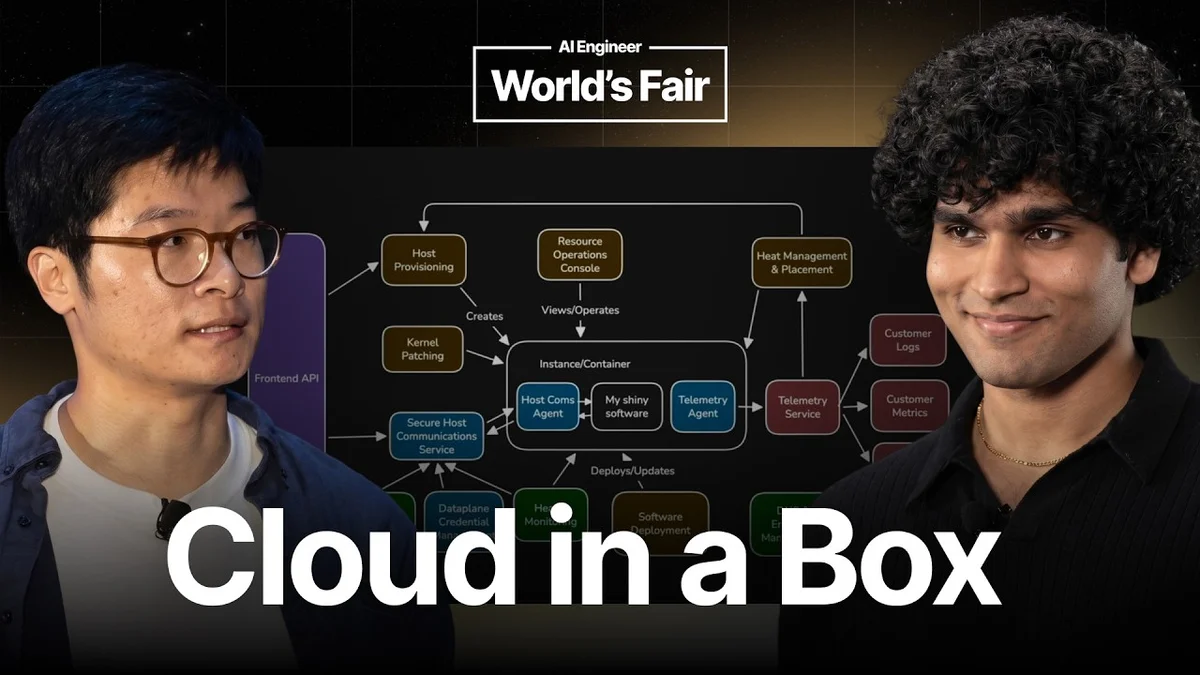
Emulated Founders Detail Data Engine for Autonomous AI Engineers

Emulated co-founders Joseph Wang and Sid Patlollu break down why training truly autonomous software engineers requires multi-node real-cloud environments.

Joseph Wang and Sid Patlollu presenting Emulated at AI Engineer World's Fair
Joseph Wang and Sid Patlollu discuss data requirements for autonomous software engineering.· AI Engineer
Visual TL;DR
Current AI Coding AgentsDriver
From the articleAI coding agents can generate pull requests, but running an enterprise software platform requires far more than isolated code edits.
Emulated FoundersCore
From the article 5 mentionsJoseph Wang, CEO of Emulated, along with CTO Sid Patlollu, built their technical foundation in network infrastructure, distributed databases, and sandbox architecture.
Single-Node SandboxesDriver
isolated code edits fail to mimic real-world distributed system challenges
From the article 2 mentionsHowever, Wang explained that single-node deterministic simulations hit a wall when attempting to model cloud-scale platforms like Alphabet Inc.
Autonomous AI EngineersContext
require training beyond high-level application logic to solve low-level infrastructure problems
From the articleAt the AI Engineer World's Fair, Joseph Wang and Sid Patlollu, co-founders of data lab Emulated, argued that training truly autonomous software engineers requires shifting from single-container code sandboxes to multi-node cloud environments that mimic entire tech companies.
Multi-Node Cloud EnvironmentsCore
mimic entire tech companies, including multi-version concurrency and clock skew
From the articleAt the AI Engineer World's Fair, Joseph Wang and Sid Patlollu, co-founders of data lab Emulated, argued that training truly autonomous software engineers requires shifting from single-container code sandboxes to multi-node cloud environments that mimic entire tech companies.
Real Cloud EnvironmentsEffect
shift from single-container sandboxes to full enterprise reality for training
From the article 3 mentionsSimulating real cloud platforms requires host provisioning, VPC setup, front-end APIs, authentication, telemetry, and billing engines.
Enterprise RealityOutcome
enables AI to handle mission-critical platforms and distributed database issues
From the articleAI coding agents can generate pull requests, but running an enterprise software platform requires far more than isolated code edits.
Contents(4)

AI coding agents can generate pull requests, but running an enterprise software platform requires far more than isolated code edits. At the AI Engineer World's Fair, Joseph Wang and Sid Patlollu, co-founders of data lab Emulated, argued that training truly autonomous software engineers requires shifting from single-container code sandboxes to multi-node cloud environments that mimic entire tech companies.

The Founders Behind Emulated

Joseph Wang, CEO of Emulated, along with CTO Sid Patlollu, built their technical foundation in network infrastructure, distributed databases, and sandbox architecture. Their experience with mission-critical platforms highlighted a distinct capability gap in current AI models. While frontier large language models handle high-level application logic well, they routinely fail when confronting low-level infrastructure problems such as multi-version concurrency control, clock skew, or data corruption in distributed database engines.

Why Code Diff Benchmarks Fall Short

Popular benchmarks like SWE-bench Pro or Terminal Bench evaluate agents across 50 to 100 turns, resulting in pull requests containing a few thousand lines of code. Wang pointed out that this setup omits crucial engineering work. Real software engineering requires discovering context across stale tickets, interpreting customer feedback, executing gradual rolling deployments, and observing service behavior under live traffic load.

"The model capability gap is a data gap," Wang said during the talk. He emphasized that AI models do not regress when trained on higher-quality datasets, meaning current limitations stem directly from low-fidelity training setups.

Moving from Single-Node Sandboxes to Real Cloud Environments

To train models for real infrastructure duties, Emulated places entire software engineering environments into containerized setups. Agents face issues like lagging node learners, flapping nodes, and network partitions. Patlollu demonstrated a multi-node etcd consensus cluster simulation where agents must adjust cluster state while maintaining service uptime to minimize operational blast radius.

However, Wang explained that single-node deterministic simulations hit a wall when attempting to model cloud-scale platforms like Alphabet Inc. (NASDAQ:GOOGL) or AWS. Simulating real cloud platforms requires host provisioning, VPC setup, front-end APIs, authentication, telemetry, and billing engines.

The Enterprise Reality and Market Comparison

Building high-fidelity simulation environments for reinforcement learning remains one of the hardest problems in software automation. StartupHub.ai data rates platform capabilities in this domain with a 71/100 score, placing Emulated alongside major industry players such as OpenAI, which holds an 84/100 score, and Perplexity AI at 71/100. By focusing strictly on infrastructure workflows, Emulated aims to train agents that manage complete software lifecycles safely and reliably.

© 2026 StartupHub.ai. All rights reserved. You may not republish this article in full without a license. Search engines and AI research tools may crawl and summarize for reference. Bulk reproduction or model training requires a license. See our terms.
Daniel Singer

Written by

Daniel Singer

Editor, StartupHub.ai

Daniel Singer is the editor of StartupHub.ai, a technology expert and thought leader on AI and its applications across sectors, from fintech and healthcare to developer tooling and consumer software. He writes and tests the tools covered here thoroughly and regularly, and built StartupHub.ai to give founders, operators and buyers a clearer read on what they are actually being sold.