

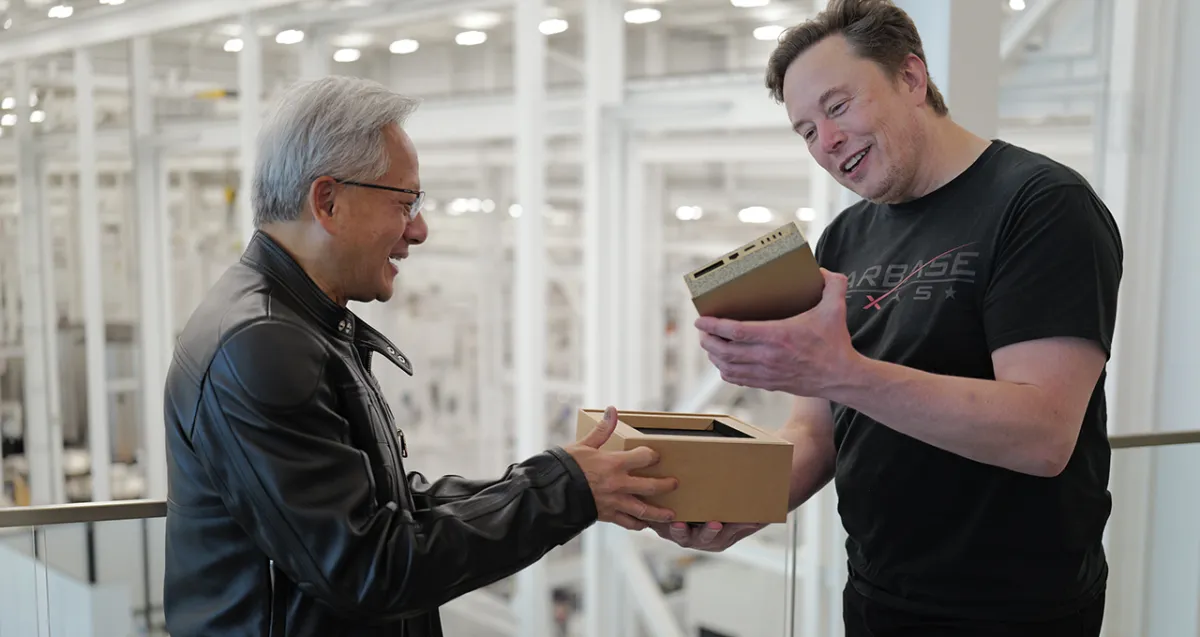
NVIDIA CEO Jensen Huang personally delivered the company's new DGX Spark system to Elon Musk at SpaceX's Starbase facility, marking a significant moment for edge AI computing. This compact, petaflop-class supercomputer, designed to operate outside traditional data centers, signals a strategic shift in how high-performance AI development will occur. The handoff underscores NVIDIA's push to democratize advanced AI capabilities, putting immense processing power directly into the hands of innovators.
The DGX Spark is a formidable machine, packing 128GB of unified memory and delivering a full petaflop of AI performance. This capability allows it to run complex models with up to 200 billion parameters locally, a feat previously reserved for large-scale data center infrastructure. Its arrival at SpaceX, amid Starship's test preparations, highlights the potential for such powerful, portable AI in demanding fields like aerospace and advanced robotics. According to the announcement, this move extends NVIDIA's nine-year bet on AI, moving beyond centralized computing to distributed, on-site applications.
Democratizing Petaflop AI
Beyond its raw power, the DGX Spark's form factor is revolutionary. Roughly the size of a piece of origami paper and the thickness of a hardcover book, this 1.2 kg device houses an NVIDIA GB10 Grace Blackwell Superchip. This integration of cutting-edge hardware, including NVIDIA ConnectX networking and NVLink-C2C, transforms a desktop into a potent AI development environment. The unified CPU-GPU memory is particularly crucial, enabling developers to prototype, fine-tune, and run inference without the latency and cost of constant cloud interaction.
Crucially, the DGX Spark is not just hardware; it arrives with the full NVIDIA AI software stack, including frameworks, libraries, pretrained models, and NVIDIA NIM microservices. This comprehensive package dramatically lowers the barrier to entry for advanced AI development, allowing creators to immediately tackle tasks like customizing image-generation models or deploying optimized chatbots. It positions the DGX Spark as a true "launchpad" for innovation, rather than merely a development box.
The impact of the DGX Spark extends far beyond SpaceX. Major PC manufacturers like Acer, ASUS, Dell Technologies, HP, and Lenovo are integrating this petaflop AI capability into their desktop systems. This broad ecosystem ensures that supercomputer-class performance is becoming accessible to a wider array of users, from robotics labs at Arizona State University to creative studios like Refik Anadol's, and even autonomous delivery pioneers like Zipline. These deployments demonstrate a clear trend towards decentralized, powerful AI at the point of creation.