
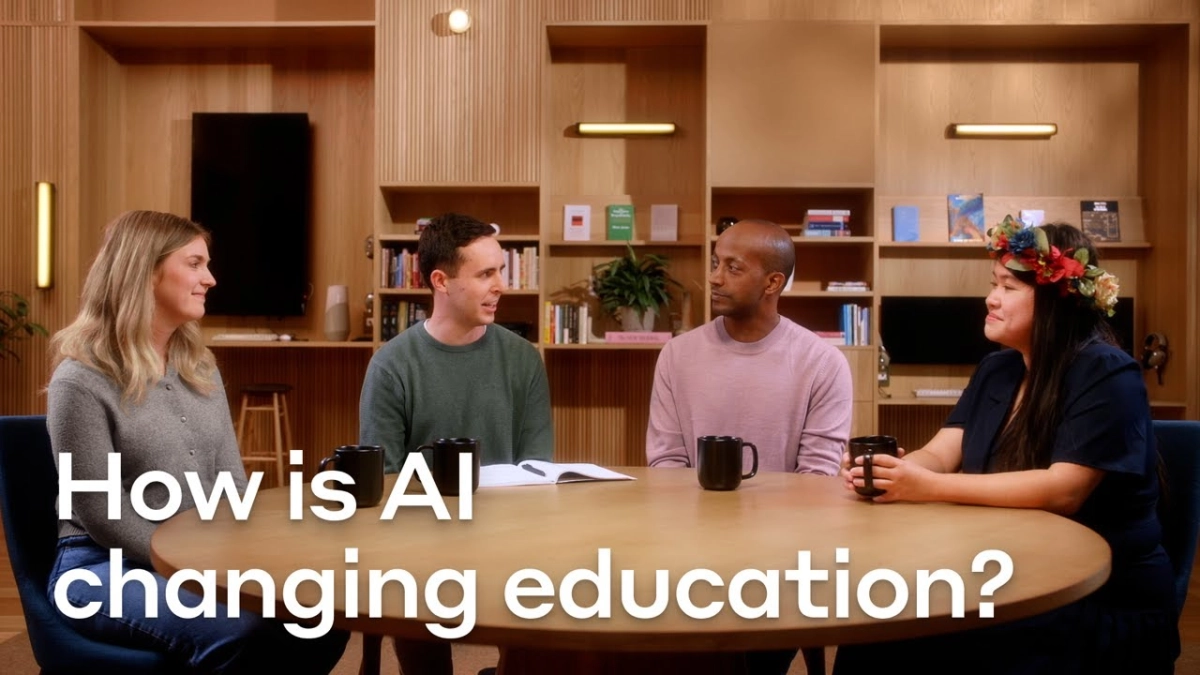
Artificial intelligence is not merely changing education; it is acting as a "forcing function that makes everyone deal with it now," as Maggie Vo, Head of Anthropic’s Ministry of Education, succinctly put it. This sentiment encapsulates the urgent yet nuanced conversation unfolding among the Anthropic team about AI’s profound impact on learning. In a recent video discussion, Vo, alongside Drew Bent (Education Lead, Beneficial Deployments), Zoe Ludwig (Manager, Ministry of Education), and Ephraim Tekle (Education Product Lead, Claude Apps), shared their professional and deeply personal perspectives on the transformative potential and inherent risks of integrating AI into educational systems. Their collective experience, spanning from high school math teaching to academic research and parenting, underscored the complexity of this technological shift.
The core tension in AI’s role in education lies in its dual nature: a tool of immense potential and significant peril. Drew Bent articulated this perfectly, stating that education is "the perfect example" where AI presents "massive benefits" but also "a lot of concerns." On one hand, AI promises to democratize access to high-quality learning, personalize tutoring, and alleviate teacher burnout by automating administrative tasks. On the other, it invites existential questions about the very nature of learning, posing risks like increased cheating and the potential for AI to replace, rather than augment, human thought. This dilemma forms the bedrock of Anthropic’s approach, emphasizing careful study of both the "light and shade" of AI systems.
Indeed, current student behavior serves as a compelling "wake-up call" regarding these risks. Internal research at Anthropic revealed that a significant portion—47%—of student interactions with their AI model, Claude, were "very direct transactional types of interactions with little engagement." Students are, in essence, "flipping the script," using AI to bypass deeper learning processes. This trend highlights a critical challenge: AI models, often built for productivity tasks like answering questions, were not inherently designed with pedagogical goals in mind. This emergent use by students for quick answers rather than thoughtful engagement underscores the urgent need for educators to adapt.
This shift necessitates a fundamental re-evaluation of what and how we teach. The emphasis must move beyond rote memorization, which AI can easily replicate, towards fostering critical thinking, synthesis, and creative problem-solving. As Maggie Vo emphasized, "Finding the answer is just the start of your learning journey." Educators must cultivate skepticism and curiosity in students, teaching them to question information, verify sources, and understand the "why" behind the "what." This approach encourages students to become discerning consumers of information, a skill vital in an AI-saturated world.
Interactive learning experiences, powered by AI, offer a promising path forward. Imagine students engaging in role-playing simulations with AI to practice job interviews or receiving personalized handouts tailored precisely to their unique interests, allowing them to connect with subjects on a deeper level. Such applications can scale personalized learning and continuous feedback, providing every student with a dedicated "tutor" that adapts to their individual pace and needs, a vision Ephraim Tekle passionately champions.
Anthropic is actively addressing these challenges through initiatives like their AI Fluency courses, developed in partnership with professors Joe Feller and Rick Daken. These courses aim to provide a foundational framework for understanding AI, moving beyond mere "prompting hacks" to equip educators and students with the ability to assess AI interactions for efficiency, effectiveness, ethics, and safety. Through collaborations with institutions like the American Federation of Teachers (AFT), Anthropic seeks to learn from real-world classroom experiences, developing features like "Learning Mode" in Claude, which guides students through material and prepares them for exams without simply providing answers. This commitment reflects a broader responsibility to ensure AI serves as a tool for empowerment, not dependency.
However, many uncertainties persist. Zoe Ludwig highlighted the evolving nature of skills, questioning which will be augmented by AI and which will continue to demand purely human support. The rapid pace of technological change also strains educational institutions, which are "generally slow-moving" by design. Maggie Vo reiterated that "moving fast and breaking things is not an option" in education, underscoring the need for deliberate, thoughtful integration. The long-term implications for student development, particularly regarding data privacy and the potential for "brain rot" from over-reliance on AI, remain open questions. The Anthropic team acknowledges that they "don't have the answers" but are committed to fostering a collective conversation and developing tools that prioritize human capabilities and ethical considerations. Ultimately, the goal is not just about leveraging AI for learning, but about preserving and enhancing the uniquely human aspects of education.