

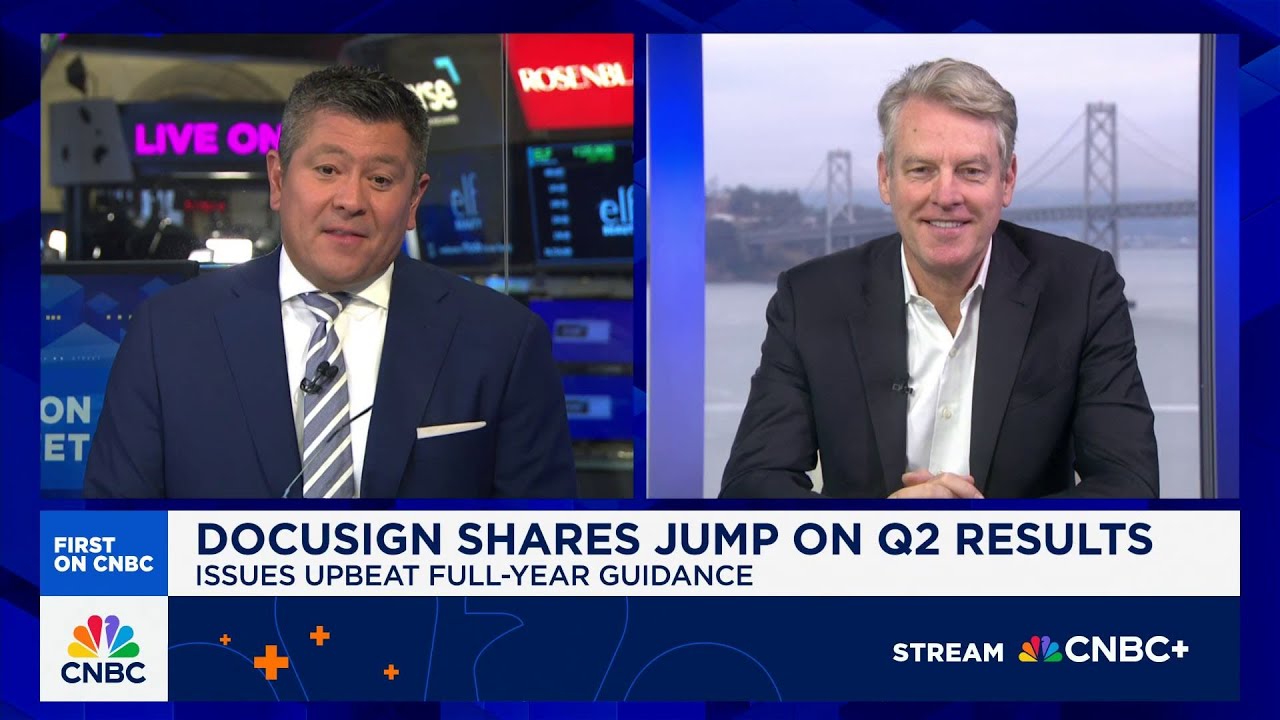
The era of merely digitizing documents is yielding to a more profound transformation: intelligent agreement management, a shift DocuSign CEO Allan Thygesen underscored in a recent interview. Speaking with CNBC's 'Squawk on the Street' hosts, Thygesen detailed how DocuSign's robust second-quarter performance was "powered by our new suite of intelligent agreement management solutions that leverages modern AI," marking the company’s strongest quarter in two years. This evolution signals a strategic pivot, moving beyond the fundamental convenience of e-signatures to deliver immediate, tangible value through artificial intelligence.
DocuSign's current thrust is to enable businesses to derive actionable intelligence from their vast repositories of agreements. Thygesen emphasized, "We're able to help companies get value from AI right now." This is not a distant promise but a present capability, allowing organizations to extract critical insights, optimize operations, and significantly streamline their agreement workflows. For a salesperson, this could mean AI recommending the most suitable contract for a specific customer or suggesting optimal terms during a renewal negotiation. Beyond sales, the applications extend to purchasing departments, recruiting, and virtually any function reliant on contractual agreements.
The core of this AI integration addresses a fundamental business need: efficiency and speed. Thygesen succinctly captured this, asking, "How do I get insights out of my agreements? How do I get to closure faster?" This encapsulates the tangible benefits DocuSign aims to provide, moving away from static documents to dynamic, intelligence-rich agreements that actively contribute to business acceleration. The company's vision is to transform the entire agreement lifecycle, from creation and negotiation to execution and management, making each step more efficient and insightful.
DocuSign's customer base, initially rooted in financial services like banking and mortgages, has broadened considerably. Its solutions now see widespread adoption across manufacturing, retail, technology, and government sectors.
While the concept of tokenizing contracts or leveraging blockchain for enhanced security and traceability is a frequent topic in technological discourse, Thygesen offered a pragmatic perspective. He noted that such applications are "maybe in the very long run, but right now that's not a major driver." The immediate opportunity lies in optimizing existing digital processes and extracting basic insights through AI, a process that can be implemented for customers in a matter of weeks. This realistic view highlights DocuSign's focus on current, high-impact solutions rather than speculative future technologies.
The company's recent partnership with the U.S. General Services Administration (GSA) exemplifies this practical approach to expansion. This collaboration allows government agencies to procure standardized DocuSign offerings at a discounted rate, a significant step in digitizing federal operations. While the federal business has historically been a smaller segment for DocuSign, this partnership aims to enhance efficiency for both taxpayers and service recipients, demonstrating a commitment to broader public sector impact. DocuSign's journey reflects a mature understanding of market needs, prioritizing immediate, impactful AI applications over nascent, long-term technological shifts.



