


The efficacy of Retrieval Augmented Generation (RAG) and sophisticated AI agents hinges less on the large language model (LLM) itself and more fundamentally on the quality and structure of the underlying data. In the enterprise setting, where documents are diverse, messy, and often locked in proprietary formats, data preparation remains the most significant and tedious bottleneck to deploying reliable AI. Docling emerges as an open-source framework specifically engineered to solve this pervasive challenge, transforming unstructured inputs into clean, hierarchical data that LLMs can actually utilize.
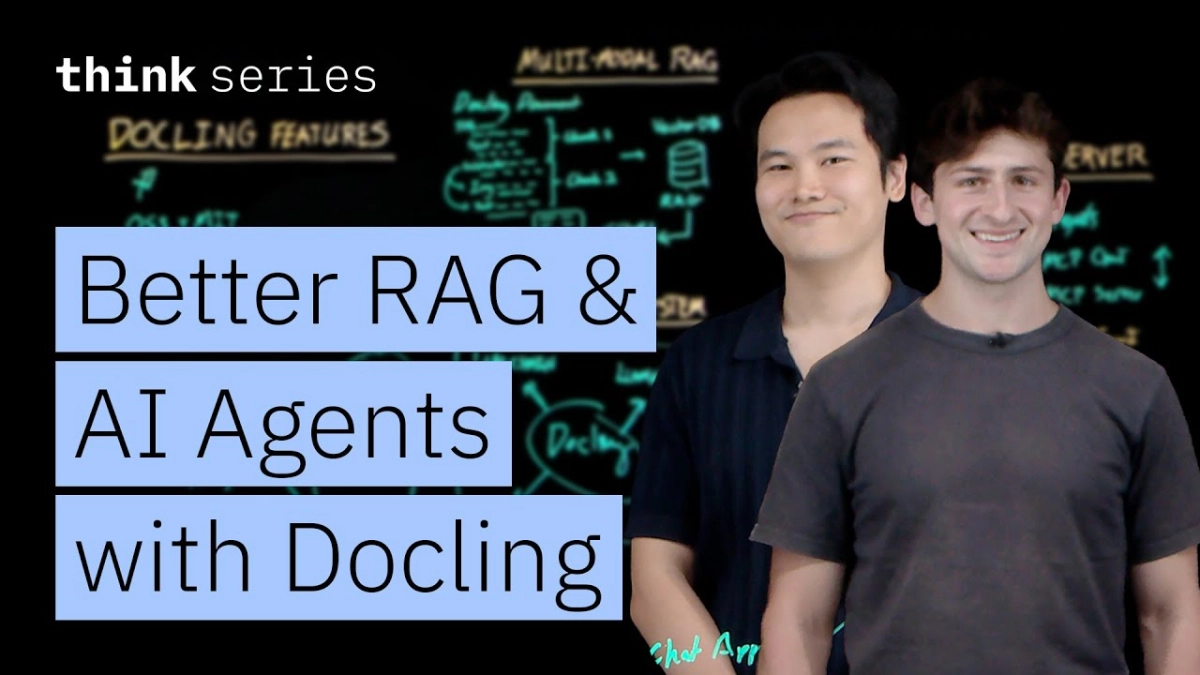
Cedric Clyburn, Senior Developer Advocate at Red Hat, and Ming Zhao, IBM Software specialist, highlighted this critical requirement in their discussion on Docling, presenting the framework as the essential layer required to move enterprise AI applications from proof-of-concept to production reality. They detailed how Docling processes a variety of file types—from PDFs and scanned images to spreadsheets—and prepares them for integration into complex AI workflows.
For organizations heavy with legacy data, the reality is that unstructured documents often defeat standard parsing methods. Traditional Optical Character Recognition (OCR) merely strips text from a document, losing the crucial hierarchical and spatial context necessary for accurate AI retrieval. Zhao emphasized this core challenge, stating, “The real challenge in RAG or agentic AI isn’t building the agent but curating the knowledge and the context behind it.” Docling addresses this by outputting a rich, hierarchical document format, complete with element types, headings, and per-element metadata, thereby providing structure-aware chunking out of the box.
This capability is vital for improving retrieval signals. By splitting documents based on semantic structure—sections, tables, and captions—rather than naive fixed-size token counts, Docling ensures that relevant context, like parent titles and headers, is automatically carried into each chunk. This process produces more cohesive chunks and significantly better retrieval signals than naïve fixed-size splits.
Docling’s approach extends directly into agentic workflows through its support for the Model Context Protocol (MCP) server. This open standard is designed specifically for AI agents to interact reliably with external tools and data sources. The MCP server allows desktop clients and developer environments to plug in directly, enabling agents to leverage natural language commands to convert complex documents into structured formats without manual scripting.
A key capability for high-value enterprise use cases, such as processing invoices or legal reports, is structured information extraction. Where basic OCR strips text, Docling allows developers to define a precise Pydantic or JSON schema for extraction. This provides type safety and validation from the outset.
Unstructured data is converted into clean, validated JSON ready for API or RAG ingestion.
Furthermore, Docling significantly enhances Retrieval Augmented Generation through its multi-modal capabilities. Images and tables within documents are preserved, and figures can be optionally enriched with textual descriptions so they are retrievable alongside standard text chunks. Every retrieved element includes provenance, page numbers, and bounding box information, allowing for visual confirmation and auditing. This transparency is indispensable in regulated industries that demand verifiable results.
Docling is positioned strategically not as an end-to-end solution but as a foundational middleware layer for the rapidly expanding AI ecosystem. Its existing integrations with major RAG frameworks—including LangChain, LlamaIndex, and Haystack—minimize the need for custom "glue code" and accelerate deployment across diverse infrastructure. This integration ecosystem allows teams to swap underlying components, like vector databases or LLMs, without disrupting the core data preparation pipeline.
The open-source nature of Docling, governed under the MIT license and supported by the Linux Foundation Data and AI, is a significant draw for regulated and security-conscious sectors like defense, healthcare, and finance. Clyburn affirmed the framework’s suitability for these environments, noting, “It's got a governing organization that helps it be perfect for secure, regulated environments.” The ability to deploy robust, transparent document processing systems on-premise addresses key governance and data residency concerns that prohibit the use of many third-party cloud solutions. Docling thus offers a standardized, enterprise-ready path to unlocking the vast stores of proprietary, unstructured organizational knowledge for immediate AI utility.

