

A new report from vFunction, the architectural observability company, reveals a critical and growing disconnect in how organizations manage their software architecture. Despite 63% of surveyed companies claiming that software architecture is fully integrated throughout their development lifecycle, over half of them (56%) acknowledge that their documentation no longer reflects the current state of production systems. This misalignment has led to significant operational consequences, from project delays and security challenges to increased complexity and reduced productivity across teams.
The findings come from vFunction’s “2025 Architecture in Software Development” study, which surveyed more than 600 IT professionals. The report highlights a widespread gap between perceived and actual architectural health, especially as AI tools accelerate development while masking growing structural problems beneath the surface.
Architectural Misalignment is the Norm—Not the Exception
Organizations are under constant pressure to deliver software faster, and many have turned to AI-assisted development tools to keep pace. However, the unintended effect is growing architectural complexity. Functional code is produced quickly, but system-wide architectural principles are often ignored, resulting in microservices sprawl, undocumented dependencies, and overlooked compliance issues.
56% of respondents report that their architectural documentation does not match production environments. This disconnect has tangible consequences: 53% experienced project delays, 50% faced security or compliance issues, 46% hit scalability limits, and 32% dealt with service disruptions directly tied to these inconsistencies. These numbers are even more alarming when considering that 47% of companies incurred unexpected operational costs due to architecture misalignment.
“When architectural documentation diverges from reality, businesses suffer tangible consequences,” said Moti Rafalin, CEO and co-founder of vFunction. “It impacts not only development speed but the organization’s ability to scale, comply with regulations, and serve customers reliably.”
Executives and Engineers See the Problem Differently
The survey reveals a sharp divergence in how executives and technical practitioners understand the state of their architecture. While 52% of executives believe documentation is fully aligned with production, only 36% of engineers agree. Interestingly, executives are more likely to recognize the business impact: 70% of executives cite project delays tied to architecture, compared to 49% of practitioners who are more focused on technical discrepancies.
This perception gap extends to priorities for fixing the problem. Executives tend to emphasize governance (81%) and better documentation tools (79%), while developers and architects focus on improving collaboration between teams (69%) and integrating architecture earlier in the software development lifecycle (66%). The study concludes that both perspectives are necessary for lasting solutions, but misalignment between business and engineering priorities remains a major barrier.
Industry and Company Size Matter
The gap between documentation and reality varies by industry. Software and hardware companies have the best alignment, with 63% reporting accurate documentation. In contrast, only 31% of financial services companies and 34% of manufacturers say the same. These differences highlight how regulation-heavy sectors and legacy systems tend to lag in architectural modernization.
Company size also plays a role. Smaller companies ($100–$999 million in revenue) are better able to maintain alignment (52%) than larger enterprises (over $1 billion), where only 40% report documentation matches their production environments. The larger the organization, the harder it becomes to maintain architectural consistency across teams, codebases, and geographies.
AI Promises Simplification—but Could Add Complexity
AI is being viewed as both a problem and a potential solution. 65% of companies surveyed believe AI will simplify their application architecture in the long run. However, without guardrails, the speed and volume of AI-generated code could actually worsen structural complexity. AI models often lack system-level understanding and generate functional code that may bypass architectural constraints, leading to unintentional duplication, integration risks, and non-compliant code.
“As organizations aggressively adopt AI to automate processes and generate code, they’re introducing new layers of complexity into their architecture,” said Rafalin. “AI currently lacks a system-wide view, which could escalate risks in security, scalability, and compliance if not properly governed.”
To counter this, 90% of survey participants agree that integrating architecture insights into observability tools would improve their software development practices. OpenTelemetry—a popular open-source observability framework—is being adopted by 59% of respondents, either as their primary method (27%) or in combination with proprietary tools (32%).
vFunction Expands Its Platform to Address These Challenges
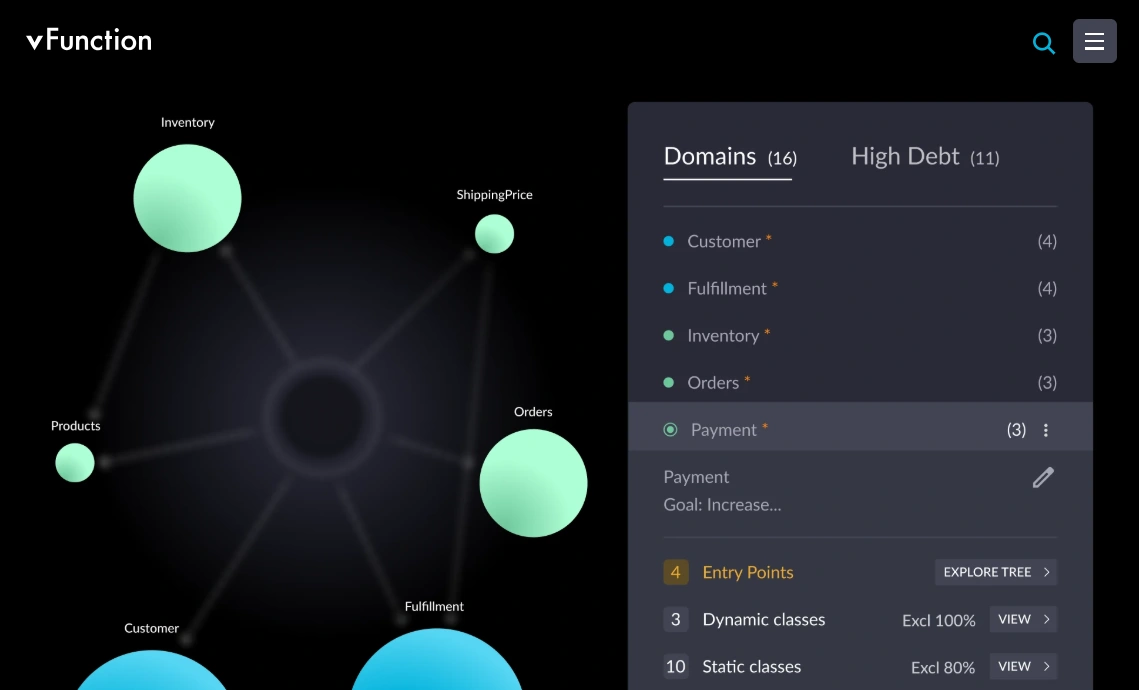
To tackle these issues, vFunction announced new capabilities in its architectural observability platform. The upgrades aim to help teams visualize, manage, and modernize software systems more effectively—especially in the face of rapid AI-assisted development and increasing architectural drift.
One of the most significant additions is subsystem-level microservices management. This feature allows engineering teams to isolate and govern specific areas of an application, such as a set of microservices used by a single product or business domain. By narrowing the focus to manageable scopes, teams avoid cognitive overload and apply governance more precisely.
The platform also now integrates deeply with OpenTelemetry, enabling users to apply tagging rules based on deployment metadata like cloud provider, instance type, and region. This provides DevOps and architecture teams with a direct line of observability into architectural boundaries, enforcement zones, and compliance checkpoints.
For legacy systems, vFunction introduced component diagrams for visualizing architectural flows in monolithic applications. These diagrams expose domain-level interactions and call paths, helping teams identify architectural violations and dependencies before refactoring. The platform also offers AI-guided starting points for modernization efforts, using embedded expert knowledge to suggest tailored refactoring paths.
Real-Time Architecture and Enterprise Integration
The platform now supports live integration with enterprise architecture (EA) tools through open APIs and architecture-as-code exports, including C4 diagrams. This capability keeps architectural systems of record up to date by automatically discovering and pushing real-time services, dependencies, and subsystem relationships into EA platforms. It removes the burden of manual documentation and enables collaboration between architects, developers, and business stakeholders.
“Maintaining an accurate view of architecture is essential for scaling systems and avoiding costly surprises,” said Amir Rapson, CTO and co-founder of vFunction. “Our platform supports continuous architectural lifecycle management—design, measurement, validation, and remediation—so teams can evolve systems intentionally, not reactively.”

