

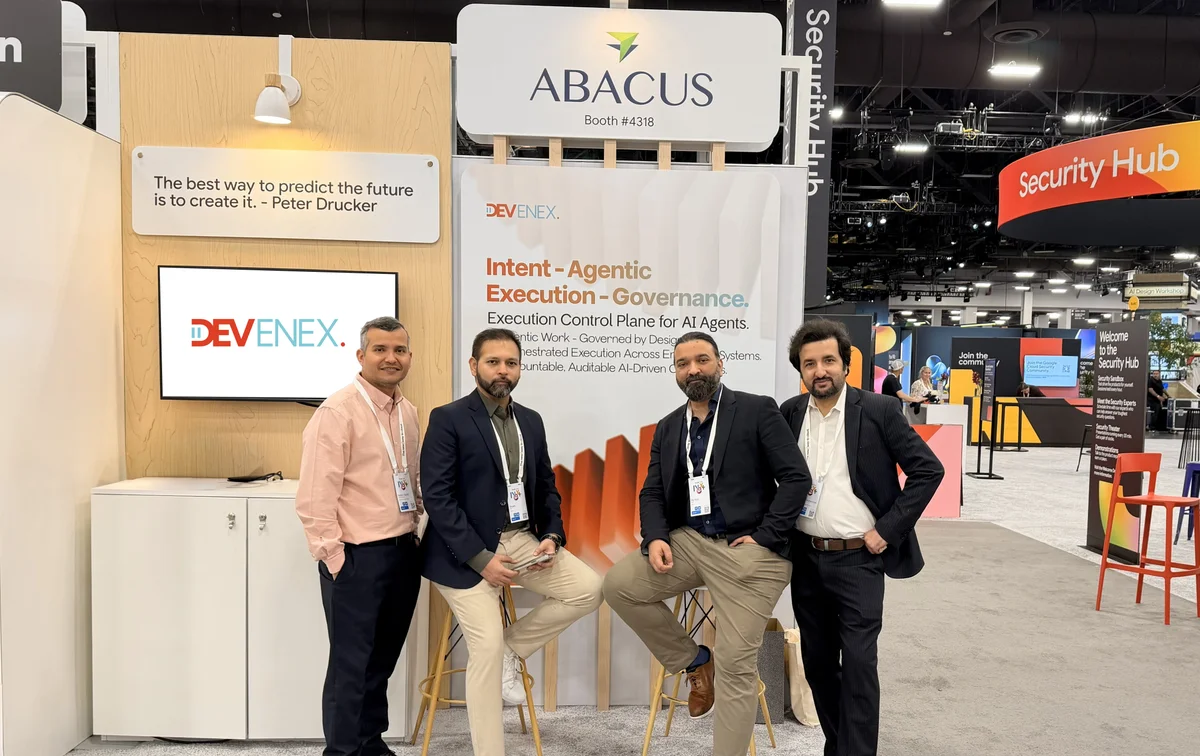
Devenex is built around a hard compliance reality: enterprise AI governance can no longer live in a policy document.
Devenex is built for the moment when AI governance has to leave the conference room and meet the enterprise system.
As the EU AI Act, SOC 2, and ISO 42001 reshape enterprise expectations, Devenex gives regulated organizations a structured way to produce evidence at the point of AI-driven execution.

Devenex is built around a hard compliance reality: enterprise AI governance can no longer live in a policy document.
Devenex is built for the moment when AI governance has to leave the conference room and meet the enterprise system.
Regulated organizations already know how to write policies, define controls, and map risk frameworks. The harder problem is proving what happened when an AI-driven action was ready to execute. A policy can say how a system should behave. It cannot, by itself, prove that a specific action was checked, authorized, tied to the right identity, and preserved as evidence before it touched a live workflow.
“Governance cannot stop at the document layer,” says Shoab A. Khan, Co-Founder and CEO of Devenex. “A policy tells the organization what it believes. Evidence proves whether the organization acted that way when it mattered.
That distinction sits at the center of Devenex, the Execution Control Plane for enterprise AI agents and other enterprise execution sources. The company was built for an environment where AI agents, automated processes, human operators, and system events can all trigger actions across core platforms. In regulated settings, those actions cannot be treated as routine technical events. They have to be governed.
The timing is important. Enterprise AI expectations are tightening around frameworks such as the EU AI Act, SOC 2, and ISO 42001. Devenex is architecturally designed to support compliance with these frameworks by creating structured execution evidence as part of the workflow itself. It is not the certificate. It is the infrastructure that helps enterprises demonstrate the control, repeatability, and proof that frameworks increasingly require.
“Regulated enterprises are not only being asked what their AI systems can do,” says Aly Kuly Khan, Co-Founder and Chairman of Devenex. “They are being asked how those systems are controlled, how decisions are authorized, and whether the evidence exists without reconstruction after the fact.”
That last phrase matters. Many enterprise tools produce downstream records. They log activity. They show status. They help teams investigate what happened after an action has already moved through a system. That can be useful for incident review, reporting, and operational analysis.
It is not the same as governance.
In high-risk AI and regulated enterprise workflows, a record after execution may be too late. If an AI agent modifies a financial record, approves a workflow, triggers a payment, or initiates a consequential operational process, the compliance question is not only what happened. It is whether the action should have been allowed to happen in the first place.
“Evidence after execution may explain an event,” Shoaib says. “It does not prove that the event was governed before it occurred. That is the difference Devenex was built around.”
Devenex’s compliance architecture begins before the action. Each proposed execution is checked against policy, tied to the responsible identity, approved through the required control path, and preserved as audit-grade evidence. The action may originate from an AI agent, a human operator, an automated process, or a system event. Devenex treats each source as part of the same enterprise execution problem.
That is where the product’s four-artifact model becomes important. Every governed execution produces a Canonical Plan, Authorization Record, Execution Trace, and Evidence Pack.
For compliance teams, the four artifacts answer different parts of the review problem. The Canonical Plan captures the request/intent with the plan it generated. The Authorization Record preserves the control decision. The Execution Trace shows the detailed telemetry. The Evidence Pack creates the proof set needed for audit, investigation, or regulatory response.
Together, those artifacts create Decision to Execution Lineage. The goal is to give enterprises a clear chain from request to planned action to authorization to evidence.
“Compliance teams need more than a timestamp and a system log,” Shoaib says. “They need a governed chain of evidence that shows what was intended, what was permitted, and what proof exists when the organization is asked to explain it.”
That need is especially urgent for boards, general counsel, chief compliance officers, chief risk officers, CISOs, and AI leaders. Agentic AI changes the accountability surface. If autonomous or semi-autonomous systems act with enterprise authority, leadership must be able to answer basic questions with confidence.
Who authorized the action? What policy applied? Why was the action permitted? Which identity was bound to the decision? What evidence can be produced for regulators, auditors, or internal review?
In regulated industries, those are not secondary concerns. They are operating requirements.
Financial services, insurance, healthcare, public sector organizations, and regulated technology companies face the first pressure point because the cost of ungoverned execution is high. These sectors already operate inside strict audit, risk, privacy, and accountability expectations. AI agents do not remove those obligations. They make them more immediate.
“The more authority AI agents have, the closer governance has to move to the moment of action,” Aly says. “Regulated organizations cannot afford to discover after the fact that execution outpaced authorization.”
Devenex is backed by Abacus, the global enterprise technology group with nearly 40 years of experience, more than 5,000 resources across four continents, and more than 1,500 enterprise clients. For compliance buyers, that foundation matters. Governance infrastructure is not a lightweight AI feature. It sits near liability, operational control, regulatory readiness, and board accountability.
Abacus’s track record gives Devenex an institutional base in the environments where trust is earned slowly and tested often. The point is not history for its own sake. It is delivery credibility inside enterprise systems where failure has consequences.
“Compliance buyers look for more than capability,” Aly says. “They need confidence that the organization behind the infrastructure understands regulated environments, enterprise complexity, and the cost of getting governance wrong.”
Its April 22, 2026 debut at Google Cloud Next placed the product in front of enterprise buyers at the same moment compliance teams were being forced to think beyond AI pilots. That shift is where compliance pressure will intensify. Pilots can often survive with manual oversight. Production systems cannot depend on improvised governance.
As AI agents move deeper into enterprise operations, compliance will move closer to execution. The organizations that can produce execution-level evidence will be better positioned when auditors, regulators, boards, or customers ask how AI actions are controlled. The organizations that rely on policy documents alone will face a harder question later: what can they actually prove?
“Compliance will follow the action,” Shoaib says. “If enterprise AI is going to execute, then governance evidence has to be created at the same point. That is how regulated organizations make AI accountable in practice."
For more information, visit theDevenex website.