

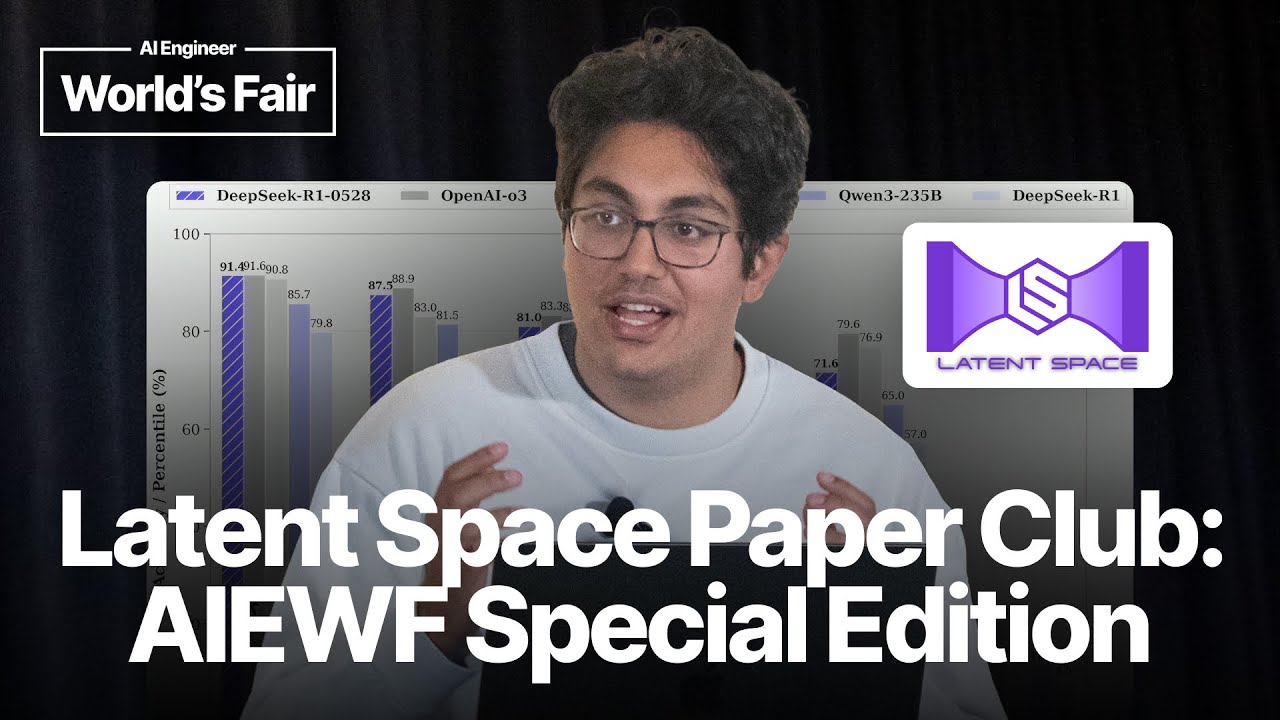
DeepSeek's latest models, notably DeepSeek R1-0528 and its distilled variants, signal a pivotal shift in artificial intelligence development, prioritizing emergent reasoning capabilities and efficient deployment. This evolution suggests a future where computational prowess extends beyond mere scale, delving into sophisticated, autonomous problem-solving.
Vibhu Sapra, speaking at the AI Engineer World's Fair in San Francisco, highlighted these advancements during a special edition of the Latent Space Paper Club. The discussion underscored DeepSeek's methodical approach to unlocking deeper intelligence in large language models (LLMs) and making it accessible.
DeepSeek R1-0528, despite its iterative naming, delivers significant performance boosts, particularly in complex reasoning tasks. Sapra noted, "Previously used ~12k tokens but now reasons for 25k tokens. Double the reasoning effort." This substantial leap in its problem-solving capacity translates to performance levels comparable to more established, larger models in domains like mathematics and coding.
A core insight lies in DeepSeek's reliance on a pure Reinforcement Learning (RL) process to cultivate reasoning capabilities without extensive supervised data. The stated goal is to "explore the potential of LLMs to develop reasoning capabilities without any supervised data, focusing on their self-evolution through a pure RL process." This self-evolutionary approach fosters emergent behaviors, including "reflection moments" and "aha moments," where models revisit and re-evaluate previous steps.
This methodology ties into the concept of inference-time scaling. Instead of merely pre-training LLMs with exponentially more data and compute, DeepSeek's models are designed to spend more computational effort during inference when tackling harder questions. This dynamic allocation of thought allows for more deliberate and accurate responses.