

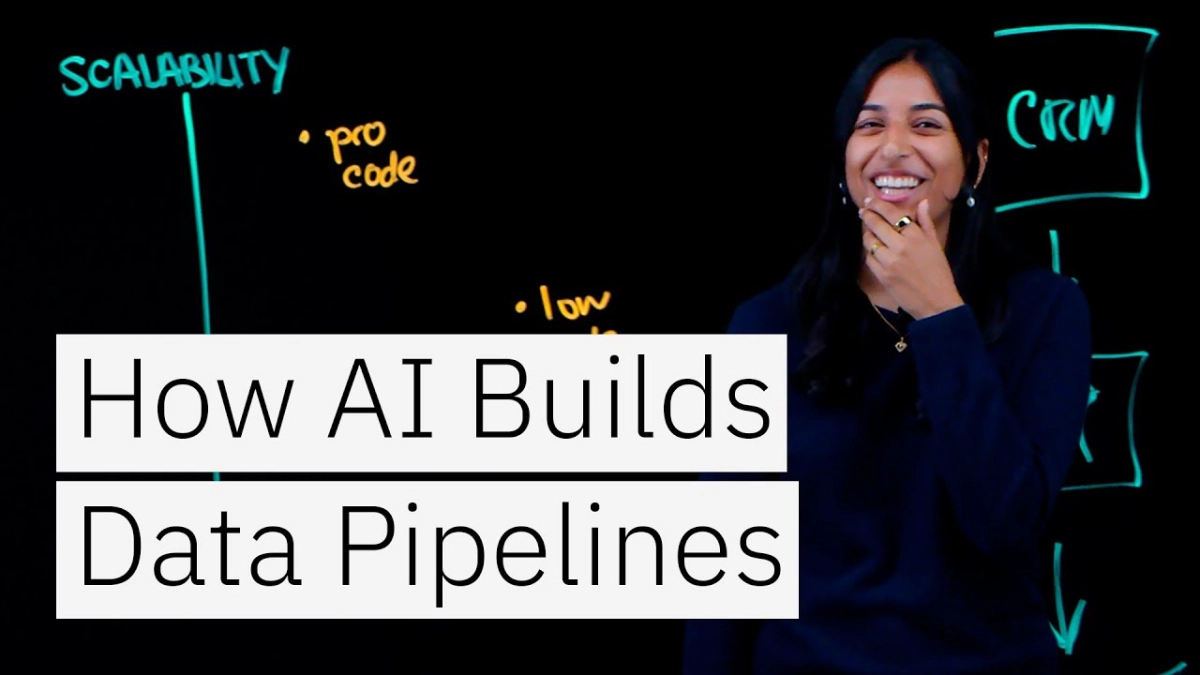
The optimal approach to data integration is not a monolithic choice but a strategic alignment of tools with user capabilities and project demands. This core insight underpins the detailed analysis provided by Shreya Sisodia, Product Manager at IBM, in her recent video, where she dissects the interplay between AI Agents, low-code platforms, and traditional SDKs in shaping modern data pipelines. Sisodia, representing IBM, offers a nuanced perspective on how these distinct authoring experiences cater to varying technical proficiencies and operational requirements within an organization, a critical consideration for founders, VCs, and AI professionals navigating the evolving data landscape.

Sisodia introduces the concept of data integration through a relatable cooking analogy: ordering takeout, using a meal kit, or cooking entirely from scratch. This framework effectively categorizes the three primary authoring experiences. The "takeout" equivalent is the no-code approach, powered by AI agents and assistants. Here, a user simply articulates their data pipeline needs in plain English, such as "filter my customer orders in the last 30 days." The AI agent, leveraging large language models, interprets this request, infers necessary transformations, understands the data model, and instantly orchestrates a data pipeline. "An agent can even go one step further by not just building the pipeline, but orchestrating it too," Sisodia explains, highlighting the agent's ability to break down requests into steps and coordinate sub-agents for reads, writes, and transformations. This method is ideal for business users, analysts, or operations teams seeking rapid answers and quick experimentation without deep technical expertise, effectively lowering technical barriers. However, its limitations include restricted customization, as users are "bound by what the AI can interpret," and potential challenges in debugging due to the abstraction of underlying processes, making it less suitable for production-ready, mission-critical systems without additional oversight.
Moving to the "meal kit" analogy, Sisodia describes low-code data integration, characterized by drag-and-drop visual canvases. This approach offers a middle ground, providing more control than no-code without requiring extensive coding. Users assemble data pipelines by connecting pre-built components or "nodes" on a screen, configuring them to connect sources, apply transformations, and direct data to targets. For instance, one might drag a Salesforce connector, define connection details, then add a filter stage for a 30-day condition, and finally, a Snowflake target. This visual method is particularly well-suited for data engineers who are familiar with ETL and integration tools and seek a balance between development speed and granular control. Low-code promotes collaboration among technical teams, allowing for easier review and duplication of pipelines, and facilitates quicker onboarding for new users. Yet, it faces scalability challenges with overly complex Directed Acyclic Graphs (DAGs) and can make bulk changes tedious, as custom code integration might not always be straightforward.
Related Reading
- AI pricing needs to come down to increase adoption, says Jefferies' Brent Thill
- Enterprise AI Spend Diverges: Agents Lag, Model Access Surges
- AWS AgentCore Unlocks Production-Ready AI Agents for Enterprise
The third paradigm, "cooking from scratch," represents the pro-code authoring experience, primarily accomplished through Python SDKs. This method grants developers and experienced data engineers maximum flexibility and granular control over every aspect of data pipeline design, building, and management. Instead of visual interfaces or natural language prompts, users write code, allowing for precise customization and the ability to handle intricate logic and complex data transformations. Sisodia illustrates its power by noting, "With the Python SDK, I can write a single script that updates those changes in seconds," referring to updating a data type across a hundred pipelines. This level of programmability is invaluable for large-scale operations, enabling efficient bulk changes and seamless integration into existing DevOps workflows, including versioning, testing, and continuous integration/continuous deployment (CI/CD). The trade-off, however, is a steep learning curve, requiring significant coding expertise. The lack of visual representation can also impede collaboration with non-technical stakeholders, and the initial time investment for building pipelines from scratch is considerably higher.
Ultimately, the choice of the "best" authoring experience is contingent upon the specific context. No-code accelerates accessibility, democratizing data integration for a broader user base. Low-code, by striking a balance, accelerates execution and fosters collaboration among technical teams. Pro-code, demanding specialized skills, accelerates scalability and automation for complex, enterprise-grade solutions. In practice, modern data teams frequently encounter a skill gap, where not every member possesses the deep coding expertise or specialized ETL knowledge. Therefore, a comprehensive strategy often requires leveraging all three approaches in tandem. This flexibility ensures that every user, irrespective of their technical skill level, can select the most appropriate tool for the task at hand, leading to faster, more effective data integration across the entire organization.