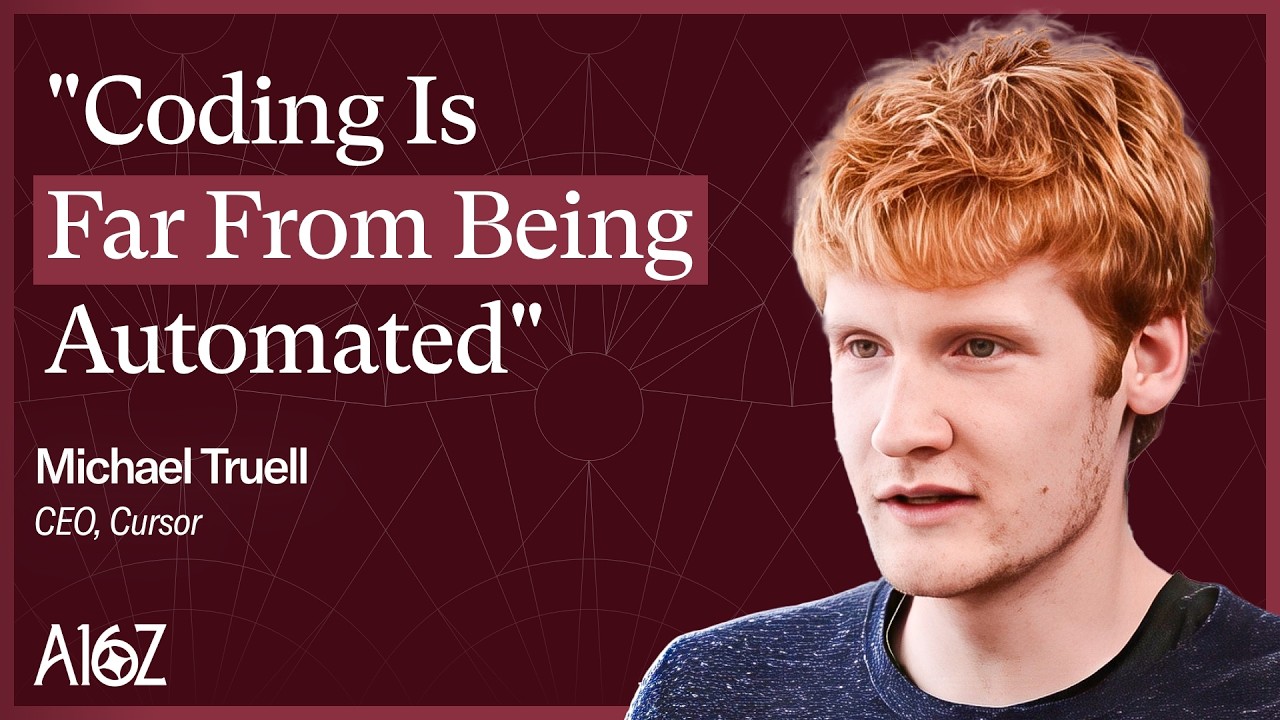

Michael Truell, CEO of Cursor, joined Martin Casado, General Partner at a16z, at the a16z Runtime event to dissect Cursor's explosive growth and unconventional strategies in the burgeoning AI-powered developer tools market. Their discussion illuminated how deliberate constraints and a contrarian mindset propelled a small team of MIT graduates to create one of the fastest-growing developer tools ever built, challenging established norms from product development to talent acquisition.
Cursor's journey began with a pivotal realization: while many were building AI agents in abstract labs, the real opportunity lay in crafting genuinely useful AI products integrated into daily workflows. Truell articulated this shift, stating, "This was the first existence proof of, you know, AI, that, you know, it's we shouldn't be working on AI in a lab, it's time to actually build systems out in the real world and there's real useful things that you could be doing." This pragmatic approach, born partly from a collective "PTSD from modeling work" that emphasized expediency over science fiction, steered them away from grand, unproven AI agents towards a tangible tool: an AI-native code editor.
Their initial "whiteboard exercise" explored a "Cursor for X" framework across various knowledge work verticals, including mechanical engineering CAD systems. However, they soon discovered a "blind man and the elephant problem" in these fields, struggling to gain intuitive understanding of user needs. This led them back to their core competency: programming. The decision to build a full editor, rather than a mere extension, was a bold move against prevailing wisdom. "At the time, people just thought it was very weird to do an editor," Truell explained. "They said you can't get people to switch their code editor, they're too tied to it, which we knew was wrong." This conviction stemmed from their own experience switching to VS Code due to GitHub Copilot's utility, proving that a truly superior product could overcome ingrained user habits.
Their focus was laser-sharp on power users, eschewing the "democratization" narrative. They believed that by solving the most complex problems for the most demanding users, they would naturally create a product that eventually appealed to a broader audience. This deep immersion into the developer workflow enabled them to define what the "actual act of that knowledge work looks like" as AI matured.
The company's operational speed matched its product vision. Truell recounted how they quickly moved from concept to a daily-driver IDE in a couple of weeks, then to external beta in a few months. This rapid iteration was fueled by a lean team and a commitment to monthly investor updates that served as a powerful "commitment device."
Talent acquisition at Cursor is as unorthodox as their product strategy. They employ a rigorous two-day work trial for engineering and design candidates. "Everyone who gets hired on the eng team and the design team spends two days in office, and they work on a project," Truell noted. This immersive experience, which includes multiple meals with the team, functions as both a technical and cultural interview, assessing a candidate's agency and fit over traditional credentials. This approach has yielded a high rate of successful hires, even as the company has scaled to over 200 people.
Scaling an AI-native product brought its own unique set of challenges. Beyond the "normal, boring cloud services stuff" that eventually required running large Kubernetes clusters with a tiny team, Cursor encountered unexpected hurdles with API providers. Truell humorously described how they "got very good at hunting out all the Sonnet tokens that exist in the world," strategically spreading their API usage across multiple providers to ensure resilience and manage capacity. This highlighted the evolving landscape where even foundational AI models require sophisticated operational strategies to maintain service. The market, as Truell observed, is experiencing an "iPod moment" and is poised for "iPhone moments," signifying a rapid, transformative evolution.
Despite the philosophical "Ouroboros question" of an AI-powered code editor potentially disrupting itself, Truell remains grounded. He firmly believes that the act of building software is "so far away from being automated." Cursor's strategy is to continue pushing the boundaries within the editor, viewing it as the primary "pane of glass" for engineers. They also recognize the need for a multi-product approach, with complementary tools that aid in team review and collaboration, acknowledging a comprehensive "AI coding bundle" is yet to be fully realized. Their journey underscores that in the fast-paced AI world, success is found not just in technological prowess, but in strategic focus, operational agility, and a willingness to embrace unconventional paths.