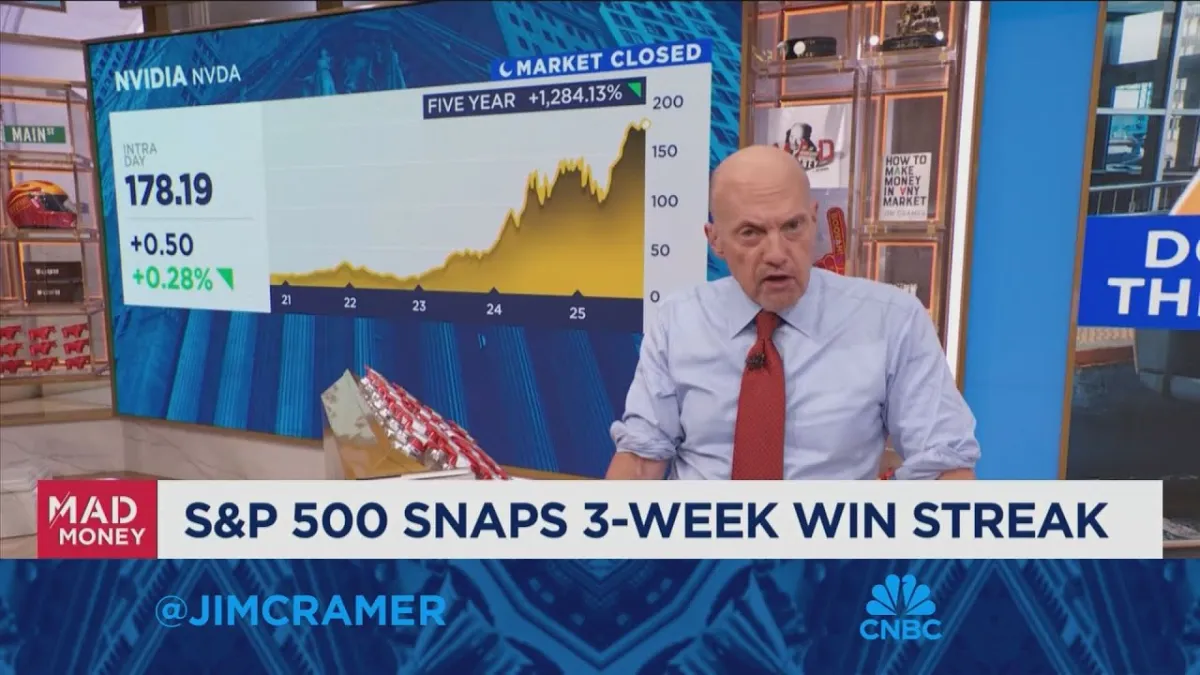
Dismissing the chorus of AI negativity as mere “promotional pessimism,” Jim Cramer, host of CNBC’s Mad Money, implored investors to look beyond the dire warnings of a market crash. His recent broadcast served as a staunch defense of the burgeoning artificial intelligence sector, particularly the massive data center build-out, which critics are labeling an "outrageous bubble."
Cramer spoke during an episode of Mad Money, where he regularly offers insights into market action and investment strategies. His focus was squarely on the prevailing sentiment surrounding AI stocks and the substantial capital expenditures being poured into the foundational infrastructure of this new technological era, arguing that this pessimism creates an "overhang on the entire market."
The prevailing bearish narrative, according to Cramer, is designed to “scare people away from owning stocks.” He highlighted the consistent warnings from "billionaire critics" who argue that the AI data center expansion represents an unsustainable bubble, poised to collapse and drag the broader market down. Yet, Cramer firmly rejects this doomsaying, asserting a profound trust in the visionaries leading the charge. He explicitly stated, "I will not call it a bubble because I trust the judgment of Jensen Huang, he's the CEO of NVIDIA, who's arguably the father of both accelerated computing... and generative AI." This faith extends to other tech titans, whose strategic decisions, Cramer believes, are far more indicative of future success than any bearish forecast.
Unlike the speculative excesses of the dot-com era, where many internet ventures were financed by shaky institutions and vendor loans, Cramer stressed that the current AI investment is underpinned by robust financial health. "The AI spend has been done out of the vast cash flow of these companies," he explained, referring to the trillion-dollar tech giants. These are not nascent startups burning through venture capital; they are established titans like Amazon, Alphabet, and Meta, leveraging their immense reserves to fund the next industrial revolution. These corporations are not borrowing money; they are deploying their own formidable cash flows into what they perceive as the most significant technological frontier.
The drive behind this unprecedented investment, Cramer argued, is a potent mix of conviction and competitive imperative. The CEOs of these leading tech firms genuinely believe AI will be the "next industrial revolution." More profoundly, they are "terrified they'll be left behind" in this transformative race. This fear, rather than recklessness, fuels their strategic spending, knowing that falling behind now could mean irrelevance in the future. They understand the stakes are existential, a stark contrast to the often-unfounded exuberance of past tech booms.