
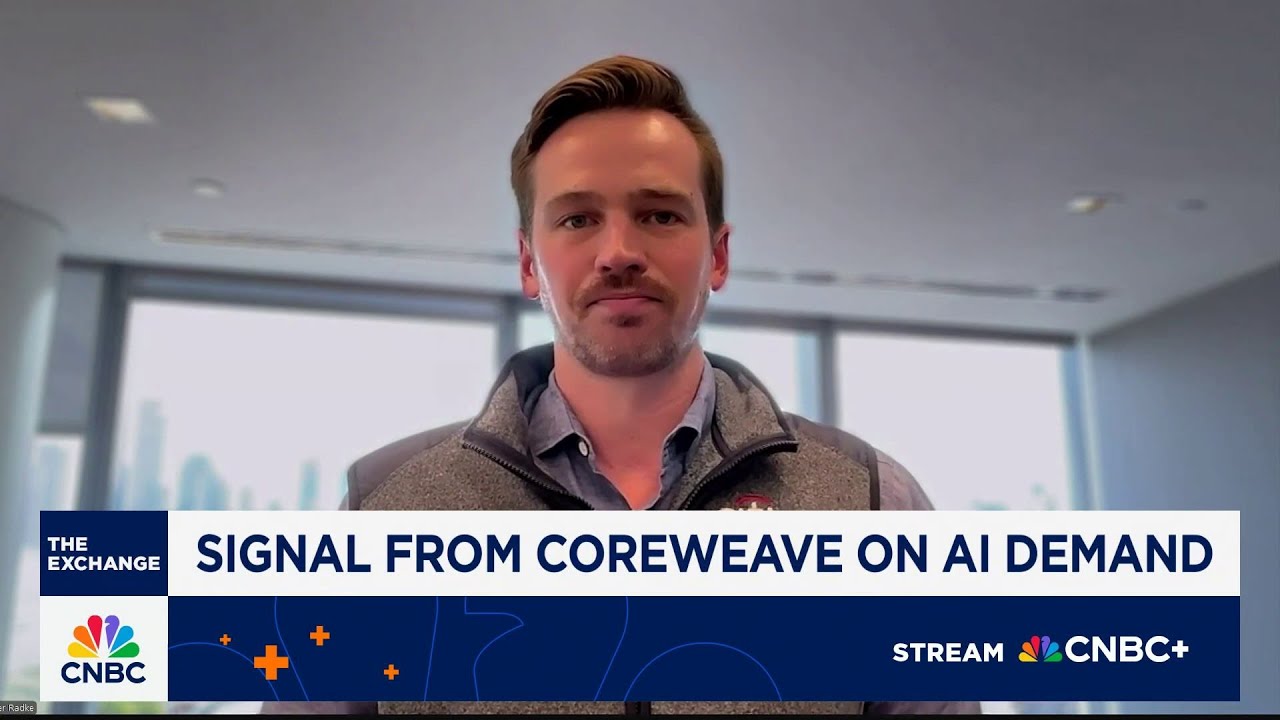
CoreWeave’s recent earnings, which saw its stock slide despite impressive revenue beats, reveal a nuanced story of the burgeoning AI infrastructure market, as discussed by Citi Research’s Tyler Radke with CNBC’s Frank Holland on "The Exchange." The market's initial reaction to a seemingly softer backlog overlooked critical underlying strengths and the unique position CoreWeave occupies in the intensely capital-intensive AI landscape.
Tyler Radke, Co-Head of U.S. Software Equity Research at Citi, spoke with Frank Holland about CoreWeave's latest financial results, the persistent capacity constraints within the cloud sector, and the broader implications for AI demand. While some analysts expressed concern over the backlog not being "as impressive as some had hoped," Radke offered a more optimistic, long-term perspective.
Radke clarified that the nature of CoreWeave’s business, dealing with the "biggest AI companies on the planet" such as Microsoft, OpenAI, Google, and AWS, inherently leads to lumpy deal timings. He pointed out that a substantial Microsoft deal, which constitutes "70% of their revenue," had already closed in the first part of Q3, thereby not reflecting in the Q2 backlog number. This temporal disconnect can distort quarterly backlog figures, yet it signals robust underlying demand.
Looking ahead, CoreWeave anticipates revenue growth to "reaccelerate in Q4" as a significant number of Blackwell chips come online, further bolstering their capacity. This strategic ramp-up in capital expenditure, coupled with a "massively increased their contracted power this quarter," serves as a strong leading indicator for sustained future demand. This proactive investment demonstrates CoreWeave's commitment to meeting the insatiable appetite for AI compute.
Holland raised a pertinent question regarding CoreWeave's long-term sustainability, asking if the company might be merely a "temp worker or a band-aid" as hyperscalers like AWS build out their own advanced capacity. Radke firmly countered this, asserting that CoreWeave is "one of the few companies on the planet that can actually successfully operate these large scale GPU AI training clusters at scale." He emphasized that this is not a simple undertaking, requiring substantial capital, power, and physical space—challenges that are not "magically going to be solved in the years ahead."
The sheer scale of the AI market, which Radke suggested could potentially be "even larger" than the trillion-dollar public cloud market, provides ample room for specialized players like CoreWeave. While hyperscalers are investing in custom AI chips, CoreWeave's exclusive partnership with Nvidia and their ability to deploy cutting-edge GPU clusters fill an immediate and critical void. The recent addition of Google, a company known for its in-house TPUs, as a CoreWeave customer further underscores the overwhelming demand and the necessity for diverse, high-performance compute solutions beyond what even the largest tech giants can internally generate.



