

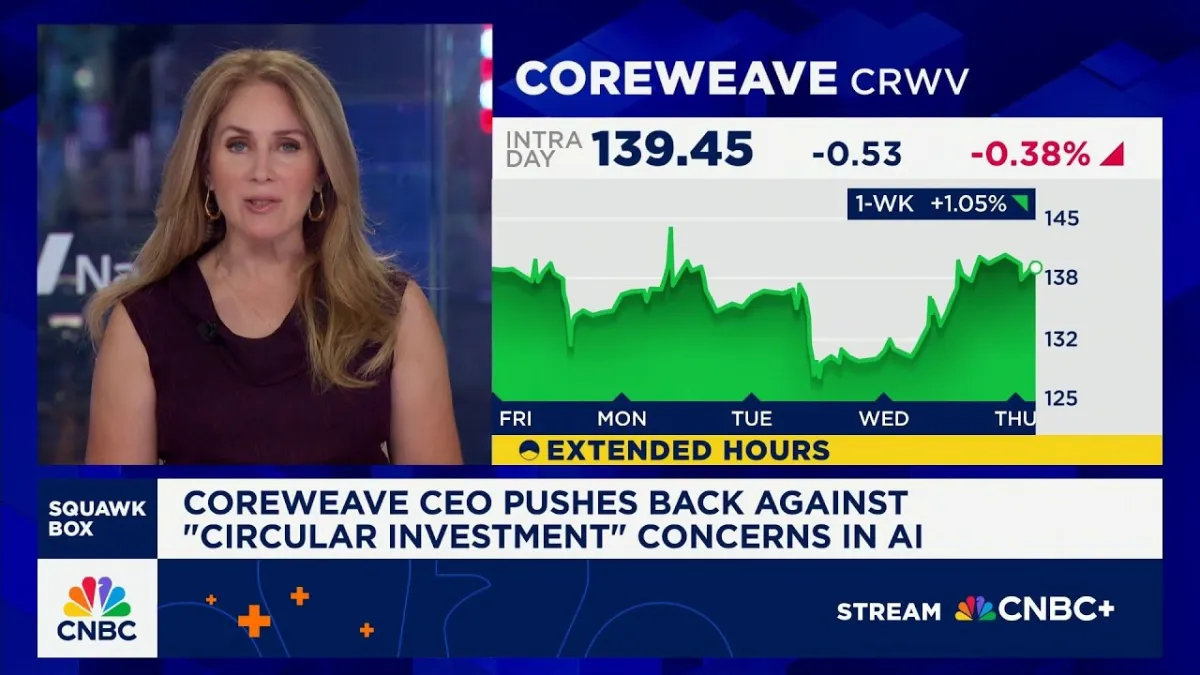
The surging demand for AI infrastructure has ignited a fierce debate in the tech sector, centered on whether the substantial investments are fueled by genuine need or by a "circular" flow of capital among interconnected players. CoreWeave CEO Michael Intrator recently pushed back against these concerns, asserting that the current build-out is a fundamental, demand-driven expansion.
Intrator, speaking on CNBC, addressed the skepticism surrounding the nature of large-scale AI investments. His company, CoreWeave, an AI cloud provider, has recently announced significant deals: a $6.5 billion expansion with OpenAI, a $14 billion agreement with Meta, and a $6 billion order for chips from Nvidia. The latter deal, in particular, has drawn scrutiny, given Nvidia's existing stake in CoreWeave.
Intrator's core argument rests on the undeniable demand from the world's largest tech companies. "The largest tech companies in the world are purchasing this infrastructure because they have demand," he stated emphatically. "There's nothing circular about that." He characterized the current landscape as a "fundamental infrastructure build-out," suggesting that the scale of investment is a natural response to an unprecedented technological shift. For Intrator, the sheer utility and necessity of this infrastructure for advancing AI capabilities underscore its legitimacy.
This perspective highlights a critical insight: the rapid maturation of AI from theoretical concept to practical application necessitates an entirely new class of computational power. Companies like OpenAI and Meta are not merely speculating; they are deploying AI models at a scale that demands immense, specialized computing resources. CoreWeave’s position as a provider of GPU-accelerated cloud infrastructure places it squarely at the epicenter of this demand. The market for AI training and inference is burgeoning, and the underlying hardware and cloud services are foundational to that growth.
However, the CNBC hosts pressed on the specifics of the deals, particularly the relationship with Nvidia. The discussion pivoted to the concept of "vendor financing," where a supplier extends credit or makes an investment in a customer to facilitate purchases of its own products. While Intrator maintained the integrity of CoreWeave’s transactions, one host questioned whether the Nvidia deal, and even a similar one with AMD, constituted a form of vendor financing, suggesting that value might be "created out of basically nothing" to fund chip purchases.
Becky Quick, a CNBC anchor, acknowledged the distinction, stating, "I'm not arguing that they're not [vendor financing]. I'm saying they're different in terms of who has the advantage in the deal." This subtle but important clarification underscores another crucial insight: not all partnerships are created equal, even if they share structural similarities. In the highly competitive and capital-intensive AI hardware market, securing supply is paramount. For CoreWeave, the Nvidia deal, which includes a $6 billion order for chips, is not just a transaction but a strategic alignment that ensures access to the scarce, high-performance GPUs essential for its business model. Nvidia, in turn, secures a significant customer and strengthens its ecosystem.
Related Reading
- Data Centers as One Giant AI Computer
- AI's Hidden Bottleneck: The Industrial Giants Powering Data Centers
- Cerebras IPO Withdrawal Signals AI Capital Market Shift
The nature of these partnerships, whether viewed as vendor financing or strategic investment, reflects the unique economic dynamics of the AI industry. When an emerging technology requires such specialized and expensive components, traditional financing models may not suffice. Companies like Nvidia, with a dominant position in AI accelerators, have an incentive to ensure their chips are deployed broadly, even if it means providing financial backing to key partners. This accelerates the overall market adoption of AI and, by extension, Nvidia’s own growth. It is a pragmatic approach to fostering an ecosystem.
Intrator emphasized that in such a "massive scale investment in infrastructure, it is not unusual to see partnerships as people try to serve infrastructure to the consumers." This normalizes the intricate web of relationships forming in the AI sector, comparing it to other foundational infrastructure build-outs throughout history. The current AI boom requires a level of investment and coordination that naturally leads to complex, multi-faceted agreements between hardware providers, cloud services, and AI developers. These are not merely financial maneuvers but symbiotic relationships designed to overcome supply chain constraints and accelerate technological progress. The flow of capital, while sometimes appearing circular on the surface, often represents a strategic channeling of resources to ensure the necessary components and services are in place to meet exponential demand.



