

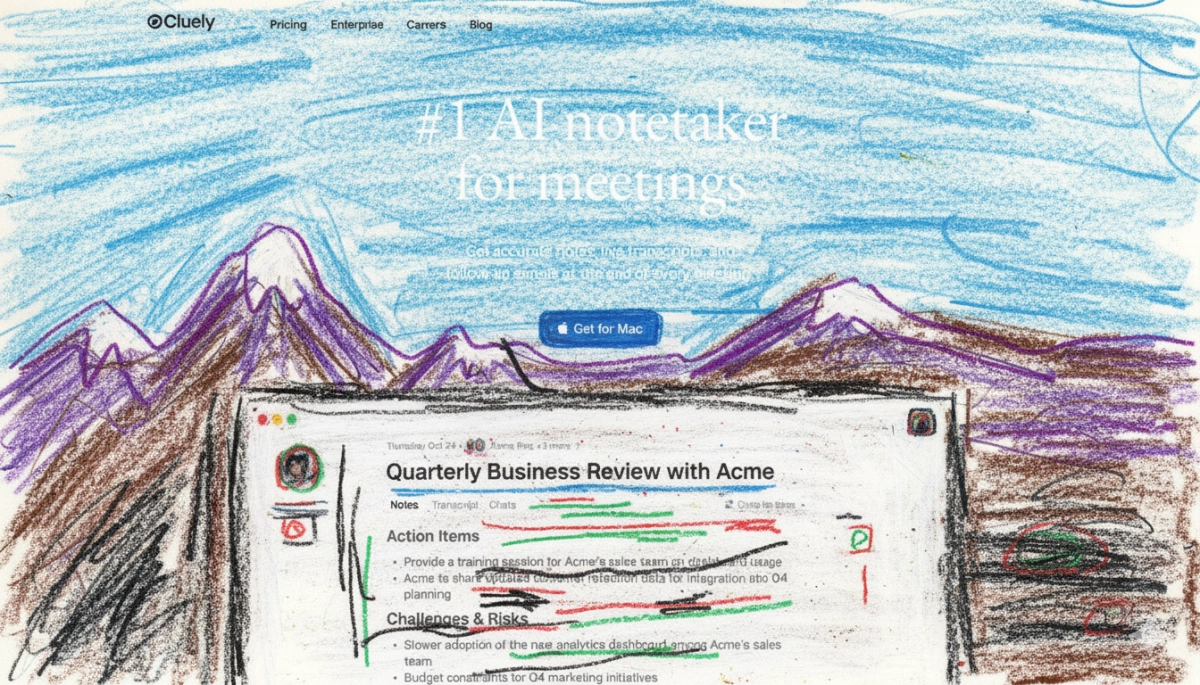
Cluely AI rocketed to a $7M ARR and Andreessen Horowitz backing with a simple, controversial promise: an invisible AI copilot that gives you an edge. Its “cheating to win” marketing, centered on a tool that sees your screen and hears your calls without ever joining as a participant, engineered viral growth and defined a new category of always-on assistance. But as the hype cycle churns, the real story is the rapidly diversifying landscape of Cluely alternatives, forcing a choice between venture-backed polish, enterprise precision, and open-source privacy.
The market Cluely helped create is no longer a one-horse race. It’s fragmenting into distinct philosophies. On one side are the vertical specialists. Winn AI, an Israeli startup with $17M in funding, targets sales teams with a “No-Typing CRM” promise. It’s less about being a universal brain and more about being a ruthlessly efficient sales admin, automating call notes, CRM updates, and follow-ups. They coined "Vibe Selling". Similarly, Aside AI acts as an AI sales coach, pulling best practices from Slack, HubSpot, and past calls to surface in-the-moment training. Both Winn and Aside trade Cluely’s broad, individual-user appeal for a clear, ROI-driven pitch to enterprise buyers: we make your sales team faster and smarter.
But the most significant challenge to Cluely’s dominance comes not from a funded competitor, but from the open-source community. Pluely has emerged as a direct, privacy-first rival, built on the principles of transparency and user control. It’s a classic tech narrative: the lean, community-driven project taking on the well-funded incumbent.
The Open Source Disruption
Pluely’s entire value proposition is a point-by-point rebuttal of the commercial AI assistant model. Where Cluely’s desktop app is a hefty 270MB, Pluely is a featherweight 10MB. It claims to use 50% less CPU and RAM, launching in under 100 milliseconds. The core difference, however, is philosophical. Cluely is a cloud-based SaaS product. Pluely runs entirely locally. According to its developers, it sends zero data, telemetry, or logs to remote servers, with all chat history saved on the user’s machine.
This isn't just about privacy; it’s about control. Pluely is built with a Rust back-end and React front-end using the Tauri framework, and it’s designed for total customization. Users can connect it to any LLM, OpenAI, Gemini, Claude, or even local models via Ollama. They can choose their own speech-to-text provider, from Deepgram to ElevenLabs. Keyboard shortcuts, window transparency, and system audio capture are all user-configurable. It delivers the same core functionality as Cluely, an undetectable, real-time AI layer for meetings, coding, and deep work, but hands the keys entirely to the user.