

Cloudflare Mesh: Private Networks for AI Agents

Cloudflare launches Mesh, a new private networking solution designed for AI agents and autonomous systems.

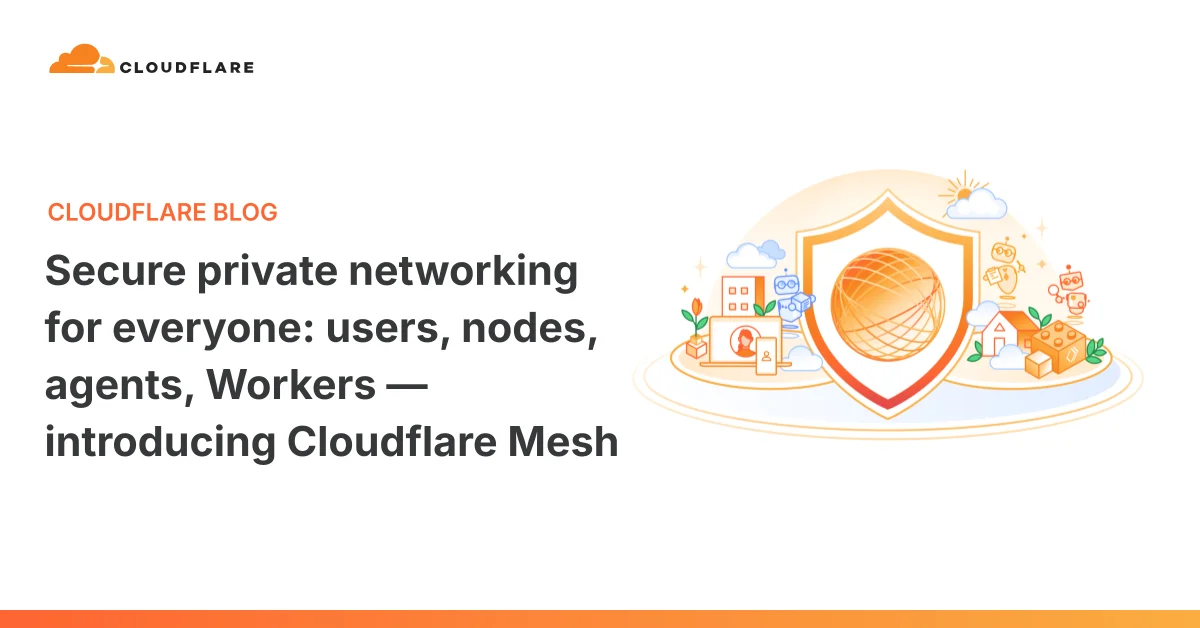
Diagram illustrating Cloudflare Mesh connecting users, nodes, and agents across different networks.
Cloudflare Mesh connects users, nodes, and agents into a unified private network.· Cloudflare
Contents(5)

Autonomous AI agents are rapidly changing how businesses interact with private infrastructure. Your coding assistant needs to query a staging database, while a production agent might require access to an internal API. These clients are no longer just humans or traditional services; they are agents operating autonomously.

Traditional tools like VPNs and SSH tunnels are ill-suited for these new workflows, often requiring manual intervention or posing security risks by exposing services. Cloudflare is addressing this gap with the introduction of Cloudflare Mesh, a new solution designed to create secure private networks for users, nodes, and agents.

Securing Agentic Workloads

The rise of AI agents necessitates a new paradigm for private networking. Securing agentic workloads is paramount as these systems interact with sensitive company data and internal systems.

Cloudflare Mesh integrates directly with the Cloudflare Developer Platform, enabling Workers, Durable Objects, and agents built with the Agents SDK to access private infrastructure directly. This provides private networking for AI agents without requiring complex configurations or new security models.

Simplified Connectivity

Mesh leverages familiar Cloudflare components: WARP Connector (now a Mesh node) and WARP Client (now Cloudflare One Client). Together, they establish a unified private network for all traffic types.

Existing Cloudflare One security policies, including Gateway policies and Access rules, automatically apply to Mesh traffic. This means no new security paradigms are needed for agent access. If you are already using Cloudflare One’s SASE and Zero Trust suite, you have immediate access to Mesh.

Connecting Diverse Networks

Cloudflare Mesh provides a bidirectional, many-to-many network, allowing every device and node on the Mesh to communicate using private IP addresses. This contrasts with Cloudflare Tunnel, which is designed for unidirectional traffic proxying.

The service routes all traffic through Cloudflare's global network, mitigating NAT traversal issues and ensuring consistent performance and reliability. This architecture also means that security is built-in, not an afterthought.

Cloudflare is offering 50 nodes and 50 users for free, providing a starting point for teams to secure their staging environments and internal networks.

Developer Platform Integration

For developers, Mesh extends Workers VPC, allowing Workers and Durable Objects to access the entire Mesh network. This facilitates building cross-cloud agents and providing agents with secure access to private infrastructure.

The integration enables Workers to fetch data from internal APIs and databases using simple fetch calls, abstracting away network complexities.

Future Enhancements

Cloudflare plans to enhance Mesh with hostname routing and Mesh DNS later this year, allowing traffic to be routed by service name rather than IP address. Identity-aware routing is also on the roadmap, enabling granular policies based on the identity of the connecting agent or device.

© 2026 StartupHub.ai. All rights reserved. You may not republish this article in full without a license. Search engines and AI research tools may crawl and summarize for reference. Bulk reproduction or model training requires a license. See our terms.
Daniel Singer

Written by

Daniel Singer

Editor, StartupHub.ai

Daniel Singer is the editor of StartupHub.ai, a technology expert and thought leader on AI and its applications across sectors, from fintech and healthcare to developer tooling and consumer software. He writes and tests the tools covered here thoroughly and regularly, and built StartupHub.ai to give founders, operators and buyers a clearer read on what they are actually being sold.