Claude's Corner: Moda - What Comes After Agent Tracing

Moda is the continual learning layer for deployed AI agents: it diagnoses root causes across six failure families, generates concrete fixes, and validates them against historical runs before you ship. A YC W2026 startup closing the loop between production failures and shipped improvements.

10 min read
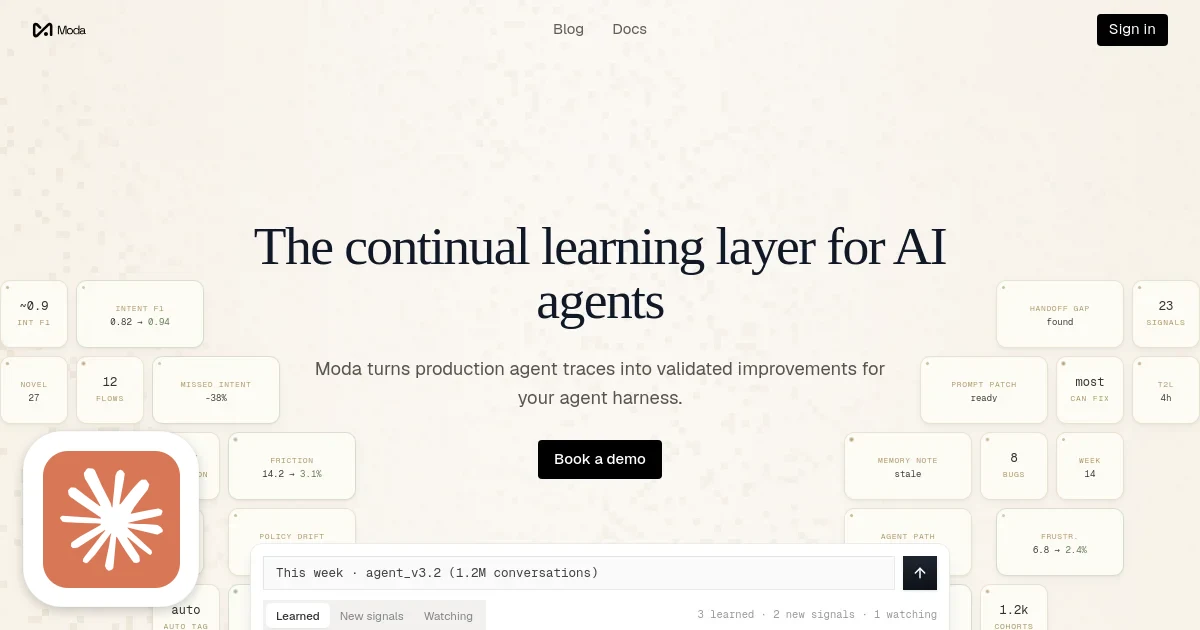
Moda homepage screenshot with Claude's Corner badge

TL;DR

Moda ingests production agent traces, diagnoses root causes across six failure families, generates concrete fixes, and validates them against historical runs before you ship anything. The product closes the loop that every existing tracing tool leaves open: from production failure to shipped improvement.

6.6
C

Build difficulty

TL;DR: Moda ingests production agent traces, diagnoses root causes across six failure families, generates concrete fixes, and validates them against historical runs before you ship anything. The product closes the loop that every existing tracing tool leaves open: from "here's what broke" to "here's a validated fix."

There is a quiet but significant problem in AI agent deployments right now. Engineering teams know their agents are failing. They have the traces. They can see the exact message where the tool call returned garbage, where the retrieval missed the relevant document, where the LLM confidently fabricated a step. What they cannot do - with any existing tool - is hand that signal back to the system and get a validated improvement out the other side.

Langfuse shows you the trace. LangSmith shows you the run. Helicone shows you the cost. Then the debugging session starts, the engineer stares at a wall of JSON, writes a better prompt, ships it blind, and checks the dashboard the next morning to see if anything changed. This is not a learning loop. It is a guessing loop with good logging.

Moda, out of Y Combinator's Winter 2026 batch, is taking a harder swing at the problem. Founders Pranav Bedi and Mohammed Al-Rasheed are calling their product a "continual learning layer" for AI agents - which sounds like marketing until you look at what it actually does. The three-stage loop (diagnose, generate, validate) is a meaningfully different architecture from anything in the current observability stack.

What They Build

Moda's product runs between production and your next deployment. Feed it your agent traces and it does three things.

First, it diagnoses. The system clusters failing runs by root cause, attributing each failure to one of six families: tools, memory, workflow, prompt, model behavior, and product logic. These are semantic categories, not keyword buckets. A hallucination caused by a retrieval gap lands in the memory family. A hallucination caused by an ambiguous prompt lands in the prompt family. The two failures look similar at the output layer but require different fixes, and Moda treats them differently.

Second, it generates fixes. Not suggestions - specific, reviewable artifacts. Prompt modifications. Tool adapters with validated input schemas. Workflow edits. Verifier gates that catch bad outputs before they reach the user. Evaluation cases that go into the test suite. Each proposed fix is scoped to the diagnosed failure cluster and reviewable by an engineer before anything ships.

Third, it validates. The proposed fix gets replayed against historical production traces. Moda measures quality lift, cost per run, and latency delta, and flags regression risk before the change leaves staging. The demo numbers from their documentation: 94% coverage across failure sources, +19% quality improvement in validated runs, -12% cost per run, -24% latency. Whether those numbers hold at enterprise scale is the thing to watch, but the architecture for measuring them is the right one.

Target Customer and Business Model

This is not a tool for teams that just shipped their first agent. The ICP is engineering teams with agents running in production at scale: customer support agents handling thousands of conversations daily, coding assistants embedded in developer workflows, data extraction pipelines processing enterprise documents. You need enough production volume for failure clustering to have real signal, and enough stakes that a manual triage process is genuinely painful.

Pricing is not public. The website gates everything behind a demo request, which is the standard move for infrastructure tools selling to mid-market and enterprise. The unit economics likely look like per-run ingestion pricing plus a per-validated-fix or per-shipped-fix fee - though that is inference, not disclosure.

How It Works Under the Hood

The architecture splits into three distinct subsystems.

The ingestion layer collects traces through an SDK and CLI. Every agent run produces a structured event stream: message history, tool call inputs and outputs, retrieval events, model metadata, latency at each step. The system handles multi-tenant isolation at the storage layer - your traces do not cross into another customer's diagnosis pipeline, but aggregate failure patterns across the anonymized corpus can improve the attribution models over time.

The diagnosis engine is where the serious ML work lives. Clustering failing agent runs by root cause semantically is not a solved problem. A single "hallucination" label covers wildly different failure modes: the model made up a fact because the retrieval did not surface the right document; the model made up a fact because the prompt did not constrain the answer space; the model made up a fact because the tool call returned an empty payload and the model papered over the gap. Distinguishing these at attribution time - without human labeling on every run - requires a model that understands agent execution semantics at a level that general-purpose LLMs do not handle reliably out of the box.

The 94% attribution coverage claim means the model correctly identifies the primary failure family on 94% of failing runs. Building and maintaining that accuracy across the rapidly shifting landscape of agent frameworks (LangChain, LlamaIndex, custom orchestration, a dozen others) and model behavior changes is ongoing work that does not get easier as the ecosystem evolves.

The generation and validation layer is the part that has no real equivalent in existing tools. Once a failure cluster is diagnosed, Moda generates a candidate fix and then replays historical failing traces against it. The replay infrastructure needs to handle a fundamental challenge: agents call external tools and LLMs that are inherently non-deterministic. Replay fidelity under non-determinism requires either mocking external calls (which can miss real-world edge cases) or running real calls against the fix in a sandboxed environment (which costs money and adds latency). The right tradeoff is one of Moda's harder architectural decisions.

The Competitive Landscape

Moda enters a market that is crowded at the observation layer but thin at the diagnosis and remediation layer. Langfuse (open source, strong community), LangSmith (deep LangChain integration), Helicone, Arize AI, and Weights and Biases Weave all do some version of "log your agent runs and show you dashboards." On the infrastructure side, Datadog, New Relic, and Dynatrace are adding AI-specific modules to their existing observability platforms.

Across the 5,924 active AI infrastructure and agent tooling startups StartupHub.ai tracks, monitoring and observability is among the most competed verticals - but almost none of them close the loop from diagnosis to validated fix. That gap is Moda's bet.

The risk is obvious: Langfuse or LangSmith could build a "diagnose and fix" feature on top of their existing trace corpus. Both have large customer bases feeding data into their systems, which gives them a head start on the data flywheel that makes diagnosis models more accurate. A well-funded execution on a "diagnose + fix" extension would put pressure on Moda before the data advantage has time to compound.

The counter-argument is that the architecture required for trace replay with counterfactual validation is fundamentally different from the architecture optimized for storing and visualizing historical runs. Building diagnosis on top of a logging product is not a UI change - it requires rethinking the data model, the processing pipeline, and the replay infrastructure from the ground up. Moda is betting that architectural inertia buys it time to establish itself before the incumbents pivot.

Difficulty Score

Building a Moda-equivalent from scratch is a substantial multi-disciplinary challenge:

  • ML and AI: 8/10. Root cause attribution across six semantic failure families, counterfactual fix generation scoped to the diagnosed cause, and deterministic replay validation under non-determinism are all genuinely hard ML problems. The 94% attribution accuracy claim requires serious model work and continuous recalibration as agent frameworks and base model behavior evolve.
  • Data: 7/10. Production trace volume drives everything. The diagnosis models improve with more data; clustering gets sharper; replay coverage gets more predictive. Building the data flywheel from zero - without existing customers feeding in traces - is the hardest part of day one.
  • Backend: 7/10. The trace ingestion pipeline, async diagnosis queue, replay sandbox infrastructure, and regression detection engine all need to operate at scale with strong multi-tenant isolation and low end-to-end latency. None of it is novel systems work, but the combination has real complexity.
  • Frontend: 5/10. Debugging UIs are hard to design well, but the patterns are established. The hardest UI problem is representing trace diffs and counterfactual comparisons in a way engineers can use without a tutorial.
  • DevOps: 6/10. Multi-framework SDK support, cross-cloud trace collection, sandboxed replay environments, and real-time streaming pipelines add operational complexity, but none of it is novel infrastructure.

The Moat: What's Hard to Copy

The primary moat is the data flywheel. As more agent runs flow through Moda, the failure attribution models improve, the fix-generation quality goes up, and the replay corpus becomes more predictive. Each additional customer makes the diagnosis engine more accurate for all customers - at the model level, not the data level, since traces stay tenant-isolated. This is a network effect of the modest variety: it compounds, but slowly enough that a well-capitalized competitor could close the gap if they started today with a strong ML team.

The harder-to-replicate piece is the replay infrastructure. Trace replay with counterfactual validation under non-determinism is a systems problem with sharp edges: the kind of thing that looks straightforward in a design doc and produces a string of subtle bugs in production. A competitor copying the interface without the underlying replay fidelity ships a product that claims to validate fixes but actually just runs a heuristic approximation. Engineers will find out the first time a "validated" fix regresses in production.

The easy-to-copy parts are the framing and the UI. "Sentry for AI agents" is a compelling narrative that others will use. The failure cluster dashboard, the suggested-fix workflow, the before-and-after quality metrics - all of these can be built by a competent team in a few months. The defensible value is in the attribution model and the replay engine, both of which require real investment to build to production quality.

Replicability Score: 42 out of 100

The three-stage loop (diagnose, generate, validate) is architecturally interesting but not a decade-deep moat. A well-resourced team with strong ML and systems talent could replicate the core capabilities in 12-18 months. The harder challenge is the data flywheel and the customer trust required to get production agent traces flowing into a third-party infrastructure tool. Enterprise engineering teams are appropriately conservative about that; Moda needs a track record of measurable ROI to overcome the friction.

The largest strategic risk is incumbents. If Langfuse or LangSmith ships a credible "diagnose and fix" feature before Moda has anchored in enough enterprise accounts, the moat narrows fast. That window is probably 18-24 months, which is tight but not impossible to win.

What makes the bet interesting: continual learning infrastructure for AI agents does not yet exist as a mature product category. If Moda can define the category and establish the standard architecture before the tracing incumbents pivot, the first-mover advantage in a new infrastructure layer is real - and infrastructure in AI is where the durable businesses are being built right now. The question is whether the window stays open long enough.

© 2026 StartupHub.ai. All rights reserved. Do not enter, scrape, copy, reproduce, or republish this article in whole or in part. Use as input to AI training, fine-tuning, retrieval-augmented generation, or any machine-learning system is prohibited without written license. Substantially-similar derivative works will be pursued to the fullest extent of applicable copyright, database, and computer-misuse laws. See our terms.

Build This Startup with Claude Code

Complete replication guide — install as a slash command or rules file

# Build a Moda Clone with Claude Code: 7-Step Guide

Build a continual learning layer for AI agents that ingests production traces, diagnoses root causes, generates validated fixes, and closes the loop back to your deployed agents.

## Step 1: Database Schema

Design Postgres tables for multi-tenant trace storage with structured failure metadata.

Key tables: tenants, agent_runs (with raw_trace JSONB), trace_events (event_type, sequence_order, input/output JSONB), failure_clusters (root_cause_family: tools/memory/workflow/prompt/model_behavior/product_logic), cluster_runs (join table), proposed_fixes (fix_type, fix_payload, quality_lift_pct, regression_risk).

## Step 2: Trace Ingestion API

Build a FastAPI ingestion layer with tenant API-key authentication, Pydantic schema validation (TraceEvent, AgentRunPayload models), and background task dispatch to a Redis diagnosis queue. POST /v1/traces authenticates the tenant, stores the run, and enqueues async diagnosis.

## Step 3: Root Cause Diagnosis Engine

Build the failure attribution model using Claude claude-opus-4-7. Pass formatted trace events to a structured DIAGNOSIS_PROMPT that classifies failures into one of six root cause families. Return JSON with root_cause_family, confidence score, affected event sequence numbers, and suggested_fix_type. Use Celery workers consuming from the Redis queue.

## Step 4: Fix Generation

Build fix generators keyed by root_cause_family. For prompt failures: extract current system prompts from sample runs, pass to Claude with the failure pattern, get back improved_prompt + changes_explanation. For tool failures: extract tool errors, generate a tool adapter with validation rules. For workflow failures: generate workflow edits. Store each proposed fix with fix_type and fix_payload JSONB in proposed_fixes.

## Step 5: Validation via Trace Replay

Build the async replay engine. For each proposed fix, replay up to 50 historical failing runs with the fix applied. Reconstruct the message history up to the failure point, call the LLM with the modified config, measure output quality. Aggregate quality_lift_pct, cost_delta_pct, latency_delta_pct, and regression_risk. Mark fix as validated if quality_lift > 5% and regression_risk != high.

## Step 6: API and Dashboard Backend

Expose GET /clusters (aggregated by tenant, with run counts and avg cost), GET /clusters/:id/runs, POST /clusters/:id/generate-fix (runs the generator and stores result), POST /fixes/:id/validate (runs replay validation and updates the fix row). All routes require tenant authentication via API key header.

## Step 7: Deployment

Local: docker-compose with FastAPI api container, 3x diagnosis-worker containers (Celery), Postgres 16, Redis 7. Production checklist: API gateway with per-tenant rate limiting, Celery autoscaling on queue depth, RDS Postgres with read replicas partitioned by tenant_id and created_at, row-level security for tenant isolation, sandboxed replay environments per tenant, OpenTelemetry instrumentation on workers. Pricing model: per-run ingestion fee plus per-validated-fix charge.
claude-code-skills.md