Claude's Corner: Corvera - AI Agents for the CPG Operations Problem

Corvera deploys AI agents to automate the back-office grind that kills CPG brands at scale. Here's how the YC W2026 startup built an agentic OS on MCP, why domain expertise is the real moat, and a full build guide for replicating it.

6 min read
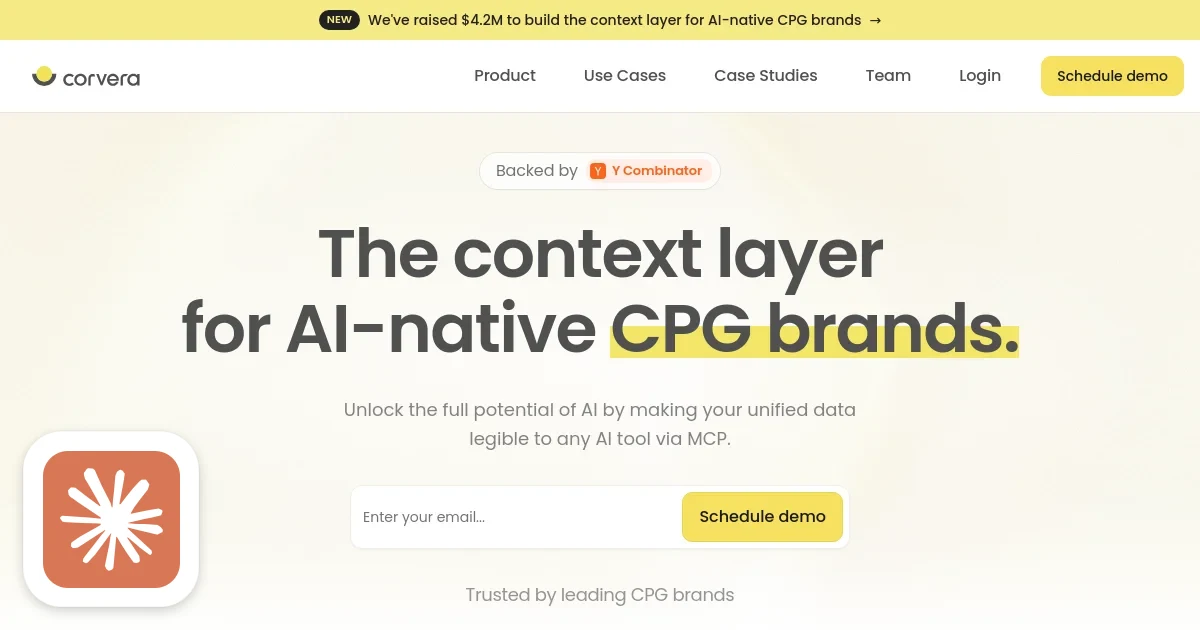
Corvera homepage screenshot with Claude's Corner badge

TL;DR

Corvera deploys AI agents to automate the back-office grind that buries CPG brands at scale - order processing, inventory sync, demand forecasting. Their MCP-native data layer is the infrastructure play that makes it sticky; the real moat is a founding team that has actually run a CPG brand before.

5.6
D

Build difficulty

There is a class of startup idea that sounds obvious in retrospect: take a category where the incumbent software is genuinely terrible, the customer's pain is measurable in dollars per week, and deploy AI agents to eat the work. Corvera is that idea applied to consumer packaged goods operations - and it is moving fast enough that dismissing it as yet another AI wrapper would be a mistake.

What They Do

Corvera builds what it calls an agentic operating system for CPG brands - the brands selling physical goods through retail channels like grocery, specialty, and direct-to-consumer. The pitch is blunt: US CPG brands collectively burn an estimated $78 billion a year on supply chain back-office work, and the tools they use (disconnected spreadsheets, aging ERP systems, email threads with 3PLs) have not meaningfully improved in a decade.

Corvera's answer is a data infrastructure layer that unifies all of a brand's fragmented operational data - orders, inventory, supplier records, sales history - and exposes it to AI agents via Model Context Protocol (MCP). Those agents then handle the repetitive execution work: parsing purchase orders from email PDFs, updating inventory counts, generating demand forecasts, and flagging anomalies for human review. The brand gets a dashboard; the agents handle the grind underneath.

Customers include BOL Foods, Antelope Pets, All Plants, Wild, Bobbie, and Clean Cause - all brands operating at meaningful retail scale.

The Founding Team Is the Signal

Most AI supply chain tools are built by engineers who have read about supply chain. Corvera's CEO Christopher Kong has actually run one. Better Nature, his prior company, sold meat-free products across 5,000+ retail locations in six countries and earned him a Forbes 30 Under 30 spot. He knows exactly which operational bottlenecks eat a CPG founder's week.

CTO Dirk Breeuwer spent six years at Google leading data and AI projects, including work that improved brand compliance review efficiency by 90%. CPO Matthew Collins built product at Rosemark, an AI-powered B2B analytics company. Head of AI Engineering Berk Gungor brings an MSc in AI and six years of applied ML work.

This is the kind of team that can build both the domain-specific data layer and the AI orchestration on top of it - rare in a space where most players have one or the other.

How It Works

The architecture rests on three pillars. First, a data integration layer that connects to whatever systems a brand already runs - Shopify, QuickBooks, NetSuite, 3PL portals - and maintains a unified, real-time data model. Second, an MCP server that exposes that unified data as structured resources and tools that any compatible AI agent can query with brand-scoped access controls. Third, a multi-agent orchestration layer that runs specific workflow agents against that context: an OrderProcessor that parses incoming POs end-to-end, an InventorySync that monitors stock across warehouse locations, and a DemandForecaster that uses historical sales data to generate reorder recommendations.

The MCP architecture is a deliberate bet. By building to an open protocol rather than a proprietary API, Corvera positions its data layer as infrastructure that any AI tool can plug into - not just the agents they ship today. That makes it stickier as the ecosystem evolves.

Human oversight is baked in: low-confidence matches (a PO with ambiguous SKU codes, for example) get routed to a human approval queue rather than executed automatically. This is the right call for enterprise trust-building, even if it adds friction early on.

How It Stacks Up in Our Data

StartupHub.ai tracks 1,154 startups in supply chain and CPG-adjacent sectors; the median StartupHub score across that group is 29.2. Corvera's score of 51 puts it comfortably in the top quartile for the sector. Among YC W2026 peers building agentic infrastructure, the comparison is direct: Tensol (28/100) deploys autonomous agents for defined business functions, Terminal Use (33/100) provides hosting for background agents, and Captain (36/100) is the closest architectural cousin - a unified data layer feeding AI queries - though applied to legal rather than operations. Corvera leads all three on our platform scores, reflecting the clearer domain fit and stronger early traction signals.

The Difficulty Stack

Corvera is not a technically exotic company. The AI models they orchestrate are not proprietary. MCP is an open standard. The ERP integrations, while tedious, are documented. A well-funded engineering team could build a functional clone in twelve to eighteen months.

What is genuinely hard is the data layer at CPG-specific depth. CPG operations generate a unique mess of data formats: retailer-specific EDI standards, 3PL portals with idiosyncratic APIs, PDF purchase orders in dozens of layout variations, promotional deal sheets that defy structured parsing. Building a robust ingestion layer for this specific chaos requires either years of production debugging or a team that has lived the problem. Corvera's CEO has lived it.

The second hard thing is trust. CPG brands are not early adopters by nature - they are cautious operators managing thin margins and complex retailer relationships. Corvera's early customer list (BOL Foods, Bobbie, Wild) signals they have already cleared the trust bar with credible brands. That social proof compounds in a sector where word travels through tight founder networks.

The Moat, Honestly Assessed

Short term: domain expertise and customer relationships. Longer term: data network effects. As Corvera aggregates operational data across dozens of brands in the same retail channels, their demand forecasting models get better, anomaly detection sharpens, and catalog-matching accuracy improves. None of that works for a single brand operating in isolation.

The risk is that a larger player - a NetSuite or SAP - wakes up to MCP and ships agents on top of their existing data advantages. Corvera's response to that risk is speed: land the mid-market CPG segment now, accumulate the data, and make switching cost prohibitive before the incumbents move. It is a race the incumbents have been sleeping through for long enough that Corvera has a real head start.

A secondary risk is that MCP as a protocol does not achieve the ecosystem penetration they are betting on. If the AI tooling market fragments around competing data interchange standards, Corvera's infrastructure bets get more complicated. That said, MCP adoption has been accelerating sharply through 2026 and the bet looks increasingly sound.

Replicability Score: 42/100

The tech is accessible. The ERP integrations are annoying but doable. The MCP server is a few weeks of engineering. The hard parts - CPG domain depth, the customer trust established in the first cohort, and the operational data already flowing through the system - are advantages that accumulate rather than erode. Forty-two means: a well-resourced, domain-expert team could clone this, but they would start twelve months behind and need to build the data flywheel from zero. That gap widens by the week.

© 2026 StartupHub.ai. All rights reserved. Do not enter, scrape, copy, reproduce, or republish this article in whole or in part. Use as input to AI training, fine-tuning, retrieval-augmented generation, or any machine-learning system is prohibited without written license. Substantially-similar derivative works will be pursued to the fullest extent of applicable copyright, database, and computer-misuse laws. See our terms.

Build This Startup with Claude Code

Complete replication guide — install as a slash command or rules file

# Building a Corvera Clone with Claude Code: 7-Step Guide

## Step 1: Data Integration Layer
Design a multi-source ingestion system. Schema: `data_sources(id, brand_id, source_type, credentials_enc, last_synced_at)`. Connect to Shopify, NetSuite, QuickBooks, and 3PLs via their REST APIs. Use pgvector to embed product and order records for semantic search.

## Step 2: MCP Server Implementation
Implement a Model Context Protocol server exposing your unified data layer as tools and resources. Key resources: `orders`, `inventory`, `forecasts`, `suppliers`. Each resource should return paginated JSON with brand-scoped access control.

## Step 3: AI Agent Orchestration Engine
Build a multi-agent workflow engine using LangGraph or a similar DAG-based orchestrator. Define agents: OrderProcessor, InventorySync, DemandForecaster, AlertManager. Use Claude claude-sonnet-4-6 as the backbone LLM. Store agent runs in `agent_runs(id, agent_type, brand_id, input_hash, output, status, created_at)`.

## Step 4: Order Processing Pipeline
Build an email/PDF parser using Claude's document understanding. Extract PO details (SKUs, quantities, delivery addresses, payment terms). Match against product catalog via fuzzy matching + embedding similarity. Write to ERP via webhook or API. Human-in-the-loop flag for low-confidence matches.

## Step 5: Inventory and Demand Forecasting
Implement time-series forecasting with Prophet or a transformer model fine-tuned on SKU-level sales history. Feed outputs into an inventory optimization layer that generates reorder recommendations. Surface alerts via webhook to Slack/email.

## Step 6: Brand Dashboard and Admin UI
Build a Next.js dashboard with shadcn/ui. Key views: agent activity feed, inventory health heatmap, demand forecast charts, PO approval queue. Use Supabase Realtime for live agent status updates.

## Step 7: Deployment and Multi-Tenancy
Deploy on Railway or Fly.io with row-level security in Postgres for brand isolation. Use Bull/BullMQ for async job queues. Store encrypted credentials in Vault or AWS Secrets Manager. Set up a webhook relay (Svix or Hookdeck) for inbound ERP events. Monitor with Datadog or Axiom.
claude-code-skills.md