

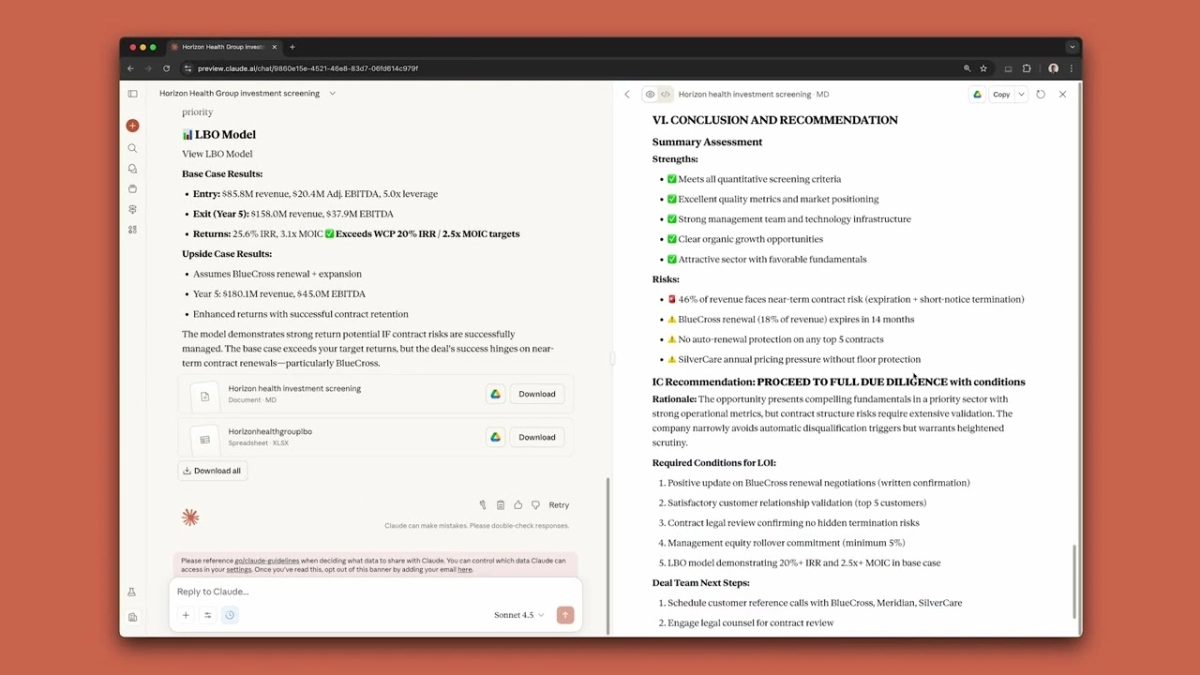
The recent demonstration of Claude’s capabilities in accelerating private equity workflows showcases a significant shift in how complex financial analysis can be executed. This is not merely an incremental improvement but a fundamental re-imagining of the entire deal process, compressing tasks that once spanned days into mere minutes or hours. The core narrative of the video highlights this transformation, following two financial professionals as they leverage AI to navigate a complex M&A scenario.
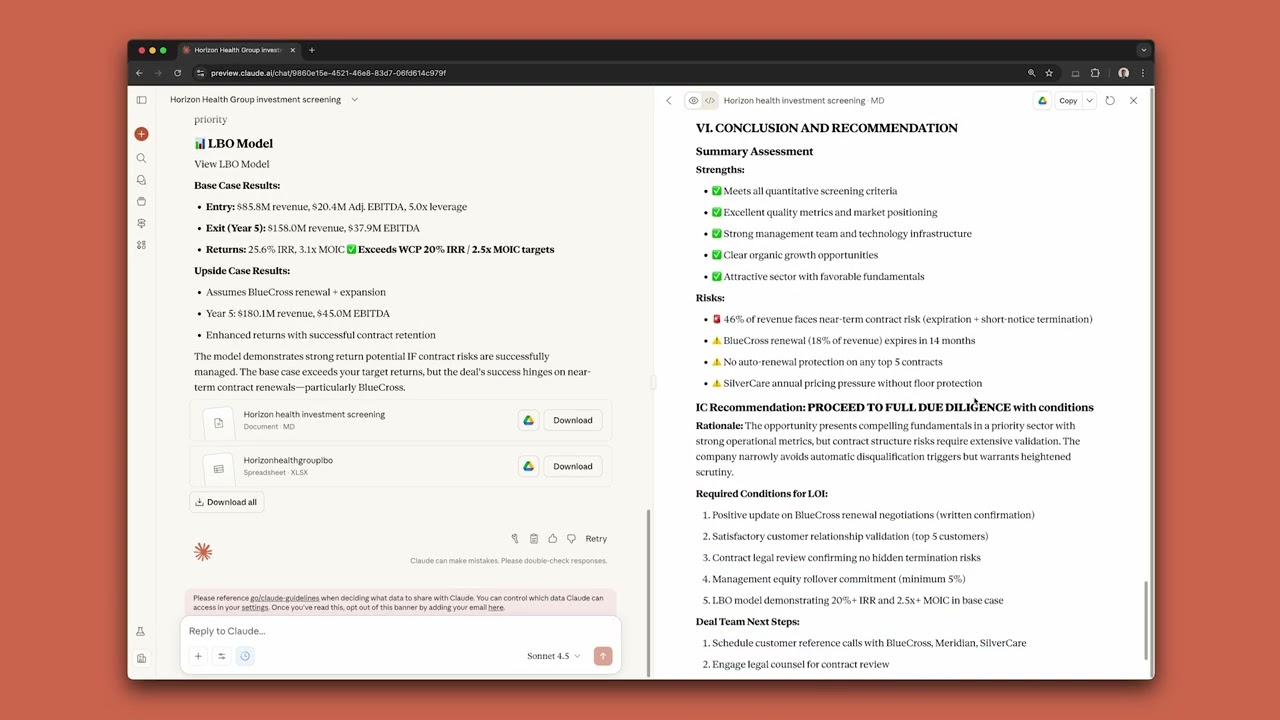
The demonstration unfolds with Sarah, an associate at Riverside Partners on the sell-side, tasked with creating a deal teaser for Horizon Health Group, an $85 million healthcare services business. On the buy-side, Jen, a VP at Wealth Capital, receives this teaser and initiates a comprehensive screening and modeling process. Both professionals leverage Claude to expedite and enhance their respective workflows, demonstrating an integrated AI assistant that profoundly impacts efficiency and the depth of analysis.
Sarah’s initial task, the creation of a client-ready deal teaser, traditionally involves sifting through vast amounts of data to extract key financials, customer retention metrics, and operational details. With Claude, this labor-intensive process is dramatically streamlined. Sarah simply prompts Claude to "Create a deal teaser for Horizon Health Group using the attached Riverside template and the Deal Teaser Skill. Extract key metrics from the data room in Egnyte, look for financials, customer retention data, and operational metrics." Claude then autonomously searches Egnyte, identifying and extracting revenue, margins, retention metrics, and facility details. The result is a professional, client-ready presentation in less than two minutes. The voiceover emphasizes this speed, stating, "In under two minutes, Sarah's got a professional teaser ready to send." This immediate turnaround exemplifies the first core insight: AI’s ability to drastically reduce the time spent on data aggregation and initial document creation, freeing up valuable human capital.
Upon receiving the teaser, Jen at Wealth Capital begins her due diligence. Her prompt to Claude is multifaceted: "Screen this Horizon Health Group teaser against our Wealth Capital investment criteria from SharePoint. Flag any risks in customer contracts (which can be found in Egnyte data room). Make a quick write-up of this. Then build an LBO model assuming 5.0x leverage, 5-year hold, and 8% revenue growth in year 1 tapering to 3% by year 5. Make a base and upside case. Use the attached Excel template and the LBO skill." Claude’s response is equally impressive. It pulls investment criteria from SharePoint, extracts relevant data from the teaser, and, critically, delves into the Egnyte data room for contract specifics.
This deep dive into contract analysis reveals a high-priority risk that might easily be overlooked in a manual review. Claude identifies that a BlueCross contract, representing 18% of Horizon Health Group’s revenue, expires in December 2025, just 14 months from the diligence date. Furthermore, 28% of revenue is exposed to short-term termination clauses. The video’s narrator highlights this crucial discovery: "Claude is deeper diligence. It searches the Egnyte data room to find that BlueCross Regional is 18% of revenue with a contract that expires December 31, 2025." This uncovers a material contract risk, demonstrating the second core insight: AI's capacity for enhanced due diligence and precise risk identification. By autonomously analyzing granular data, Claude provides a more thorough and less fallible assessment than traditional methods, preventing potential deal-breakers from advancing unnoticed.