The integration of artificial intelligence into core developer workflows is no longer a distant promise; it is rapidly becoming a tangible reality that fundamentally alters how engineering teams operate. A recent demonstration of Claude Code in Slack illustrates this shift, showcasing an AI assistant capable of moving beyond simple code generation to actively investigating, diagnosing, and resolving complex production issues directly within a team's communication hub. This represents a significant leap from isolated AI tools to deeply embedded, context-aware collaborators, offering profound implications for productivity and system reliability.
The video effectively demonstrates how Anthropic's Claude Code, when integrated with Slack, acts as an intelligent agent within a typical development scenario. The narrative begins with a critical alert posted by Emily Anderson in a product team Slack channel: "Hey team, request from support - Customer (Acme Corp) is seeing a bug in production. Their payment processing webhooks are failing silently. No errors in the UI but transactions aren't completing. Error logs show: 'WebhookTimeoutException: Response time exceeded 30s limit'. Can someone investigate ASAP?" This immediate, high-stakes context is precisely where human engineers often face pressure and time constraints.
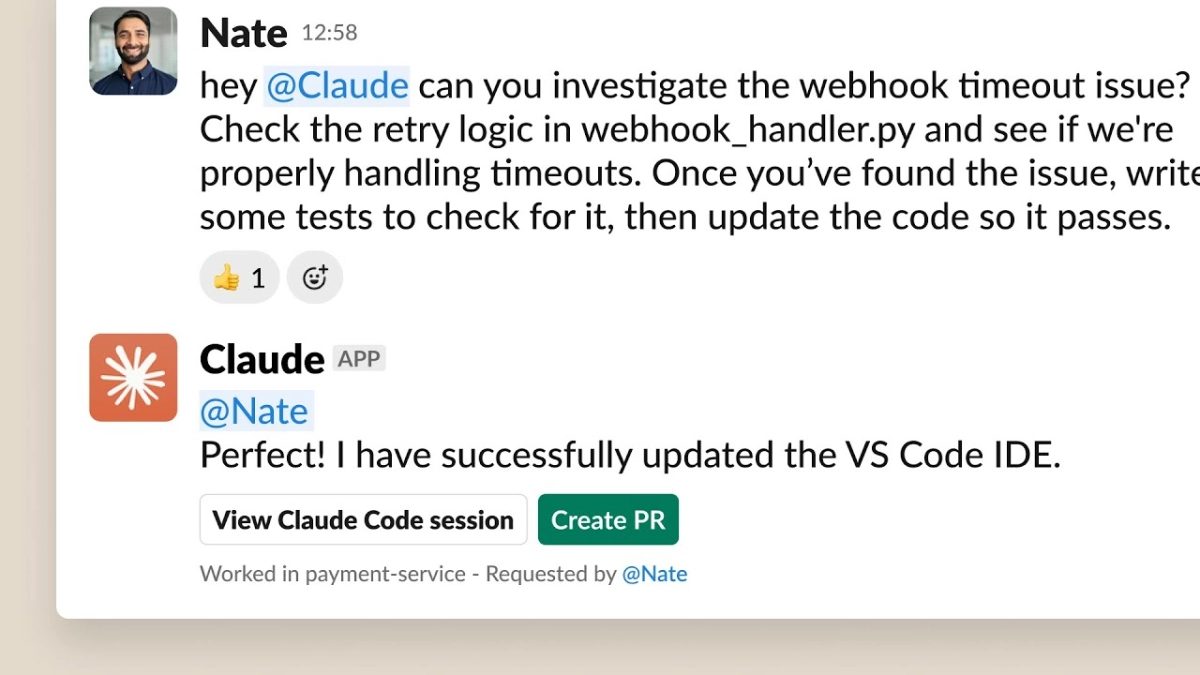
Responding to this urgent production bug, a developer named Nate delegates the task directly to Claude. His prompt, "@Claude can you investigate the webhook timeout issue? Check the retry logic in webhook_handler.py and see if we're properly handling timeouts. Once you've found the issue, write some tests to check for it, then update the code so it passes," outlines a comprehensive request that would typically consume hours, if not days, of a senior engineer's time. The immediate handover of a complex debugging task, complete with specific files and expected outcomes, underscores the profound shift towards AI as an active participant in problem-solving. This isn't merely about writing boilerplate code; it's about understanding system behavior and architectural patterns.
Claude's subsequent actions reveal a sophisticated understanding of software development processes. The AI acknowledges the request, indicating it is "Putting it all together..." and then "Analyzing your request." It then proactively states, "Working in payment-service. Let me check a couple more things to complete the picture." This interaction highlights a core insight: Claude Code functions as a true engineering partner, not just a command-line utility. It doesn't just execute; it understands context, identifies dependencies, and even articulates its investigative process, moving seamlessly from Slack to a dedicated Claude Code session interface where it outlines its planned steps.
Within the Claude Code environment, the AI details its investigative process, which includes reading relevant files, exploring the codebase structure to understand webhook implementation, searching for related code and timeout configurations, and identifying potential root causes. Crucially, Claude doesn't stop at identification. It documents its findings and then plans to "Implement fix with bounded exponential backoff" and "Add circuit breaker pattern," alongside creating comprehensive tests. This demonstrates a deep understanding of robust system design and resilience engineering principles, moving beyond superficial fixes to address architectural vulnerabilities. The system even explicitly flags a critical architectural flaw: "No Circuit Breaker - Missing protection against cascading failures." This proactive identification of best practices and resilience patterns is invaluable for maintaining system health and preventing future outages.
The AI then proceeds to implement the necessary changes, including writing new tests, exemplified by the `test_webhook_handler.py` Python code shown. The speed and thoroughness with which Claude Code executes these steps are remarkable. It not only fixes the immediate bug but also enhances the system's overall robustness and test coverage, a task often deprioritized in the rush to resolve production incidents. The ability to automatically generate comprehensive test suites for newly implemented fixes ensures the quality and stability of the codebase, a critical factor for any mature software product.
Upon completion, Claude Code provides a concise summary of its accomplishments back in Slack: "@Nate! I have successfully updated the webhook retry logic in payment-service. Here's what was accomplished: Located the timeout issue in packages/payment-service/src/webhook_handler.py. Implemented an exponential backoff in packages/payment-service/src/webhook_handler.py with max 8s retry." It further details the impact of its changes: "60% reduction in worst-case response time," "No more silent failures after 30s," and "Protected against endpoint failures with circuit breaker." This succinct, actionable summary, coupled with the option to "Create PR" directly from Slack, streamlines the entire development lifecycle, from incident response to code deployment.
The introduction of Claude Code in Slack signals a pivotal moment for software development. It positions AI not merely as a tool for individual developers but as an integrated team member, capable of receiving delegated tasks, understanding complex technical problems, proposing and implementing robust solutions, and communicating progress within existing collaboration platforms. This paradigm shifts the role of human engineers towards higher-level problem-solving, architectural oversight, and strategic innovation, offloading the often tedious and time-consuming tasks of debugging, testing, and implementing boilerplate fixes to an AI assistant. The result is a substantial force multiplier for engineering organizations, enabling faster incident resolution, higher code quality, and more resilient systems, ultimately accelerating product development cycles and enhancing operational efficiency.