

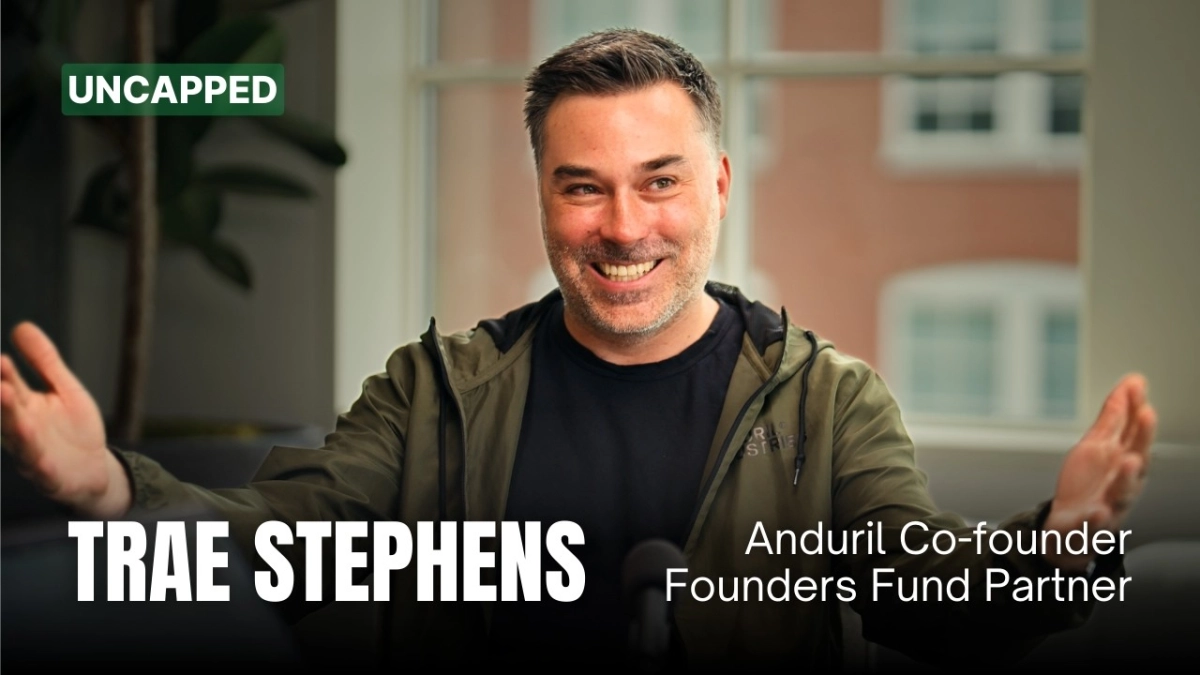
The advent of artificial intelligence has ushered in an era of unprecedented technological possibility, yet it also presents a profound challenge: distinguishing between genuine progress and mere distraction. As Trae Stephens, co-founder and Executive Chairman of Anduril and Partner at Founders Fund, articulated on the Uncapped podcast with Jack Altman, "The distorting characteristics of AI have less to do with the ability to do interesting hard things and it has much more to do with how easy it is to do uninteresting, unhard things." This insight, drawn from Stephens’ influential blog post on "Good Hard Quests," forms the bedrock of a compelling conversation that delves into the ethical, strategic, and operational complexities facing founders, investors, and policymakers in the AI age. Stephens, speaking with Altman, offered sharp analysis on hard tech, the future of warfare, AI morality, and Founders Fund’s distinct investing philosophy.
In the current AI landscape, Stephens observes a proliferation of "whiteboard founding," where entrepreneurs leverage large language model APIs to tackle highly specific, often superficial tasks. This rapid influx into easily accessible domains creates "a battle to the death in a really highly consensus category." Such ventures, while potentially lucrative for some, represent the antithesis of a "good quest." The true cost, Stephens argues, lies in the misallocation of talent. "If we take all of our level 100 players and we put them on AI slop companies, what does that mean for all of the things that aren't being done at the same time?" This "distracting distortion effect" diverts humanity’s most capable minds from foundational challenges like semiconductor fabrication, which could genuinely advance society.
The ethical dimensions of AI development are equally complex, often eliciting "visceral reactions" from the public. Stephens cites the example of AI companions designed to simulate deceased loved ones. While acknowledging the human desire for connection, "I lost my dad in 2013 to Alzheimer's and, you know, I would love to talk to my dad. That would be awesome", he raises a crucial question: "what happens to interpersonal relationships?" Drawing an analogy to online dating, he notes how algorithms, by optimizing for shallow metrics, have inadvertently contributed to a demographic of "incels," a "powder keg for implosions of societies." The proliferation of AI companions, he suggests, could further exacerbate this societal fragmentation by offering low-risk, agreeable interactions that supplant the complicated dynamics of real human relationships.
Stephens frames these ethical dilemmas within a 2x2 matrix: Feels Good/Is Good, Feels Bad/Is Bad, Feels Good/Is Bad, and Feels Bad/Is Good. Anduril, by its nature as a defense tech company, operates squarely in the "Feels Bad/Is Good" quadrant. These are tasks that are "really important for a functioning society," even if they evoke discomfort. He argues that policy plays a crucial role in navigating the "Feels Good/Is Bad" quadrant, citing gambling and pornography as examples where regulation is necessary to mitigate societal harm. The process, he explains, is iterative: technology develops, boundaries are inevitably crossed, and then, in a "well-functioning democracy," guardrails are built. Fortunately, in the realm of defense, where autonomous systems have existed for decades (like the C-RAM system for naval vessels), a bipartisan consensus on responsible AI development has long been in the making. Anduril actively engages with lawmakers, not defensively, but to help them understand and shape policy for these emerging technologies.
Anduril's own "good quest" centers on revolutionizing the defense industrial base through "hard tech" and manufacturing at scale. Stephens highlights the stark contrast between the traditional software startup mentality and the demands of producing physical goods. The challenge isn't just building a single, groundbreaking prototype, but scaling production to "tens of thousands of things." He illustrates this with the example of Tesla: "The skill set that was required to build the first Roadster... very different than, we're going to make a million cars." Similarly, the objective for defense is to produce a Patriot missile equivalent for "one-tenth the cost." Achieving this requires a deep understanding of manufacturing processes, supply chain verticalization, and meticulous design for manufacturing, capabilities often overlooked in the software-dominated venture capital world.