

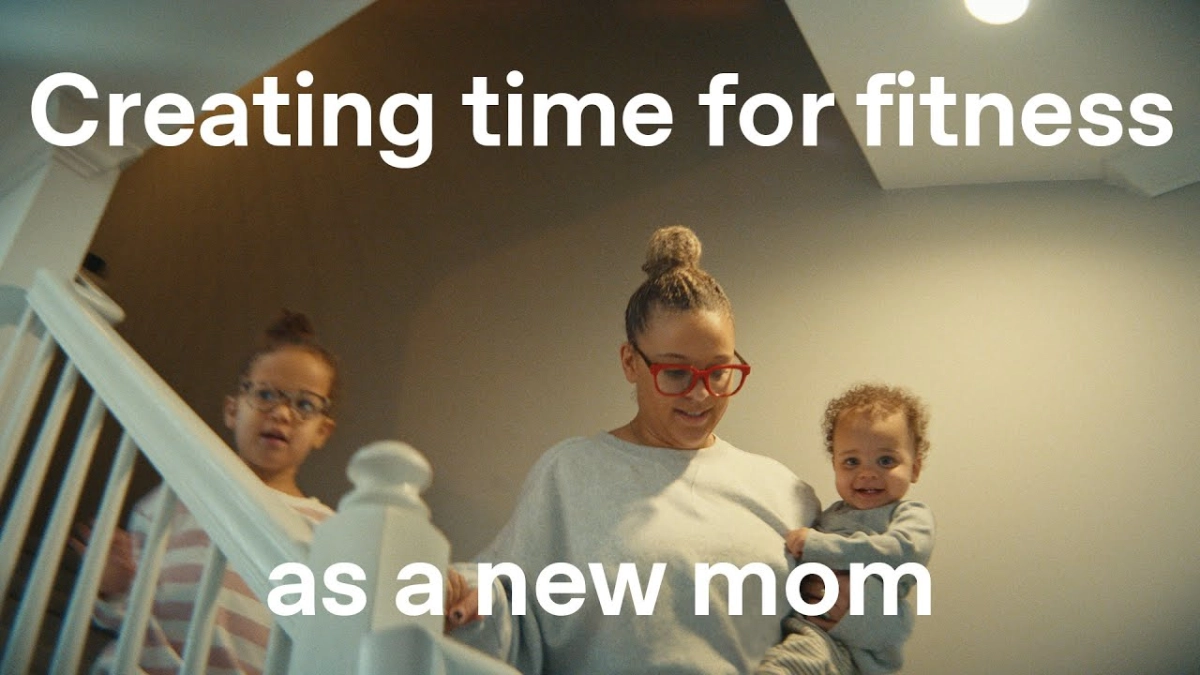
The most profound technological revolutions often manifest not in complex, proprietary enterprise architectures, but in the immediate, low-stakes friction points of daily life. For venture capitalists and founders observing the consumer application of large language models (LLMs), the case study of Lauren, a mother of two toddlers using ChatGPT to optimize her fitness regimen, provides a crucial signal: the next wave of AI value lies in hyper-personalized utility that adapts seamlessly to unpredictable human schedules. This is not about optimizing logistics for a Fortune 500 company; it is about reclaiming 20 minutes of self-care while pushing a double stroller.
This documented case study, released by OpenAI, positions the generative model as an essential tool for balancing the demands of parenthood. Lauren detailed her struggle to maintain a personal wellness routine amidst the chaos of managing young children, explaining that she was “trying to figure out the balance of mom life and taking care of myself.” The solution presented was not a dedicated, expensive fitness application, but a prompt-driven interaction with a generalized LLM, demonstrating AI’s capability to serve as an instant, infinitely flexible personal concierge for niche needs.
The true insight for the tech ecosystem is the demonstrated value of contextual awareness. Lauren’s query was highly constrained: “What can I do with 20 minutes and a stroller?” This is a constraint-based problem that traditional static workout apps or human trainers struggle to address efficiently. The LLM, however, instantly synthesizes exercise science with real-world limitations—time, equipment (a stroller), and location (a sidewalk)—to deliver an actionable routine. This capacity for instantaneous, constraint-aware solution generation marks a significant inflection point in consumer AI adoption. The model is effectively eliminating the mental overhead associated with planning, a pervasive, yet often unmonetized, form of daily cognitive load.
This application underscores a strategic vulnerability for specialized vertical software platforms, particularly those in the wellness and coaching sectors. When a foundational model like ChatGPT can generate nuanced, effective, and free workout plans tailored to specific, highly variable circumstances, the perceived value of subscription-based, curated content declines precipitously. This utility rapidly commodifies generalized expertise.
Lauren succinctly described the feeling of having an ever-present resource, noting, “I feel like it’s just having a little coach in my pocket.” This casual framing should be interpreted by founders as a profound shift in user expectation. The AI is no longer a tool requiring expertise; it is an invisible, intuitive partner that lowers the activation energy required to initiate complex tasks, whether that task is writing code or executing a set of lunges while pushing a stroller uphill.
The critical variable here is iteration speed. A human coach might take days to respond; a proprietary fitness app might offer a limited library of "mom workouts." The LLM delivers a new, unique, and executable plan in seconds. Furthermore, the capacity of the model to continuously generate novel approaches combats the inherent monotony that derails long-term fitness compliance. Lauren confirmed this generative advantage, observing that the model “always gives me new ideas and things that I never thought of before.”
This adaptability is the core product feature. The LLM thrives on the unpredictable rhythms of life, converting sudden downtime or unexpected environmental factors into opportunities for utility.
The strategic takeaway for those building or investing in AI infrastructure is the importance of high-frequency, low-stakes iteration. Every prompt Lauren submits regarding her workout, her timing, or her location serves as valuable feedback, refining the model’s understanding of real-world physical constraints and user intent. These small, daily interactions compound into massive datasets that improve contextual reasoning far more effectively than laboratory testing.
The widespread adoption of generative AI in mundane personal tasks, such as fitness planning for busy parents, validates the platform's reliability and its ability to handle sensitive, context-heavy requests. This builds the requisite user trust necessary before individuals migrate to using these tools for higher-stakes decisions, such as financial planning or medical triage. This trust is essential for scaling. The seamless integration of ChatGPT into the unpredictable, high-demand environment of early motherhood proves its robustness as a consumer utility.



