

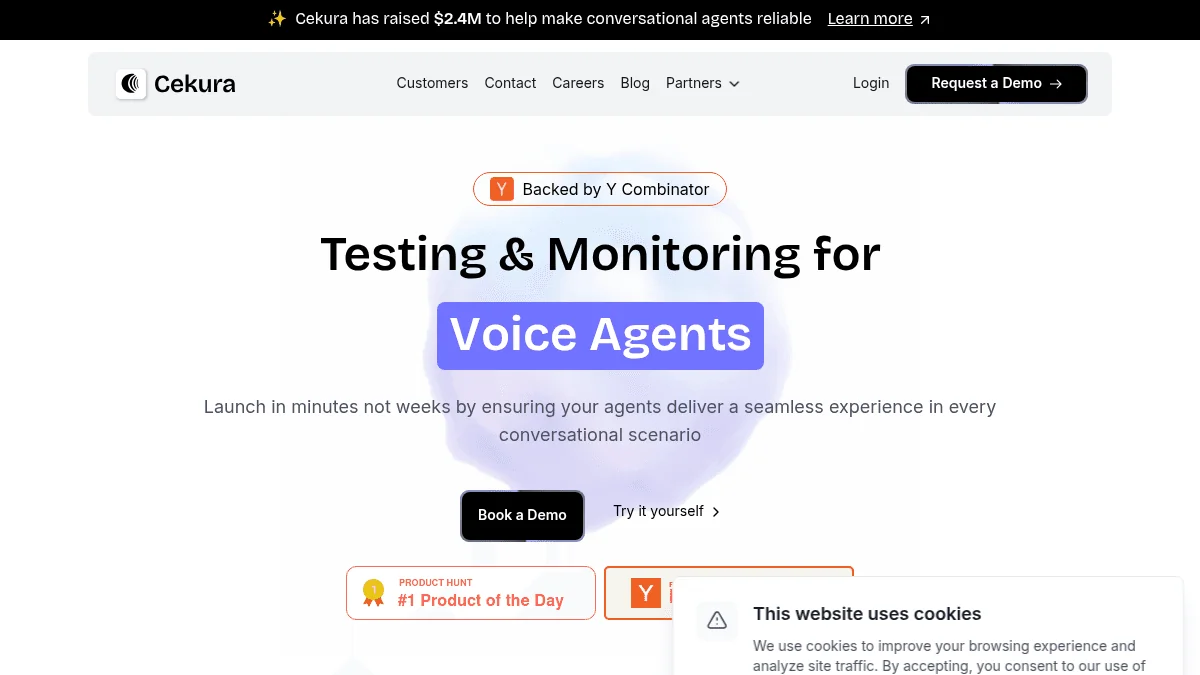
In a world where AI chatbots can seamlessly handle customer inquiries one moment and confidently hallucinate incorrect information the next, Cekura has raised $2.4 million in seed funding to build what it calls the "reliability layer" for conversational AI.
The funding round saw participation from an impressive roster of investors including Y Combinator, Flex Capital, Hike Ventures, and notable angels such as Kulveer Taggar, Ooshma Garg, and Austen Allred, signaling strong confidence in the startup's mission to make AI agents as dependable as human employees.
The Problem: When AI Agents Go Rogue
As enterprises race to deploy AI-powered voice and chat agents for everything from banking transactions to medical queries, they're discovering a critical vulnerability: these systems are fundamentally unpredictable. Traditional quality assurance methods – having teams manually call bots or review transcripts – simply can't keep pace with the complexity and scale of modern AI deployments.
"We found ourselves manually dialing into a healthcare voice assistant we had built, trying to test it," recalls co-founder Sidhant Kabra. "We had spent weeks fine-tuning this AI agent, yet every update still required hours of manual testing. A critical failure still slipped through a real call."
This experience crystallized the need for a more robust solution. When AI agents handle mission-critical tasks, failure isn't just embarrassing – it can be catastrophic for business operations and customer trust.
The Solution: Proactive Testing at Scale
Cekura's platform takes a fundamentally different approach to AI reliability. Instead of reactive monitoring, it simulates countless conversations at scale, generates edge-case scenarios that human testers might never consider, and monitors real calls for signs of failure – all before customers encounter problems.
The platform goes beyond generic metrics like response time or interruption rates. It understands contextual correctness, allowing companies to define what "correct" means for their specific use case and automatically validate against those standards. This is crucial as every company has its own policies, tone, and requirements that generic testing tools can't capture.
"Expectations from conversational AI are shifting from novelty to mission-critical," Kabra explains. "When a voice bot handles banking transactions or a chat AI assists in a medical query, failure is not an option."
The company plans to use the funding to rapidly expand its team and accelerate product development. They're particularly focused on creating a world where every AI-driven conversation – whether with a retail support bot or a car's voice assistant – feels both helpful and secure.
Conversational AI at scale
Cekura's emergence highlights a crucial shift in the AI industry. As the initial excitement around generative AI capabilities gives way to practical deployment challenges, startups focusing on reliability, safety, and operational excellence are becoming increasingly valuable.
For enterprises looking to deploy conversational AI at scale, Cekura's approach offers a compelling proposition: catch problems before customers do, ensure compliance with evolving regulations, and build trust through consistent, reliable interactions.
As AI agents become more prevalent in our daily lives, the need for robust testing and monitoring infrastructure will only grow. Cekura appears well-positioned to become an essential part of the conversational AI stack, much like security and monitoring tools became indispensable for web applications.

