

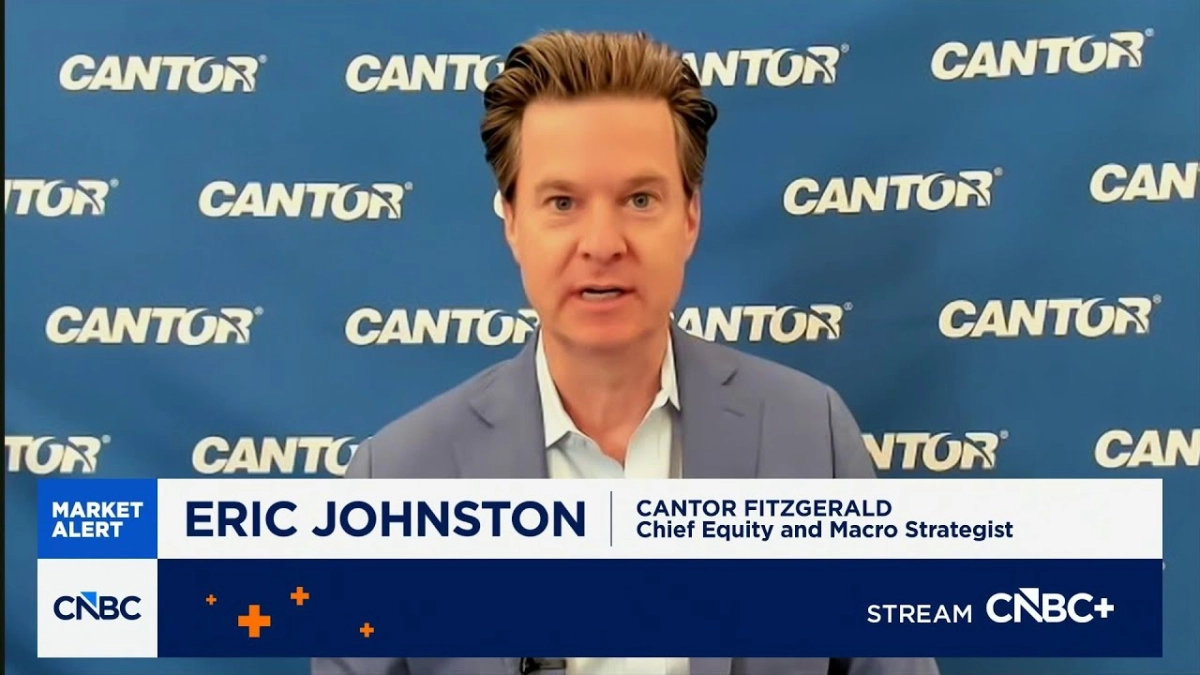
Eric Johnston, Chief Equity and Macro Strategist at Cantor Fitzgerald, articulated a clear, yet nuanced, perspective on the market outlook, specifically emphasizing unwavering confidence in the Artificial Intelligence capital expenditure cycle despite potential short-term volatility. Johnston spoke with the hosts of CNBC’s ‘Squawk on the Street’ about near-term market risks, longer-term expectations for 2026, and the sustained investment thesis underpinning the AI buildout. This stance directly counters some prevailing market anxieties, positioning Cantor Fitzgerald on a distinct trajectory.
The core of Johnston’s near-term caution stems from historical patterns and current investor positioning, suggesting a correction might be overdue. He noted that when we’ve seen price performance like the recent run, "we’ve historically our backtest shows you’ve historically seen a drawdown in January or the first quarter." Furthermore, he identified specific catalysts that could trigger this pullback, including a potential Supreme Court tariff ruling, the announcement of a new Federal Reserve Chair, and the arrival of more accurate economic data. These factors combine to create an environment ripe for a temporary retreat.
Johnston also highlighted structural vulnerabilities that amplify near-term risk, particularly concerning the infrastructure powering the AI boom. He pointed to the possibility of a "data center scare," specifically citing concerns about buildout costs or issues with power grid capacity, which could spook markets. Compounding this is the current state of investor balance sheets: "Institutional cash levels are at historic lows and individual investors have historically high leverage." Such elevated leverage and low liquidity create fragility, meaning even minor shocks could cascade into steeper declines.
Despite these headwinds, Johnston remains resolutely bullish on the long-term trajectory of AI investment, which he sees as a powerful, structural tailwind for the coming years. He stated, "we are bullish on the AI capex outlook for the year." This confidence is rooted in the sheer scale of investment currently underway, noting that companies are "pumping $40 billion into the market" for this infrastructure buildout. This massive, sustained deployment suggests that the AI story is not a fleeting trend but a foundational shift in corporate spending.
The analyst also provided context on the current monetary environment, observing that while the market is pricing in rate cuts—he anticipates "three cuts" for the year, potentially even "be three"—the underlying economic strength, supported by fiscal stimulus, remains robust. He sees the combination of fiscal support and expected monetary easing as a "very powerful combination." This dual support structure underpins the belief that any Q1 drawdown will be temporary, setting the stage for better performance later in the year.
Johnston’s analysis of treasury yields further supports his long-term optimism. He pointed out that the free cash flow yield continues to fall, reaching "about three and a half percent," which is a multi-decade low. This low yield environment, coupled with the compelling valuation perspective for growth stocks, makes equities more attractive relative to fixed income. This dynamic suggests that even if yields edge higher, the relative attractiveness of equity assets, particularly those tied to secular growth themes like AI, remains high.
The market's current momentum, with major averages extending gains, shows underlying investor appetite. However, Johnston warns against complacency, suggesting that the market’s current trajectory may not be a "straight line." He implies that the market is pricing in a smooth continuation of growth, but external factors and investor leverage present risks that could easily "initiate a drawdown."
Ultimately, Johnston’s thesis balances short-term prudence with long-term conviction. The near-term risks are acknowledged, driven by technical positioning and specific regulatory/infrastructure concerns. Yet, the undeniable, multi-year investment cycle in AI infrastructure provides a compelling floor and significant upside potential beyond any immediate market turbulence.



