

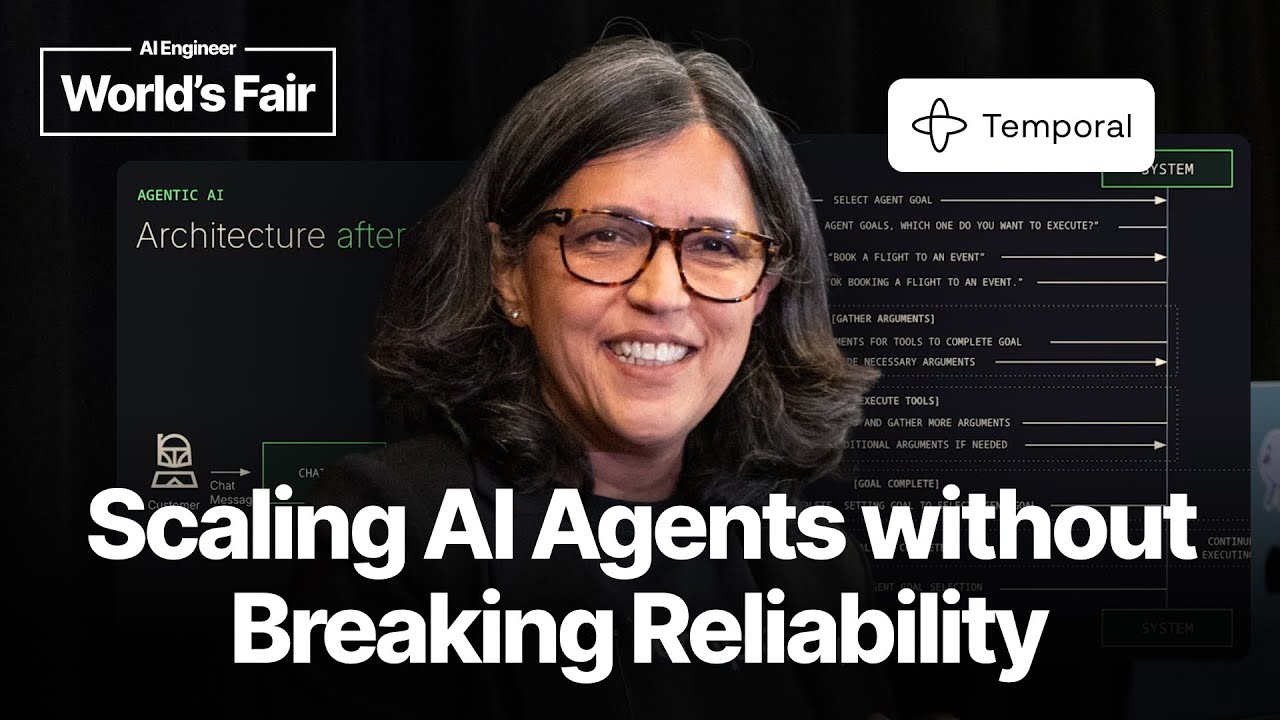
The ambition of agentic AI, where autonomous software agents interact and cooperate to achieve complex goals, faces a fundamental hurdle: reliability. As Preeti Somal, Senior Vice President of Engineering at Temporal, articulated at the AI Engineer World's Fair in San Francisco, moving AI agents from prototype to production demands a shift from simple software calls to sophisticated distributed systems. Her presentation underscored the critical need for robust orchestration, effective failure handling, and resilient infrastructure to make these intelligent systems trustworthy and scalable.
Agentic AI systems are inherently complex. They involve orchestrating interactions across myriad distributed data stores and tools, managing multi-level processes, and maintaining state over potentially long periods. Beyond this operational complexity, the probabilistic nature of Large Language Models (LLMs) introduces an inherent unreliability. As Somal noted, developers frequently encounter scenarios where an LLM call doesn't succeed 100% of the time. This necessitates mechanisms for "self-healing" and retries until valid data is returned, along with managing rate limiting from LLMs. Without robust solutions for these challenges, deploying AI agents into real-world, mission-critical applications becomes a significant undertaking, fraught with debugging and testing difficulties due to limited visibility across disparate services.
Temporal addresses these challenges by providing a reliable, scalable AI orchestrator. The platform allows developers to define their business logic as durable workflows using familiar programming languages like Python, Go, and Java. This approach abstracts away the intricate "plumbing code" associated with distributed systems, including state management, retries, and error handling. Somal highlighted that Temporal "ensures every process executes reliably, & provides guardrails for LLMs," making failures irrelevant to the core business logic. This durable execution capability ensures that even if individual components fail, the overall workflow persists and recovers, maintaining data integrity.
The impact of this approach is profound for founders, VCs, and AI professionals. Temporal’s battle-tested product, already powering critical applications at companies like Netflix and DoorDash for over a decade, brings proven reliability to the nascent field of agentic AI. One customer, Gorgias, which uses AI agents to help over 15,000 e-commerce brands, affirmed, "To be clear, without a framework like Temporal, this wouldn't be possible." This underscores the platform's ability to accelerate development, allowing teams to achieve production readiness in weeks rather than months.
By outsourcing the complexities of reliability and scalability to Temporal, developers can focus entirely on the unique business logic of their AI agents. This translates directly into faster feature delivery, the ability to handle a greater number of customers, and minimized production issues. Ultimately, this leads to happier customers who trust their agentic applications to be consistently reliable and correct. Temporal's approach represents a fundamental shift, empowering engineers to build the next generation of intelligent systems with confidence, moving beyond experimental prototypes to dependable, production-grade AI.