

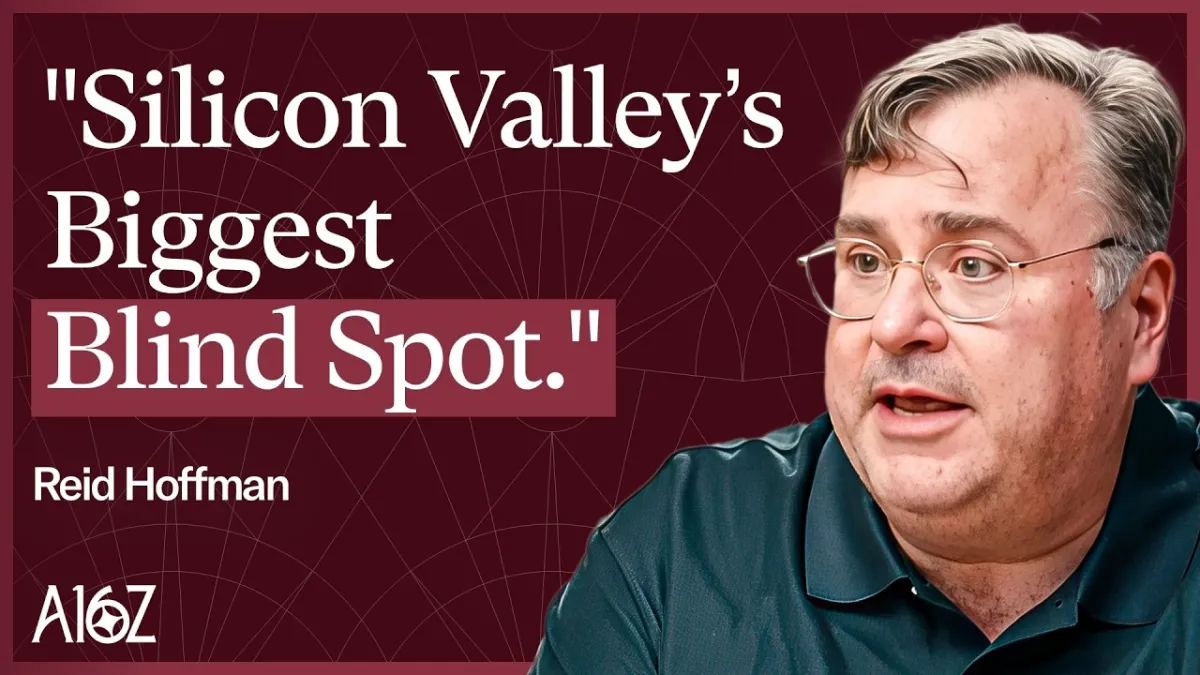
"What's the amazing thing that you can suddenly create? Lots of these companies, you go, what's your business model? 'I don't know. We're going to try to work it out, but I can create something amazing here.'" This sentiment, articulated by Reid Hoffman in a recent a16z podcast with Erik Torenberg and Alex Rampell, captures the core ethos driving the current artificial intelligence boom. Hoffman, a seasoned tech veteran who has been at the forefront of several major technological shifts, offered a nuanced perspective on AI's transformative power, urging a look beyond immediate applications to truly grasp its long-term impact on work, science, and humanity.
The conversation, held at a pivotal moment in AI development, delved into Silicon Valley's investment strategies, the limitations of current large language models (LLMs), and the evolving role of human expertise in an AI-augmented world. Hoffman challenged the prevailing "line of sight" approach to AI investment, advocating instead for a focus on areas where the technology's impact might be less immediately apparent but ultimately more profound.
One of Hoffman’s core insights centered on the inherent "blind spots" within Silicon Valley's investment landscape. While many are chasing the obvious gains in productivity tools, chatbots, and coding assistants—areas he acknowledges are still worthwhile—the real, transformative opportunities lie elsewhere. "What are the areas where the AI revolution will be magical but won't be within the Silicon Valley blind spots?" he posited, suggesting that the most groundbreaking innovations will emerge from sectors less traditionally associated with software, particularly those that bridge the digital world of "bits" with the physical world of "atoms." Drug discovery, for instance, represents a prime example of such a convergence, where AI can accelerate processes at the "speed of software" despite the complexities of biological and regulatory hurdles.
The discussion also illuminated the critical distinction between AI augmenting human capabilities and outright replacing them. Hoffman used the example of doctors, stating, "If you're not using ChatGPT or equivalent as a second opinion, you're out of your mind, you're ignorant." He highlighted that AI's diagnostic capabilities are rapidly becoming superior "knowledge stores" compared to any human. However, this does not spell the end for medical professionals. Instead, it shifts their role from mere knowledge repositories to expert users and critical thinkers, capable of interpreting AI-generated insights, applying lateral thinking, and challenging consensus where necessary.
Related Reading
- The Contrarian Compass: Navigating AI's Crowded Future
- AI's Economic Ripple: Beyond Tech to Main Street and Labor Markets
Current LLMs, despite their impressive linguistic prowess, often fall short in generating truly novel or contrarian insights. Hoffman recounted an exercise where he used various advanced LLMs to prepare arguments for a debate, noting, "The answers were B-minus or B despite absolute top prompting." This illustrates that while LLMs excel at synthesizing existing information and producing coherent, consensus-driven responses, they struggle with the kind of "sideways thinking" that drives genuine innovation and challenges established paradigms. This limitation underscores the enduring value of human creativity, intuition, and the ability to question the obvious.
The implication for founders and investors is clear: seek out opportunities that leverage AI not just for efficiency, but for fundamental breakthroughs in complex, often overlooked domains. These are the areas where the "bits-to-atoms" challenge is greatest, requiring patience, interdisciplinary collaboration, and a willingness to invest beyond the immediate horizon. For professionals, the message is to embrace AI as an indispensable tool, but to cultivate the uniquely human skills of critical thinking, creativity, and ethical judgment, which remain beyond the current scope of even the most advanced AI systems.



